Introduction
Ireland is the European trip most Pakistani travellers misunderstand. It is in the European Union, it uses the euro, and it shares an open border with the United Kingdom, so it is easy to assume that a Schengen visa or a UK visa will get you in. Neither will. Ireland is not in the Schengen Area, it runs its own visa system, and Pakistani passport holders need a separate Irish Short Stay 'C' visa before they travel.
There is a second misunderstanding, and it matters more. The Irish Immigration Service says, in general, to expect a decision about eight weeks after your documents arrive. That is the figure most guides repeat. But the Dublin Visa Office publishes its real queue every Tuesday, and on 17 November 2026 it was deciding tourism and family visit applications it had received on 7 October 2025. That is a wait of about thirteen months, not eight weeks. If you are planning a trip to Ireland from Pakistan, that queue is the single most important fact in this guide, and everything else in it is built around it.
This guide explains the visa you need, the fee, the documents, the exact application steps from Pakistan, and how the Dublin queue works, using only the official Irish Immigration Service pages, the official fee schedule, the official visa decisions table, and the Embassy of Ireland in Pakistan. Every fact was checked on 17 November 2026.
Ireland visit visa at a glance
| Item | Detail |
|---|---|
| Visa you need | Short Stay 'C' visit visa (tourist, or visit family/friend) |
| Maximum stay | Up to 90 days |
| Visa fee | EUR 60 single entry; EUR 100 multiple entry; EUR 25 transit |
| Fee refund | No, the fee is not refunded if you are refused or withdraw |
| Where to apply | Online in AVATS, then lodge documents at a VFS Global centre in Pakistan |
| When to apply | As early as you can; the official advice is three months before travel, but the Dublin queue is far longer (see below) |
| Decision time | The general guidance says about eight weeks; the Dublin queue for visit visas was about thirteen months on 17 November 2026 |
| Work allowed | No, paid or unpaid work of any kind is not allowed |
| Entry guarantee | No, a visa lets you travel to Ireland; the immigration officer at the border decides whether you enter |
| Appeal if refused | No, there is no appeal for short stay visa refusals; you must apply again |
Do Pakistanis need a visa for Ireland?
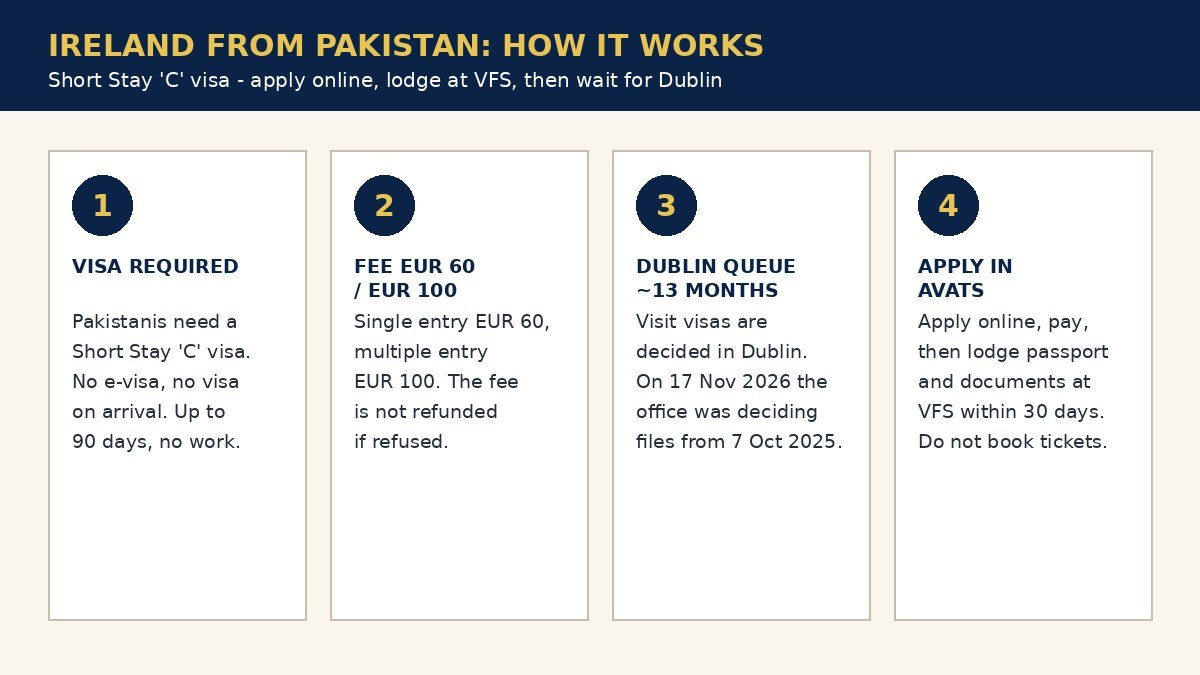
Yes. Pakistan is on Ireland's list of visa-required nationalities, and a Pakistani passport holder needs a Short Stay 'C' visa for any visit of up to 90 days, whether for tourism, visiting family or friends, or a short course. There is no visa on arrival and no e-visa for Ireland. Every traveller needs their own visa, including children. Ireland does not issue family visas, so a family of four makes four separate applications.
Three common confusions are worth clearing up at the start, because each one has caught travellers out.
First, Ireland is not in the Schengen Area. A Schengen visa does not allow you to enter Ireland, and an Irish visa does not allow you to enter the Schengen Area. If your trip covers both Ireland and, say, France or Germany, you need two separate visas. Our Schengen visa guide explains the Schengen side of that planning.
Second, a UK visa does not cover Ireland for Pakistanis. Ireland runs a Short Stay Visa Waiver Programme that lets nationals of certain countries visit Ireland on a UK short-stay visa, but Pakistan is not on that list. The eligible Asian countries are India, Indonesia, Kazakhstan, China, the Philippines, Thailand, Uzbekistan and Vietnam. The separate British-Irish Visa Scheme, under which one visa covers both countries, applies only to Chinese and Indian passport holders. If you hold a UK visit visa, you still need an Irish visa. Our UK visit visa guide covers the UK application itself.
Third, an Irish visa does not cover Northern Ireland or the rest of the United Kingdom. The waiver programme is not reciprocal: to enter the UK, including Northern Ireland, you need a valid UK visa. This matters if your plans include Belfast or the Giant's Causeway, which are in Northern Ireland, not the Republic of Ireland.
The Dublin queue: the wait nobody quotes
This is the part of the process that most guides get wrong, so it deserves its own section.
The Irish Immigration Service's tourist visa page says applicants can generally expect a decision within approximately eight weeks of the visa office receiving their documents. That is a general statement, and it does not describe the current queue for visit visas decided in Dublin.
The Dublin Visa Office publishes a table of the applications it is currently deciding, updated every Tuesday on the Visa Decisions page of irishimmigration.ie. On 17 November 2026, the table said the office was deciding tourism and family/friend visit applications it had received in Dublin on 7 October 2025. Appeals in the same category had reached 17 September 2025. In plain terms, a visit visa application that reached Dublin in October 2025 was only being decided in November 2026, about thirteen months later. The same page warns that decision dates may not move every week because of the number of applications on hand.
For comparison, on the same day the Dublin office was deciding business visa applications received on 27 August 2026, employment applications from 17 September 2026, and study applications from 22 June 2026. Visit visas are the slowest queue by a wide margin.
What does this mean for you? Three things.
First, do not plan a trip around a fixed date and do not buy tickets before you have a decision. The official guidance says exactly that: wait for approval before you buy any travel tickets.
Second, apply as early as you possibly can. The official pages recommend preparing your application three months before you travel. With the queue as it stands, three months is not enough for a visit visa, so treat the queue date, not the three-month advice, as your planning guide. Check the Visa Decisions page yourself before you apply, on a Tuesday, and read the date beside "Tourism or visit a family/friend". That date is the honest answer to "how long will it take".
Third, understand that the clock starts when your file reaches the visa office in Dublin, not when you lodge it at a VFS centre in Pakistan. The Immigration Service says your application can arrive in Dublin days or sometimes weeks after you send it. Your VFS receipt date is not your queue date.
This guide will not pretend the wait is eight weeks. It is not, for visit visas, and planning on eight weeks is how trips get ruined.
Which visa: tourist or family/friend
Both kinds of visit use the same Short Stay 'C' visa and the same 90-day maximum. The difference is the reason you select in the online system and the supporting documents that go with it.
Choose the tourist route if you are travelling for sightseeing, a holiday, or a short course, and you are arranging your own accommodation. Choose the visit family/friend route if you are staying with family or friends who live in Ireland, or visiting them as the main purpose of the trip.
In the AVATS online system, a family/friend visit is entered as visa type "Short Stay (C)", reason for travel "Visit Family/Friend", and journey type "Single" or "Multiple". Multiple-entry visas are approved only in limited circumstances, so most first-time applicants should apply for a single entry and not assume a multiple-entry visa will be granted.
The visa does not allow any work, paid or unpaid, and it does not allow you to use publicly funded services such as a public hospital. If you want to stay longer than 90 days, work, or study on a long course, you need a different visa category entirely, and this guide does not cover those.
Fees and costs
The visa fee is set by the Irish Immigration Service and is the same wherever you apply.
| Fee | Amount |
|---|---|
| Single entry, Short Stay 'C' visa | EUR 60 |
| Multiple entry, Short Stay 'C' visa | EUR 100 |
| Transit visa | EUR 25 |
The fee is an administration fee. It is not refunded if your application is refused or if you withdraw it, so only apply when your file is complete and honest. Pakistan is not on Ireland's list of fee-exempt nationalities, so the fee applies to Pakistani applicants. The only exemptions that commonly matter are for spouses and children under 18 of Irish citizens, for qualifying family members of EU citizens, and for diplomatic passport holders travelling officially.
On top of the visa fee, the VFS Global centre where you lodge your documents charges its own service fee, payable in Pakistani rupees at the centre. The amount is shown on the VFS Global Ireland-Pakistan page when you book, and it can change, so confirm it at booking time rather than relying on a figure quoted in a guide. There is no official rupee figure for the euro visa fee either: the fee is charged in euro and the rupee amount depends on the exchange rate on the day you pay. Budget also for travel insurance, certified translations, and travel to your nearest VFS centre.
Documents you need
Ireland asks for original documents, not photocopies, except where it specifically says otherwise. Do not send documents on a USB stick, memory card, CD, or through a file-sharing service. Hard copies only.
The table below is the document list from the official tourist and family/friend visa pages. Gather everything before you start the online application, because the file must reach the visa office within 30 days of creating it.
| Document | What to provide |
|---|---|
| Passport | Current passport, valid for at least six months after the date you plan to leave Ireland; include copies of previous passports if you have them |
| Passport photographs | Recent passport photographs as specified on the visa pages |
| Signed application summary | Print, sign and date the summary form AVATS creates for you |
| Proof of fee payment | Evidence that you paid the EUR 60 or EUR 100 fee |
| Application letter | A signed letter stating your purpose, dates, accommodation, how the trip is funded, and your commitment to obey the visa conditions and leave before it expires |
| Invitation letter | For a family/friend visit, an invitation letter from your host in Ireland |
| Accommodation plan | Hotel booking confirmation showing the duration of your stay (tourist route), or your host's address (family/friend route) |
| Holiday plan | A realistic itinerary for the trip |
| Medical or travel insurance | Cover for the full visit |
| Finance plan | Six months of bank statements, plus evidence of income and employment (see below) |
| Ties to home | Evidence of your obligations to return home: employment, business, family, property or study |
| Past visa refusals | Full details of every past visa refusal, for any country |
| Translations and attestations | Certified English or Irish translations of any document in another language; civil documents from outside the EU/EEA or Switzerland must be attested by Pakistan's Ministry of Foreign Affairs |
A few of these deserve emphasis, because they are where applications most often fail.
Your passport must be valid for at least six months after the date you plan to leave Ireland. If it is not, renew it before you apply.
Your bank statements must cover the six months before your travel, be originals or copies stamped by your bank, show your name and current address, and show a positive balance. Any large deposit or withdrawal must be explained. A sudden large deposit with no explanation is one of the most common reasons visit visas are refused, and it is specifically what the visa officer looks for. If someone else is paying for your trip, include their bank statements and payslips as well as your own, plus a letter explaining your relationship and exactly which costs they will cover.
There is no fixed minimum bank balance for an Irish visit visa. The official guidance is explicit: there is no set amount that guarantees approval or refusal, and the visa officer decides whether you have enough based on your individual circumstances. Do not trust any guide that quotes a fixed euro-per-day figure as an official rule. Show enough to cover your flights, accommodation, food, transport and activities for the whole trip, and make sure the money has been in the account for a while.
Your application letter is your chance to explain the trip in your own words: why you are going, where you will stay, who is paying, what you will do, and why you will return to Pakistan. Keep it factual and consistent with your documents. Any contradiction between your letter and your bank statements or bookings will be noticed.
You must declare every past visa refusal, for Ireland or any other country. The official pages are blunt: Ireland will refuse your application if you do not include information about past visa refusals. A refusal in the past does not automatically mean a refusal now, but hiding one almost certainly does.
Any document that is not in English or Irish needs a full certified translation, and you must send both the original and the translation. Birth, marriage, death and divorce certificates issued in Pakistan must be attested as genuine by Pakistan's Ministry of Foreign Affairs before they can be accepted.
How to apply from Pakistan: step by step
Step 1: Check that you need a visa and choose your route
Confirm that you need a Short Stay 'C' visa (you do, as a Pakistani passport holder), decide whether your trip is tourism or a family/friend visit, and read the current Dublin queue date on the Visa Decisions page. Do not set a travel date until you understand the wait.
Step 2: Create your application in AVATS
AVATS is Ireland's online visa application system, at visas.inis.gov.ie. Answer every question fully and honestly. Select "Short Stay (C)" as the visa type, then "Visit Tourist" or "Visit Family/Friend" as the reason, and "Single" or "Multiple" as the journey type. The system creates a summary form with a Visa Application Transaction Number. Keep that number safe: you need it to check your application and to contact the visa office.
Step 3: Pay the visa fee
Pay the EUR 60 or EUR 100 fee as directed by AVATS. Payment methods and currencies can differ by office, and the summary form tells you how to pay. Keep the proof of payment: it is one of the required documents.
Step 4: Print, sign and date the summary form
Print the summary application form, sign it and date it. The form also tells you where to send your documents. For applicants in Pakistan, this is normally one of the VFS Global Ireland centres in Islamabad, Lahore, Karachi or Mirpur. Always follow what your own summary form says, because it reflects the current arrangement for your application.
Step 5: Book your VFS appointment and prepare your file
Book an appointment at your chosen VFS Global centre and assemble the full document file from the checklist above. Put each person's documents in a separate envelope, write the applicant's name and Visa Application Transaction Number on each envelope, and place them in a larger envelope if you are applying as a group. Originals only, as explained above.
Step 6: Lodge your documents within 30 days
Submit your passport and supporting documents at the VFS centre within 30 days of creating the AVATS application. Ireland will not process your application until it has received everything. In some cases you may also need to give biometric information; your application office will confirm whether this applies to you and how to do it.
Step 7: Wait, and check the Tuesday list
Your file travels to the Dublin Visa Office for a decision. You will not usually receive progress updates. Decisions are published on the Visa Decisions page every Tuesday, listed by application number, and you can search for your own number there. Do not email or call the visa office for a status update inside the published processing time: the published list is the update. If your application is approved, an Irish visa is placed in a blank page of your passport and your passport and original documents are returned to you. If it is refused, you will receive a letter of refusal explaining why.
Where to apply in Pakistan
Applications are lodged at VFS Global centres in Pakistan, in Islamabad, Lahore, Karachi and Mirpur. VFS Global handles intake only: it takes your documents and biometrics and forwards the file. It does not decide anything.
The Embassy of Ireland in Pakistan is in Islamabad, at Level 06, West Wing, Serena Business Complex, Khayaban-e-Suhrwardy Road, G-5/1. The ambassador is Mary O'Neill. You do not apply at the embassy counter; your AVATS summary form directs you to the right lodgement point. If you are an Irish citizen in Pakistan and face an emergency, the embassy's emergency contact is a WhatsApp or SMS message to +92 302 8563388.
At the border and during your stay
A visa is permission to travel to Ireland, not a guarantee of entry. When you arrive, an immigration officer can refuse you entry even if you hold a visa. Bring your passport, your visa, and copies of the documents from your application, and be ready to show why you are visiting. If the officer is satisfied, they will place a landing stamp in your passport showing the reason for your visit and how long you may stay, up to a maximum of 90 days. You must leave before that permission expires. Ireland does not stamp passports on exit, and staying beyond your permission is against the law.
You cannot extend a visit visa for extra tourism. Extensions are granted only in rare and exceptional circumstances where something unforeseen changes after you arrive. Plan your trip inside the 90 days.
If your visa is refused
There is no appeal mechanism for short stay visa refusals. If you are refused and still want to travel to Ireland, you must make a new visa application, pay the fee again, and address the reasons set out in your refusal letter. This is why the first application matters so much: a refusal costs the fee, costs the months in the queue, and stays on your record for every future application.
The refusal letter will state the reasons. The patterns behind most visit visa refusals are consistent with the official guidance: documents missing or of poor quality, finances that do not cover the trip, no clear evidence of ties to Pakistan, inconsistencies between the application and the supporting documents, an undisclosed past refusal, or false or misleading information. False information is the most serious of these: it can lead to a refusal with no appeal and a block from Irish visas for five years.
If you are refused, read the letter carefully, fix the specific problem it names, gather stronger evidence, and only then apply again. Applying again immediately with the same file will produce the same result.
Common mistakes to avoid
Do not buy flight tickets or pay for non-refundable accommodation before you have a decision. The official guidance says to wait, and with a queue measured in months, a booked ticket is a wasted ticket.
Do not apply three months before travel and expect to travel on time. That advice predates the current queue. Read the Dublin queue date first and plan around it.
Do not assume a UK or Schengen visa covers Ireland. It does not, for Pakistanis. Apply for the Irish visa separately.
Do not submit photocopies where originals are required, and do not send documents on a USB stick or a file-sharing link. They cannot be processed.
Do not hide a past refusal. Declare it, explain what changed since, and let the officer judge the application on its merits.
Do not put a large sum into your bank account just before applying and hope it goes unnoticed. It will be noticed, and without a clear explanation it will damage your application.
Do not use an agent who promises a guaranteed visa, a faster queue, or a special route. There is no priority service for visit visas from Pakistan, no agent can move your file up the Dublin queue, and anyone who says otherwise is selling you something that does not exist.
Visiting Ireland: a short guide to the trip itself
Ireland is a small country, and a well-planned week covers a lot of it. Dublin is the usual starting point: Trinity College and the Book of Kells, Temple Bar, St Patrick's Cathedral, and the National Museum. The Cliffs of Moher in County Clare are the country's most famous sight, rising 214 metres above the Atlantic and running for about eight kilometres along the coast. The Ring of Kerry, Galway city, the Burren, and the Wicklow Mountains are the other classic stops.
Ireland uses the euro, English is spoken everywhere, and cars drive on the left, as in Pakistan. There are no direct flights from Pakistan to Ireland: most itineraries connect through Dubai, Doha, Abu Dhabi, Istanbul or London, and the journey usually takes a full day. Summer is the most popular season, which also means higher prices and busier sights, while spring and autumn are quieter and cheaper. Book accommodation with free cancellation where possible, and keep every booking in the file you submit with your visa application, since the visa officer will want to see where you plan to stay.
More TourPointGo guides for your next trip: USA visit visa, Canada visitor visa, Australia visit visa, Turkey visit visa, UAE visit visa, Saudi visit visa, Egypt visit visa and Morocco visit visa.
Frequently asked questions
Do Pakistanis need a visa to visit Ireland?
Yes. Pakistan is a visa-required nationality for Ireland. You need a Short Stay 'C' visa before you travel. There is no visa on arrival and no e-visa.
How much is the Ireland visit visa fee from Pakistan?
EUR 60 for a single-entry Short Stay 'C' visa and EUR 100 for a multiple-entry visa. The fee is non-refundable. A VFS Global service fee is charged separately in rupees at the centre where you lodge your documents.
How long does an Ireland visit visa take from Pakistan?
The general guidance says about eight weeks after the visa office receives your documents. The reality for visit visas decided in Dublin is much longer: on 17 November 2026, the Dublin Visa Office was deciding tourism and family/friend applications it had received on 7 October 2025, a wait of about thirteen months. Check the Visa Decisions page on irishimmigration.ie for the current date before you plan.
Can I visit Ireland on a UK visa?
No, not as a Pakistani passport holder. The Short Stay Visa Waiver Programme does not include Pakistan, and the British-Irish Visa Scheme covers only Chinese and Indian nationals. You need a separate Irish visa.
Can I visit Ireland on a Schengen visa?
No. Ireland is not in the Schengen Area. A Schengen visa does not allow entry to Ireland, and an Irish visa does not allow entry to Schengen countries.
Where do I submit my Ireland visa application in Pakistan?
Apply online through AVATS, then lodge your passport and documents at a VFS Global Ireland centre in Islamabad, Lahore, Karachi or Mirpur, as directed by your AVATS summary form. You must lodge them within 30 days of creating the online application.
How much money do I need to show for an Ireland visit visa?
There is no official fixed amount. You must show six months of bank statements and enough money to cover the whole trip, and the visa officer decides whether it is enough based on your circumstances. Explain any large deposits. A sudden unexplained deposit shortly before applying will hurt your application.
Can I work in Ireland on a visit visa?
No. The Short Stay 'C' visa does not allow any work, paid or unpaid, and does not allow you to use publicly funded services such as a public hospital.
What happens if my Ireland visa is refused?
You will receive a letter explaining why. There is no appeal for short stay visa refusals. You must make a new application, pay the fee again, and address the reasons in the refusal letter.
Can I appeal a refused Ireland visit visa?
No. The Irish Immigration Service states there is no appeal mechanism for short stay visa refusals of this nature. A new application is the only route.
Does an Irish visa let me visit Northern Ireland?
No. Northern Ireland is part of the United Kingdom. You need a valid UK visa to enter it, and an Irish visa does not cover it.
How can I check my Ireland visa decision?
Decisions from the Dublin Visa Office are published every Tuesday on the Visa Decisions page at irishimmigration.ie, listed by application number. Search for your Visa Application Transaction Number there.
Conclusion
An Ireland visit visa from Pakistan is straightforward in its rules and difficult in its waiting time. The visa itself is a Short Stay 'C' visa, the fee is EUR 60 for a single entry, the application runs through AVATS and a VFS centre, and the documents are the standard set: passport, photographs, insurance, a clear plan, six months of bank statements, and honest evidence that you will return home. None of that is complicated. What is complicated is the queue. On 17 November 2026, Dublin was deciding visit applications from October 2025, and any honest plan has to start from that fact, not from the eight-week figure. Apply early, apply completely, declare everything, and do not book travel until the visa is in your passport.
Sources
All sources below were read on 17 November 2026.
- Irish Immigration Service, "How to apply for a short stay 'C' visit (tourist) visa"
- Irish Immigration Service, "Visit family/friend visa"
- Irish Immigration Service, "Preclearance and entry visas fees"
- Irish Immigration Service, "Visa Decisions"
- Irish Immigration Service, "Short stay visa waiver programme"
- Citizens Information, "Visa requirements for entering Ireland"
- Department of Foreign Affairs (Ireland), "List of Visa Required / Non Visa Required Nationalities"
- Embassy of Ireland, Pakistan
- VFS Global, Ireland – Pakistan
- AVATS online visa application system
Disclaimer
TourPointGo is an independent visa-information website. It is not a government authority, embassy, consulate, visa consultancy, travel agency or immigration law firm. Visa rules, fees and processing times change, and the Dublin queue moves every week. Always confirm the current rules on the official Irish Immigration Service website and follow the instructions on your own AVATS summary form before you apply or pay anything. This article was researched on 17 November 2026 and reflects the official information available on that date.








1 thought on “Ireland Visit Visa From Pakistan 2026: Fees, Dublin Queue and How to Apply”