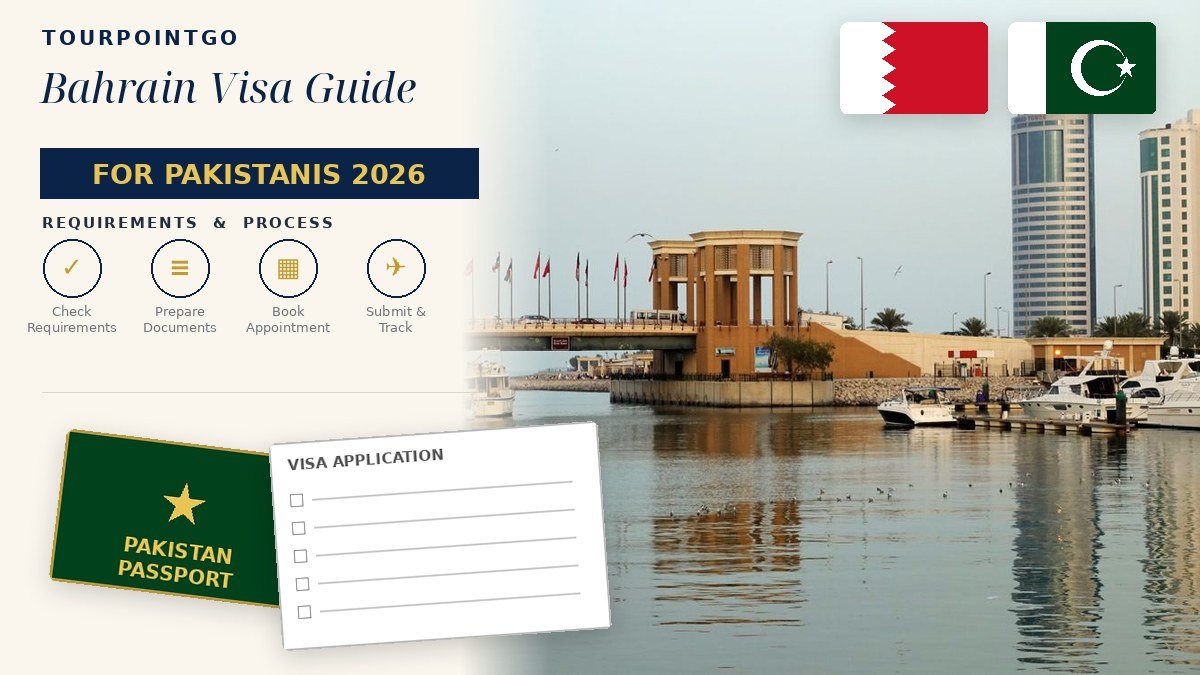
Bahrain is one of the easiest Gulf breaks a Pakistani traveller can plan: a short flight from Karachi, Lahore or Islamabad, an island small enough to cross in an afternoon, and a mix that few Gulf destinations match, from a UNESCO-listed fort and a 4,000-year pearl-diving past to a modern Manama waterfront, a Formula 1 circuit and some of the Gulf’s best-loved souqs. The visa side of the trip is straightforward too, provided you apply in the right order. The single most common mistake is the one this guide is written to prevent: flying to Bahrain expecting a visa on arrival, when the route for Pakistani passport holders is an entry visa arranged in advance, normally online through Bahrain’s official eVisa platform.
The short version is this. Pakistani ordinary passport holders need a visa for Bahrain. Bahrain does not offer visa-free entry to ordinary Pakistani passports, and Pakistan is not on Bahrain’s visa-on-arrival list, which covers around 69 nationalities. What Pakistanis can use, and what most tourists in this guide will use, is the visit eVisa issued in advance through the Nationality, Passport and Residence Affairs (NPRA) eVisa platform at evisa.gov.bh. Bahrain’s national portal states that eVisas are available for visitors from more than 200 countries, and the platform itself is where you confirm your own eligibility, choose your visa type and pay. If you already live in another Gulf country, a separate GCC resident route may apply instead, with its own residence and profession conditions. If neither online route fits your case, the fallback is a visa through a Bahraini sponsor, a travel agency or a Bahrain embassy, arranged before you travel.
One honesty note runs through this guide. Bahrain’s official pages describe the system in general terms, while the exact fee for your nationality and visa type is shown on the eVisa platform itself during your application. Where this guide gives a fee from the NPRA fee schedule as reported by independent guides, it says so, and it tells you to confirm the figure the portal shows before you pay. Fee totals, in particular, combine a non-refundable application fee with a visa fee, so a single number quoted by an agent without that breakdown is not a reliable comparison.
Key Facts at a Glance
| Item | Detail |
|---|---|
| Visa needed for Pakistani ordinary passport holders | Yes, arranged before travel |
| Visa-free entry | No, except for Gulf Cooperation Council nationals |
| Visa on arrival for Pakistanis | No; Pakistan is not on Bahrain’s visa-on-arrival list |
| Main route for tourists | Visit eVisa in advance through the NPRA eVisa platform at evisa.gov.bh |
| Official fee schedule (NPRA, as reported) | Single-entry 2-week eVisa BD 10; 3-month multiple-entry BD 17; 1-year multiple-entry BD 45 |
| Official fee confirmed on the government services catalogue | Multiple-entry visitor eVisa valid for one year BD 45; extension of a visit eVisa for two weeks BD 25 |
| Passport validity | At least 6 months from your date of arrival |
| Processing time (as commonly reported) | 3 to 5 working days; apply at least 2 weeks before travel |
| Use the visa within | 3 months of approval, as reported; your approval states the exact window |
| Extension | A visit eVisa can be extended for two weeks for BD 25, through NPRA |
| Work on a visit visa | Not permitted |
| Information checked | 29 October 2026 |
Do Pakistanis Need a Visa for Bahrain?
Yes. Bahrain’s national portal is clear on the starting point: every nationality entering Bahrain needs an entry visa, except for nationals of the Gulf Cooperation Council states, namely Kuwait, Oman, Saudi Arabia, Qatar and the United Arab Emirates. A Pakistani ordinary passport is not a GCC passport, so the exemption does not apply, and there is no separate visa-free arrangement for Pakistani tourists.
The second shortcut to rule out is visa on arrival. Bahrain does offer visas on arrival, but only to visitors from around 69 listed countries, and Pakistan is not among them. The countries on that list include the United States, the United Kingdom, Canada, Ireland, Australia, New Zealand, the European Union states, Japan, South Korea, Singapore and Malaysia, among others. If a travel agent or a social media post tells you that a Pakistani passport gets a visa on arrival in Bahrain, do not rely on it. Arriving without an approved visa risks refusal of boarding by your airline in Pakistan, or refusal of entry at Bahrain International Airport.
That leaves the advance routes, and for most readers the online eVisa is the right one. Bahrain’s national portal states that eVisas are available for visitors from more than 200 countries, and that visitors who are not eligible for an on-arrival visa must obtain an entry visa in advance. The eVisa platform run by NPRA is the official online channel for that advance visa: it lets you apply, check your application status, pay, correct an application and extend a visa. Your first step, before you pay anyone anything, is to open the platform, select Pakistan as your nationality, and read the visa types and fees it offers for your case. If the platform does not offer a type that fits you, use the sponsor route described below rather than paying a third-party site that promises a visa the platform does not issue.
Bahrain eVisa Types and Fees
Bahrain’s visit eVisas come in short and long versions, and choosing the right one saves real money. A single short trip needs only the cheapest type, while a traveller who will cross to Bahrain several times in a year is usually better served by the one-year multiple-entry visa than by buying a new single-entry visa for every trip. The table below gives the NPRA fee ladder for Pakistan, with the two figures that Bahrain’s own government services catalogue confirms shown separately.
| eVisa type | Stay allowed | Total fee (BD) |
|---|---|---|
| Visit Visa – 2 Weeks Single Entry | Up to 2 weeks | 10 |
| Visit Visa – Three Months Multiple Entry | Up to 1 month per visit | 17 |
| Visit Visa – One Year Multiple Entry | Up to 90 days per visit | 45 |
The single-entry total of BD 10 is made up of a BD 5 non-refundable application fee payable on submitting plus a BD 5 visa fee payable on approval, and the same BD 5 application fee applies across the ladder: the three-month multiple-entry total of BD 17 is BD 5 application fee plus BD 12 visa fee, and the one-year multiple-entry total of BD 45 is BD 5 application fee plus BD 40 visa fee. The application fee is not refunded if your application is refused, so check your eligibility and documents before you submit. Bahrain’s government services catalogue independently lists the one-year multiple-entry visitor eVisa at BD 45, which matches the ladder above, and it lists the extension of a visit eVisa for two weeks at BD 25. Those catalogue figures are useful cross-checks: if a website quotes you a one-year Bahrain visa at a price far above BD 45 before any service charge, it is adding its own markup, and you should ask for a written breakdown.
Bahraini dinars are a strong currency, so convert before you judge the price. At the pegged rate of about BD 1 to USD 2.65, the BD 10 single-entry visa is roughly USD 27, the BD 17 three-month visa is roughly USD 45, and the BD 45 one-year visa is roughly USD 119. Your bank or card rate on the day decides the exact rupee figure, so this guide does not state a fixed rupee total. Agent service charges, if you use an agent, are separate from the government fee and should be quoted separately.
A note on validity versus stay, because the two are often confused. Validity is the window in which the visa can be used; stay is how long each visit may last. A one-year multiple-entry visa does not mean a one-year stay. It means you may enter several times during that year, for up to 90 days on each visit. A single-entry two-week visa, by contrast, ends the moment you leave Bahrain, even if you have not used the full two weeks. Read both dates on your approval before you book a return flight, and never plan a stay that runs past the stay allowed on your approval.
Family visit eVisa
If you are visiting family, select Family Visit as the detailed purpose on the portal; it offers the same three online visa types.
The GCC Resident Route: If You Already Live in the Gulf
A large share of Pakistani readers of this guide do not live in Pakistan at all. They live in Saudi Arabia, the United Arab Emirates, Qatar, Kuwait or Oman, and they travel to Bahrain for a weekend or a family visit. For them, Bahrain offers a separate GCC resident route, and it is worth understanding because its conditions are different from the standard tourist eVisa.
Under the GCC resident route, a Pakistani national holding a valid residence permit from another Gulf state may apply for a Bahrain eVisa, or in some cases obtain a visa on arrival, provided two conditions are met. First, the residence permit must still be valid for at least three more months at the time of application. Second, the profession shown on the residence permit must be on Bahrain’s approved list, which generally covers professional and managerial roles, and excludes labourer categories. Confirm the GCC resident fee on the portal rather than assuming the standard price.
If you are a Pakistani resident of the Gulf, do not assume the GCC route is automatic. A residence permit that expires within three months, or a profession outside the approved list, can leave you outside it, in which case the standard advance eVisa or a sponsor route is the fallback. Check your own permit against the portal’s GCC resident conditions before you travel, and carry the permit itself, not just a photograph of it, because it is the document the route depends on.
This guide’s companion articles cover the Gulf neighbours many readers combine with Bahrain. For the drive across the King Fahd Causeway, see our Saudi visit visa from Pakistan guide, and for a Doha stop on the same trip, see our Qatar visit visa from Pakistan guide. If you live in the Emirates and are comparing the two systems, our UAE visit visa from Pakistan guide explains the sponsor-based UAE system, which works differently from Bahrain’s online platform.
Documents Required
Prepare a clean, complete file before you start the form. Bahrain’s platform asks for uploads in image or PDF format, and a blurry passport scan or an unconfirmed hotel booking is the most common reason a straightforward application stalls. The standard document set, as described across the NPRA guidance and independent guides, is:

- A Pakistani passport valid for at least 6 months from your date of arrival in Bahrain, with a clear colour scan of the bio-data page showing your photograph, full name, date of birth and passport number.
- A recent passport-style photograph, in colour, on a white background.
- A confirmed return or onward flight ticket.
- Proof of accommodation for your stay: a confirmed hotel booking, or, if you are staying with family or friends, a copy of your host’s Bahraini identity card printout (CPR reader printout).
- Proof that you can support yourself during your stay: a bank statement under your name covering the last three months with an ending balance of not less than the equivalent of USD 1000.
- A valid email address, because your approved eVisa is delivered by email, and a credit or debit card for the online fee payment.
- If you are applying under the GCC resident route, a copy of your Gulf residence permit, valid for at least three more months, showing an approved profession.
- If you are staying with family, the host documents for the family visit route, as the platform requests them for your case.
You must also be outside Bahrain when you apply. The eVisa is an advance permission, not something you obtain after landing, and you cannot hold more than one Bahrain visa on the same passport at the same time. If you already hold a valid Bahrain visa, sort that out before lodging a second application.
Travel insurance deserves a separate note. Bahrain’s platform guidance does not present travel insurance as a fixed condition of every tourist eVisa in the same way some destinations do, but comprehensive cover for the full stay is strongly advisable, and some sponsor and family routes ask for it. A hospital bill in Manama is not a risk worth taking for the price of a basic policy, and several airlines and hotels ask about cover in any case. Buy a policy that covers medical treatment in Bahrain for your whole stay, and carry the certificate with your eVisa.
How to Apply: Step by Step
The online application itself is short. Most of the work is in the preparation above; the form takes well under an hour once your documents are ready.
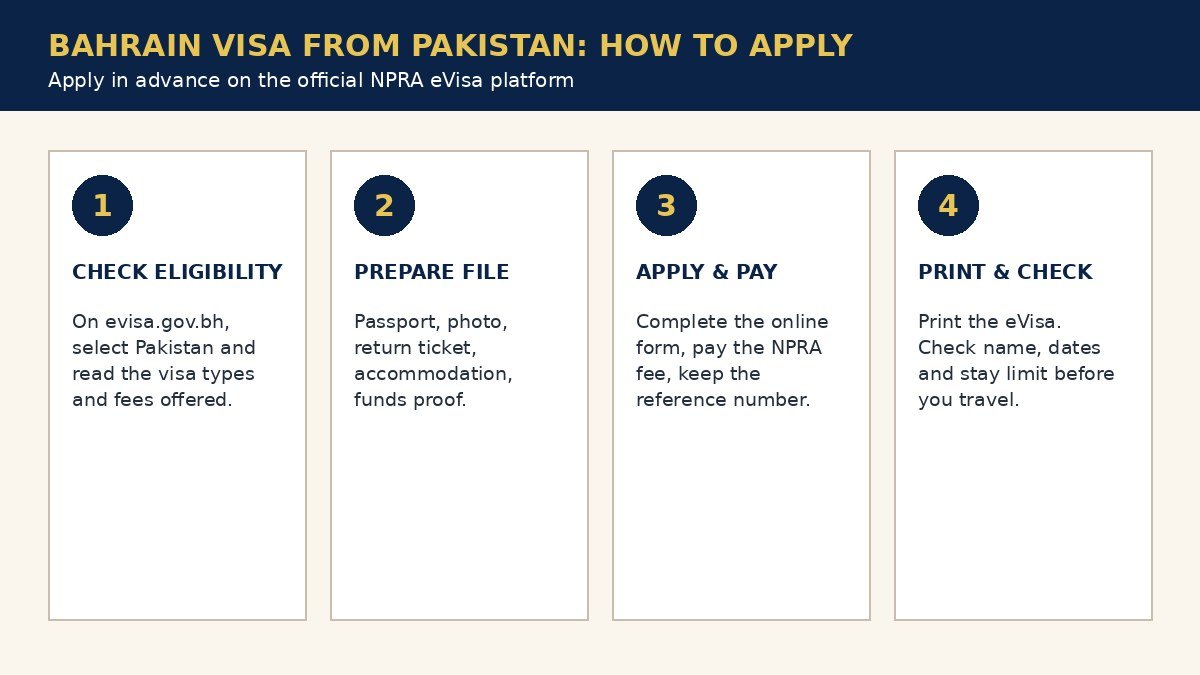
Step 1: Open the official eVisa platform at evisa.gov.bh and select Pakistan as your nationality. Read the visa types, fees and conditions the platform shows for your case, and confirm that the type you want is offered before you go further. Do not start from a third-party site that charges its own fee on top of the NPRA fee without telling you so.
Step 2: Choose your visa type. For a single short holiday, choose the single-entry two-week eVisa. For several trips in three months, choose the three-month multiple-entry visa. For regular travel across a year, choose the one-year multiple-entry visa. For a family visit, select Family Visit as the detailed purpose on the portal; it offers the same three online visa types.
Step 3: Complete the form with your details exactly as they appear in your passport. Names, passport number, date of birth and travel dates must match your documents character by character. An application cannot be edited after submission, so a spelling error can mean a fresh application and a fresh non-refundable application fee.
Step 4: Upload your documents: passport scan, photograph, return ticket, accommodation proof and bank statement, plus your Gulf residence permit if you are using the GCC resident route. Upload clear, complete pages, not cropped photographs of documents.
Step 5: Pay the fee online by card. Keep the payment receipt and the application reference number. The platform lets you check your application status with that reference, so save it somewhere you can find it again.
Step 6: Wait for the decision. Reported processing is 3 to 5 working days, with some guides reporting faster decisions in straightforward cases and slower ones in peak periods such as Ramadan and the Formula 1 Grand Prix. Apply at least two weeks before travel, and do not buy non-refundable flights or hotels until your eVisa is approved.
Step 7: Receive your eVisa by email, check every detail on it, and print a copy. Check your name, passport number, visa type, validity window and permitted stay. If anything is wrong, contact NPRA’s eVisa team at evisa@npra.gov.bh before you travel, not at the airport. Carry the printed eVisa with your passport, your return ticket and your accommodation proof, because airlines in Pakistan check your approval before boarding.
If the Online Route Does Not Fit Your Case
Not every trip fits the online platform. If the platform does not offer a visa type for your nationality and purpose, or if you need a sponsored category, the advance routes are a Bahrain embassy in your country of residence, a Bahraini sponsor, or a licensed travel agency. In that case, the sponsor in Bahrain starts the process, and you provide the same core documents: passport, photograph, return ticket, accommodation proof and funds evidence. What does not change is the timing rule: the visa must be issued before you travel. There is no reliable fallback at the airport for a Pakistani ordinary passport.
Processing Time and When to Apply
Bahrain does not publish a single guaranteed processing time for every eVisa on its general pages, and the honest planning figure is the convergent one from NPRA guidance and independent guides: 3 to 5 working days for a standard application. The portal FAQ states processing takes approximately 3 to 5 working days. Some applications are decided faster, and some take longer when documents need verification or when volumes spike around Ramadan, the Grand Prix or summer holidays. A few guides quote 24 to 72 hours for straightforward cases, but planning around the fastest reported figure is how travellers end up rebooking flights.
The practical rule is simple. Apply at least two weeks before your intended departure, and longer if you are travelling at Eid, in December or during a major Manama event. A complete application with a clear passport scan, a confirmed hotel booking and a consistent bank statement is the fastest kind. An incomplete file, a mismatched name, a blurry scan or an unconfirmed booking are the usual reasons for delay, and because the application fee is non-refundable, a rejected application costs you the fee as well as the time.
Once approved, use the visa within its validity window. Guides consistently report that an approved eVisa must be used within three months of approval, and your approval itself states the exact window. A visa that is not used in time expires, and a new application with a new fee is needed. The same discipline applies at the other end of the trip: leave before your permitted stay ends, or extend before it expires, as described below.
After Approval: Entry, Extension and Overstay
Travel with your passport, your printed eVisa, your return ticket, your accommodation proof and, if you used the GCC resident route, your Gulf residence permit. At check-in in Pakistan, airline staff may ask to see your approval and your accommodation proof, because airlines are fined for carrying passengers who are refused entry. On arrival at Bahrain International Airport, present your passport and eVisa at immigration and keep your approval’s stay dates in mind from the moment you land.
If your plans change and you need longer, do not simply stay on. A visit eVisa can be extended for two weeks for BD 25, through NPRA’s platform or an NPRA service centre, with your passport and an application form. Apply for the extension before your current stay expires, not after, and keep the extension approval with your original eVisa.
Overstaying is a poor bargain in Bahrain, as everywhere in the Gulf. An overstay can mean fines, detention, deportation and difficulty with future Gulf visas, and it can affect applications to other Gulf states that ask about previous immigration history. If you cannot extend in time, leave before your stay ends and apply afresh for a later trip rather than testing the overstay rules.
Common Mistakes to Avoid
First, do not confuse the visa types. A single-entry visa ends on exit, a multiple-entry visa does not. Travellers who buy the cheapest visa for a two-country trip, leave Bahrain for Saudi Arabia across the Causeway and then try to re-enter on the same single-entry visa are refused, because the visa is already spent. If your itinerary leaves and re-enters Bahrain, buy a multiple-entry visa.
Second, do not trust a single fee quoted by an agent. Always ask for the split between the NPRA application fee, the NPRA visa fee and the agent’s own service charge, and compare the government part against the ladder in this guide: BD 10, BD 17 and BD 45. A website that demands a large fee before your application has even been looked at is not following the official process.
Third, do not submit a weak funds file. A bank statement with a sudden large deposit just before applying, or a statement that stops a month before your trip, invites questions. A steady three-month statement that matches your claimed income and trip cost is stronger than one large number.
Fourth, do not book non-refundable travel before approval. Bahrain’s eVisa is usually quick, but “usually” is not a guarantee, and a delayed or refused application with non-refundable flights attached is an expensive lesson.
Fifth, do not work on a visit visa, paid or unpaid. A visit eVisa is for tourism, family visits and short business meetings, not employment. Working on a visit visa can mean fines, deportation and a future ban, and it can also harm a sponsor who employed you. If your trip is really for a job, your Bahraini employer must arrange a work visa through the Labour Market Regulatory Authority before you travel.
Why Visit Bahrain
Bahrain rewards a short trip out of proportion to its size. Start in Manama, where the waterfront and the modern skyline sit a short drive from the old souq, with its spice, textile and gold stalls, and from Beit Al Quran, one of the region’s most respected collections of Islamic manuscripts. Qal’at al-Bahrain, the Bahrain Fort, is the island’s UNESCO World Heritage Site, a fort and settlement mound on the northern shore whose layers run from the Dilmun civilisation to the Portuguese period, and it is the single best place to understand why this small island mattered to traders for thousands of years. Al Fateh Grand Mosque, one of the largest mosques in the world, welcomes visitors outside prayer times and gives a calm, well-guided introduction to Bahraini religious life.
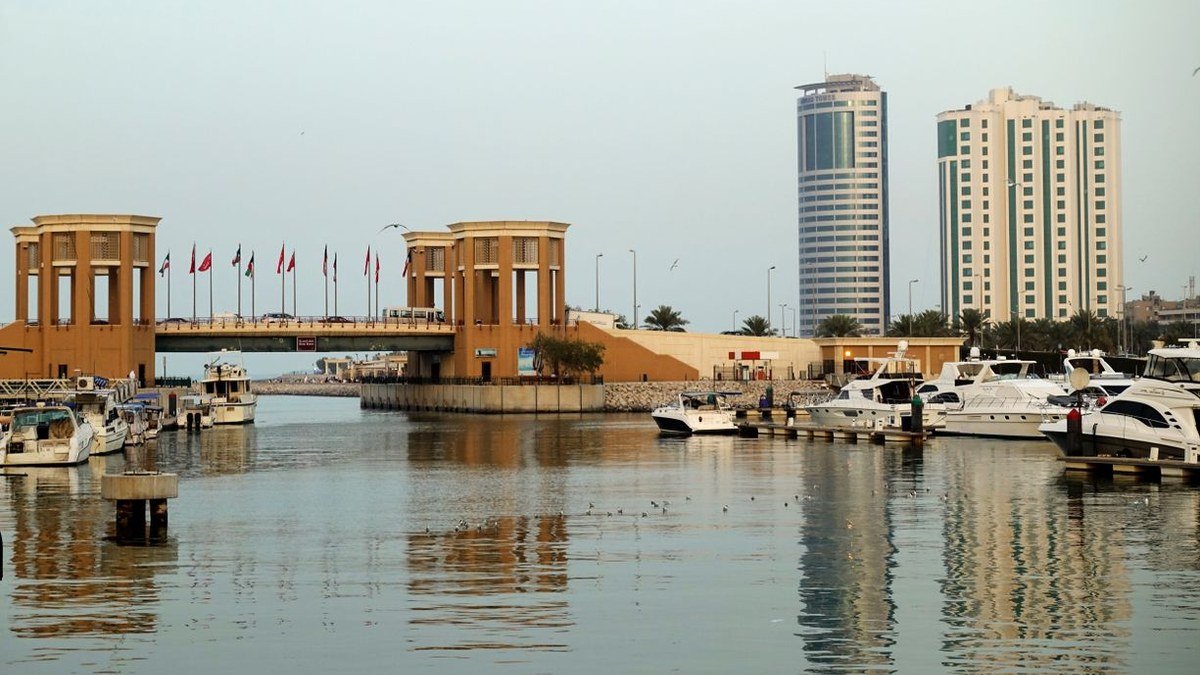
Beyond the capital, the island keeps surprising first-time visitors. The Bahrain International Circuit at Sakhir hosts the Formula 1 Gulf Air Bahrain Grand Prix and offers circuit experiences outside race weekends. The Tree of Life, a lone mesquite tree standing in the southern desert, is one of the island’s most photographed sights precisely because no one can fully explain how it survives there. Muharraq, the old capital across the water from Manama, holds the Pearling Path, a UNESCO-listed trail of merchants’ houses and a reminder that Bahrain’s wealth, before oil, came from the sea. Add beaches on the east coast, a causeway drive to Saudi Arabia for travellers combining the two countries, and a food scene that runs from Bahraini fish and rice dishes to some of the Gulf’s best international restaurants, and a two-week visa rarely feels too long.
Frequently Asked Questions
Do Pakistani citizens need a visa for Bahrain?
Yes. Pakistani ordinary passport holders need an entry visa arranged before travel. Bahrain’s visa-free exemption covers Gulf Cooperation Council nationals only, and Pakistan is not on Bahrain’s visa-on-arrival list.
Can Pakistanis apply for a Bahrain eVisa online?
Yes, through the official NPRA eVisa platform at evisa.gov.bh, which Bahrain’s national portal describes as offering eVisas for visitors from more than 200 countries. Confirm the visa types the platform offers for Pakistan before you pay, because the platform itself is the authority for your case.
How much does a Bahrain visit eVisa cost for Pakistanis?
As reported from the NPRA fee schedule, a single-entry two-week eVisa costs BD 10 in total, a three-month multiple-entry visa BD 17, and a one-year multiple-entry visa BD 45. Bahrain’s government services catalogue confirms the one-year figure at BD 45. The BD 5 application fee within each total is non-refundable.
How long does a Bahrain eVisa take?
Reported processing is 3 to 5 working days for a standard application. The portal FAQ states processing takes approximately 3 to 5 working days. Apply at least two weeks before travel, and longer around Ramadan, the Grand Prix or other peak periods.
How long can I stay in Bahrain on an eVisa?
It depends on the type. A single-entry eVisa allows up to two weeks. A three-month multiple-entry visa allows up to 1 month per visit. One-year multiple-entry visas allow up to 90 days per visit. Your approval states the exact stay allowed, and that document governs your trip.
Can I extend my Bahrain visit eVisa?
Yes. A visit eVisa can be extended for two weeks for BD 25 through NPRA. Apply before your current stay expires.
Do Pakistani residents of the Gulf get a different Bahrain visa?
They may use the GCC resident route, provided their Gulf residence permit is valid for at least three more months and their profession is on Bahrain’s approved list. Check your own permit against the portal’s conditions before travelling.
What documents do I need for a Bahrain eVisa?
A passport valid for at least six months, a clear scan of its bio-data page, a recent white-background photograph, a confirmed return ticket, accommodation proof such as a hotel booking or your host’s identity card printout, proof of funds such as a three-month bank statement with an ending balance of not less than the equivalent of USD 1000, a valid email address and a card for the fee. Gulf residents add their residence permit.
Can I work in Bahrain on a visit visa?
No. A visit eVisa does not permit employment, paid or unpaid. Work requires a work visa arranged by a Bahraini employer through the Labour Market Regulatory Authority before you travel.
What happens if my Bahrain eVisa is refused?
The application fee is non-refundable, so a refusal costs you that part of the fee. Common reasons are incomplete documents, unclear funds evidence or previous immigration issues. Fix the underlying weakness before reapplying rather than submitting the same file again immediately, and contact NPRA’s eVisa team at evisa@npra.gov.bh if you need clarification on your case.
Official Sources
- Bahrain eVisa platform, NPRA — Nationality, Passport and Residence Affairs (NPRA): https://www.evisa.gov.bh/
- Kingdom of Bahrain national portal, Visas page — NPRA eVisa platform, eVisas for more than 200 countries, on-arrival visas for more than 60 countries.
- Bahrain government services catalogue, NPRA eService fees — one-year multiple-entry visitor eVisa BD 45, two-week visit eVisa extension BD 25.
- NPRA eVisa contact: evisa@npra.gov.bh, telephone +973 1707 7077 (as reported by independent guides; confirm on evisa.gov.bh before calling).
Disclaimer
TourPointGo is an independent visa-information website, not a government authority, embassy, travel agency or immigration adviser. It cannot guarantee approval of any application. Visa rules, fees and processing times change, and the decision rests with Bahrain’s Nationality, Passport and Residence Affairs. Before you pay or travel, confirm your eligibility, visa type and fee on the official eVisa platform at evisa.gov.bh, and check every detail on your approval carefully. If your case is complex — for example a previous refusal, an overstay or a criminal record — seek advice from the relevant Bahraini authority or a qualified immigration adviser.