Nepal is one of the simplest trips a Pakistani passport holder can plan, and for a specific reason that many travellers miss: on your first visit in a visa year, the visa itself is free. Pakistan is a SAARC member, and Nepal grants citizens of SAARC countries (except Afghanistan) a gratis tourist visa of up to 30 days for their first visit in a given visa year. That means a first Kathmandu holiday, a Pokhara break or the start of a Himalayan trek can begin with a visa on arrival at Kathmandu airport, without a fee and without a trip to an embassy first.
This guide explains exactly how that free visa works, what you pay if you stay longer or travel again in the same year, which documents to carry, and how the airport process works step by step. All fees and rules below were checked against Nepal’s Department of Immigration and the Nepal Tourism Board on 2 November 2026. Where two official pages show different figures, this guide says so plainly rather than hiding the gap.
Key facts at a glance
| Question | Answer for Pakistani passport holders |
|---|---|
| Visa needed? | Yes, but it is issued on arrival or in advance from a Nepali mission |
| First visit in a visa year (up to 30 days) | Free under the SAARC gratis visa rule |
| Paid tourist visa fees (Department of Immigration) | USD 30 for 15 days, USD 50 for 30 days, USD 125 for 90 days |
| Entries | Multiple entry |
| Where to get it | Tribhuvan International Airport, Kathmandu, and designated land entry points, or the Embassy of Nepal in Islamabad in advance |
| Online form | Pre-fill the tourist visa form at nepaliport.immigration.gov.np before you fly |
| Maximum stay in a visa year | 150 days in total (January to December), including extensions |
| Extension | USD 3 per day, minimum 15 days (USD 45), at the Department of Immigration in Kathmandu or the Immigration Office in Pokhara |
Do Pakistanis need a visa for Nepal?
Yes. Every foreign national except Indian nationals needs a visa to enter Nepal, and Pakistani passport holders are no exception. The good news is in how that visa is issued. Pakistan does not appear on the Department of Immigration’s list of nationalities that must obtain a visa before arrival (that list includes countries such as Nigeria, Ghana, Afghanistan, Syria and Iran). A Pakistani traveller can therefore get a tourist visa on arrival, which is the only entry visa Nepal issues at its airports and land borders.
There is also a second route: apply in advance at the Embassy of Nepal in Islamabad. A visa issued by a Nepali mission must be used within six months of its issue date, and your permitted stay is counted from the day you enter Nepal. For most first-time visitors, the on-arrival route is simpler, but the embassy route suits anyone who wants the visa in hand before boarding, or who wants to settle any doubt about their case before travelling.
The free SAARC visa explained
This is the part of the Nepal rules that matters most for Pakistani travellers, so it is worth stating precisely.
Nepal’s Department of Immigration issues a gratis (free) visa to SAARC citizens, except citizens of Afghanistan, who are visiting Nepal for the first time in a given visa year, for up to 30 days. The Nepal Tourism Board’s visa page names the qualifying countries explicitly: Bangladesh, Bhutan, Maldives, Pakistan and Sri Lanka. The visa year runs from January to December.
Three conditions decide whether your trip is free:
- You hold a Pakistani passport. Your nationality, not your country of residence, is what counts.
- It is your first visit in that visa year. A second trip in the same calendar year is not free, even if the first trip was short.
- Your stay is up to 30 days. If you want longer than 30 days on that first visit, you pay the standard fee for the longer visa instead of claiming the free one.
A practical consequence follows from the second condition. If you plan two Nepal trips in one year, it can be worth using the free visa for the longer trip and paying for the shorter one, or simply accepting that the second trip is paid. Do not assume the free visa resets with each trip; it resets with the visa year.
Children below 10 years of age are also issued a gratis visa, except children who are United States citizens. That rule is separate from the SAARC rule and does not change anything for an ordinary Pakistani family trip, since the SAARC rule already covers the parents.
Fees for longer or repeat visits
If the free SAARC visa does not cover your trip, you pay the standard tourist visa fee published by the Department of Immigration. All three options are multiple entry, which means you can leave Nepal and re-enter during the visa’s validity without buying a new visa.
| Tourist visa | Fee (Department of Immigration) |
|---|---|
| 15 days, multiple entry | USD 30 |
| 30 days, multiple entry | USD 50 |
| 90 days, multiple entry | USD 125 |
One discrepancy must be disclosed honestly. The Nepal Tourism Board’s visa page currently shows lower figures (USD 25, USD 40 and USD 100 for the same three durations). The Department of Immigration’s own immigration office pages show USD 30, USD 50 and USD 125, and those are the figures repeated across current 2026 guides. This guide uses the Department of Immigration figures as governing, because that department issues the visa, but you should carry a little extra in convertible currency in case the counter applies a different published table on the day. Fees in Nepal are payable in cash in convertible currency, and the Tourism Board states that credit cards, Indian currency and Nepali currency are not accepted for the visa fee. The immigration office itself advises carrying cash to be safe. In practice, carry US dollars in small notes.
To put the choice in plain terms: a 15-day paid visa costs USD 30, extending a stay is USD 3 per day, and a 90-day visa costs USD 125. If you already know you will stay well beyond a month, buying the 90-day visa at arrival is cheaper than buying short and extending repeatedly, although extensions remain available if your plans change.
Documents to carry

The on-arrival process itself asks for very little paperwork, but arriving prepared prevents the two most common delays: a form that has to be filled at a crowded kiosk, and a payment problem at the bank counter. Carry the following:
- A valid Pakistani passport. As a practical rule, travel with at least six months of validity remaining and at least one blank page, and do not travel on a passport close to expiry.
- One passport-size photograph with a light background. The Tourism Board lists this as a requirement, and the airport kiosks can also take your photograph if needed.
- The printed submission receipt with barcode from the online tourist visa form, if you pre-filled it (see below).
- Cash in US dollars or another accepted convertible currency to pay the fee, if your trip is not covered by the free visa. Accepted currencies listed by the Tourism Board include euros, Swiss francs, pounds sterling, US dollars, Australian dollars, Canadian dollars, Hong Kong dollars, Singapore dollars and Japanese yen.
- Your return or onward ticket and your accommodation details. The immigration desk does not publish these as formal on-arrival requirements, but they are the ordinary evidence any immigration officer may ask for, and having them ready costs nothing.
- Proof that you can support your stay, such as a bank card or a recent bank statement, again as supporting evidence rather than a published fixed amount. Nepal does not publish a fixed daily funds figure for tourist visa on arrival, so do not believe any guide that quotes one as an official rule.
If you apply in advance at the Embassy of Nepal in Islamabad instead, the mission will confirm its own checklist and fee for that route. The embassy’s official site is pk.nepalembassy.gov.np, its telephone is +92-51-2610317-18, and its email is eonislamabad@mofa.gov.np. Confirm the current submission hours and requirements with the embassy before you go, because mission procedures change without notice.
How to get the visa on arrival, step by step
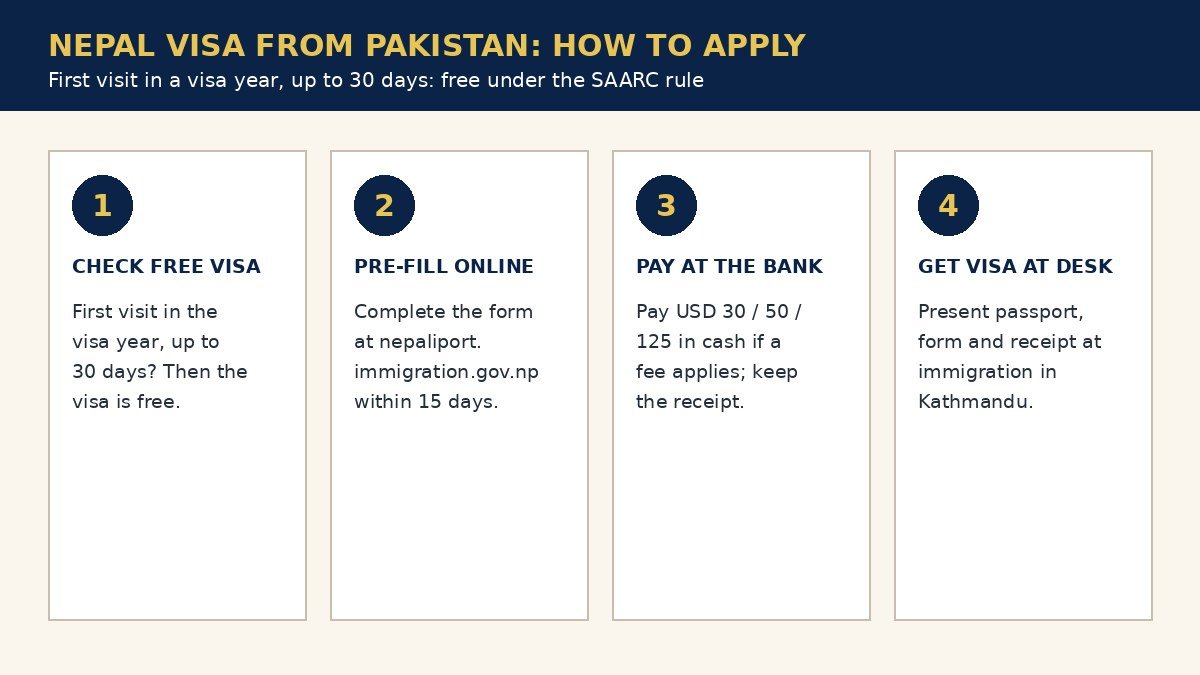
The Department of Immigration’s immigration office at Tribhuvan International Airport describes the process in three steps, and following them in order is the fastest way through the terminal.
Step 1: Fill in the form before you fly
Complete the online tourist visa form at nepaliport.immigration.gov.np before departure. You will receive a submission receipt with a barcode. Print it and carry it. That receipt is valid for 15 days from submission, so do not fill the form a month early; complete it within 15 days of your arrival date. If you do not pre-fill it, you can fill the form on the kiosk machines at the airport, but expect queues in peak tourist season.
You will also fill in an arrival card. Keep both the form receipt and the arrival card with your passport as you move through the terminal.
Step 2: Pay at the bank counter
Take your form to the bank counter in the terminal and pay according to the visa you need: nothing, if you are claiming the free SAARC visa for a first visit of up to 30 days; otherwise USD 30, USD 50 or USD 125 for 15, 30 or 90 days. Keep the payment receipt. Carry cash, as explained above, even if card payment is sometimes available at the counter.
Step 3: Present yourself at the immigration desk
Proceed to the immigration desk with your passport, your online form receipt and your payment receipt (where a fee was payable). The immigration officer issues the visa on being satisfied with your documents. Visas issued at the airport, including gratis visas, are tourist visas with multiple re-entry facility.
The same on-arrival process applies at Nepal’s designated land entry points. The Tourism Board lists Kakadvitta, Birgunj, Bhairahawa, Nepalgunj and Gaddachowki on the Nepal-India border, and Kodari on the Nepal-China border, in addition to Tribhuvan International Airport in Kathmandu. If you plan to enter by land, confirm that your chosen crossing issues visas on arrival before you travel, because not every small border post does.
Getting the visa in advance from the Embassy in Islamabad
Some travellers prefer to land with the visa already in their passport. The route is straightforward: apply to the Embassy of Nepal in Islamabad, following the mission’s own form and checklist, and collect the visa before departure. Remember the six-month rule: a visa issued by a Nepali mission must be used for entry within six months of its issue date. If your travel date slips beyond that window, the visa cannot simply be carried over.
The advance route is also the sensible choice if your case has any complication, for example a previous refusal elsewhere, a passport with very short validity, or a long planned stay that you want confirmed before booking non-refundable travel. In that situation, an embassy decision before departure is worth more than an on-arrival assumption.
Extensions and the 150-day cap
Nepal allows a tourist to stay for a maximum of 150 days in one visa year (January to December), counting all visits and extensions together. If you arrive on a 30-day visa and decide to stay longer, you can extend it at the Department of Immigration in Kalikasthan, Kathmandu, or at the Immigration Office in Pokhara. Tourist visa extensions can also be handled at Pokhara, while non-tourist extensions are handled only by the Department of Immigration in Kathmandu.
The extension fee is USD 3 per day, with a minimum extension of 15 days, so the smallest extension costs USD 45. A 30-day extension therefore costs USD 90. Apply before your current visa expires: overstaying is fined at USD 5 per day on top of the extension fee, and an overstay record can complicate future travel. Do not leave an extension to your last day, and do not assume the airport can extend a visa at departure; extensions are an immigration office matter, not an airport counter matter.
If you change the purpose of your stay, for example from tourism to study or work, you must change your visa category through the Department of Immigration with the required documents. A tourist visa does not convert itself, and working on a tourist visa is not permitted.
What the tourist visa allows, and what it does not allow
A Nepal tourist visa covers sightseeing, holidays, trekking, visiting friends and family, and similar leisure purposes. The Department of Immigration notes that even travellers entering for purposes other than tourism still enter on a tourist visa and must then change category if their purpose and length of stay require it.
The visa does not permit employment in Nepal. It also does not, by itself, authorise mountaineering expeditions or restricted-area travel: trekking permits, conservation area permits and any restricted-area permits are separate from the visa and must be arranged through the proper channels before you set out. Budget for those separately, and do not treat the visa fee as the total cost of a trekking trip.
Trekking and other practical notes
Most Pakistani visitors to Nepal come for one of three things: Kathmandu Valley’s temples and old towns, Pokhara’s lakes and mountain views, or a Himalayan trek. The visa rules are the same for all three, but the practical planning differs.
For trekking, altitude matters more than paperwork. Ascend gradually, build acclimatisation days into your itinerary, and do not let a short visa push you to rush altitude gain. If your trek runs longer than your visa, extend the visa in Kathmandu or Pokhara before you head into the mountains, not after you return.
For city trips, the main practical point is cash. Nepal’s visa fee is cash in convertible currency, and smaller towns and trekking lodges run heavily on cash too. Carry enough US dollars for the visa and your first days, and exchange the rest at authorised counters rather than relying on a single card.
For families, the free SAARC visa makes Nepal one of the cheapest first international trips from Pakistan, since a family of four on a first visit in the visa year pays no visa fee at all for stays up to 30 days. That saving is real, but it depends entirely on the first-visit condition, so check it before promising a second free trip in the same year.
Common mistakes that delay or damage an application
- Filling the online form more than 15 days before arrival, so the barcode receipt expires and must be redone at the airport.
- Arriving without cash in a convertible currency and expecting to pay the visa fee by card or in Pakistani rupees.
- Assuming the free SAARC visa applies to a second trip in the same calendar year, then being asked to pay at the counter.
- Travelling on a passport with very short validity remaining, or with no blank page.
- Booking a long trek that runs past the visa expiry date without arranging an extension in Kathmandu or Pokhara first.
- Treating the visa as a trekking permit. Permits for national parks, conservation areas and restricted regions are separate.
- Overstaying, even by a few days, and paying the USD 5 per day late fine plus risking trouble at departure.
Refusals and entry problems
Refusal on arrival is uncommon for a straightforward Pakistani tourist with a valid passport, a completed form and a clear plan, but entry is never guaranteed by any guide. The immigration officer decides on satisfaction with your documents, and a traveller who cannot explain their trip, show where they are staying, or show how they will support themselves may face further questioning.
If you are refused entry or given a shorter stay than you asked for, stay calm, answer directly, and ask what document or information is missing. Do not argue, and do not offer any payment outside the official bank counter. If your case is complicated, the safer path is to apply in advance at the Embassy of Nepal in Islamabad and travel only with a visa already issued.
Practical tips for the trip itself
Fly into Tribhuvan International Airport, Kathmandu, for the simplest arrival, since it is the main international gateway and the best staffed for visa on arrival. Build at least one buffer day at the start of a trekking itinerary for the altitude and for any arrival delay. Keep your visa stamp and your payment receipt with your passport throughout the trip, since hotels and trekking agencies may ask to see them. Finally, remember that the visa year ends in December: a trip in late December and another in January fall in different visa years, which changes the free-visa position entirely.
Frequently asked questions
Do Pakistani citizens need a visa for Nepal?
Yes, but it is issued on arrival at Tribhuvan International Airport and designated entry points, or in advance from the Embassy of Nepal in Islamabad. Pakistan is not on the list of nationalities that must obtain a visa before arrival.
Is the Nepal visa really free for Pakistanis?
For the first visit in a visa year (January to December), up to 30 days, yes: SAARC citizens except citizens of Afghanistan receive a gratis tourist visa, and the Nepal Tourism Board names Pakistan explicitly among the qualifying countries. A second visit in the same year, or a stay longer than 30 days, is paid.
How much does a paid Nepal tourist visa cost?
According to the Department of Immigration, USD 30 for 15 days, USD 50 for 30 days and USD 125 for 90 days, all multiple entry. The Nepal Tourism Board page shows lower figures, so carry a little extra in convertible currency and confirm at the counter.
How do I fill the online form?
Complete the tourist visa form at nepaliport.immigration.gov.np within 15 days of arrival, print the submission receipt with barcode, and carry it with your passport. You can also use the kiosk machines at the airport, but pre-filling saves queue time.
Can I pay the visa fee by card?
The Nepal Tourism Board states that the visa fee is payable only in cash in convertible currency, and that credit cards, Indian currency and Nepali currency are not accepted. Carry US dollars in cash to be safe.
Can I extend my stay in Nepal?
Yes, at the Department of Immigration in Kalikasthan, Kathmandu, or the Immigration Office in Pokhara, at USD 3 per day with a minimum 15-day extension (USD 45). Your total stay in one visa year cannot exceed 150 days.
What happens if I overstay?
Overstaying is fined at USD 5 per day in addition to the extension fee, and it can cause problems at departure and for future travel. Extend before your visa expires.
Can I work in Nepal on a tourist visa?
No. The tourist visa is for leisure, sightseeing, trekking and visiting friends and family. Employment requires a different visa category, arranged through the Department of Immigration.
Does the tourist visa cover trekking permits?
No. Trekking permits, conservation area permits and restricted-area permits are separate from the visa and must be arranged through the proper channels.
Should I apply at the embassy or on arrival?
For a straightforward first visit, on arrival is simpler and, if the free SAARC visa applies, free. Apply in advance at the Embassy of Nepal in Islamabad if you want the visa in hand before departure or if your case has any complication.
Official sources
- Department of Immigration, Nepal, Immigration Office (Tribhuvan International Airport), Tourist Visa
- Nepal Tourism Board, Visa Information
- Embassy of Nepal, Islamabad
- Department of Immigration online visa form (Nepaliport)
- Embassy of Nepal, Doha, Visa (confirming the gratis rule naming Pakistan and Bangladesh, Bhutan, Maldives and Sri Lanka for the first 30 days in a visa year)
Related TourPointGo guides: Sri Lanka visit visa from Pakistan, Thailand visit visa from Pakistan, Malaysia visit visa from Pakistan, Singapore visit visa from Pakistan, Indonesia visit visa from Pakistan.
Disclaimer
TourPointGo is an independent visa-information website, not a government authority, embassy, travel agency or immigration adviser. Visa rules, fees and procedures change without notice. Always confirm the current rules with the Department of Immigration of Nepal or the Embassy of Nepal in Islamabad before you travel. Nothing in this guide guarantees entry to Nepal, which is decided by the immigration officer at the point of entry.




1 thought on “Nepal Visit Visa From Pakistan 2026: Free 30-Day SAARC Visa, Fees and How to Apply”