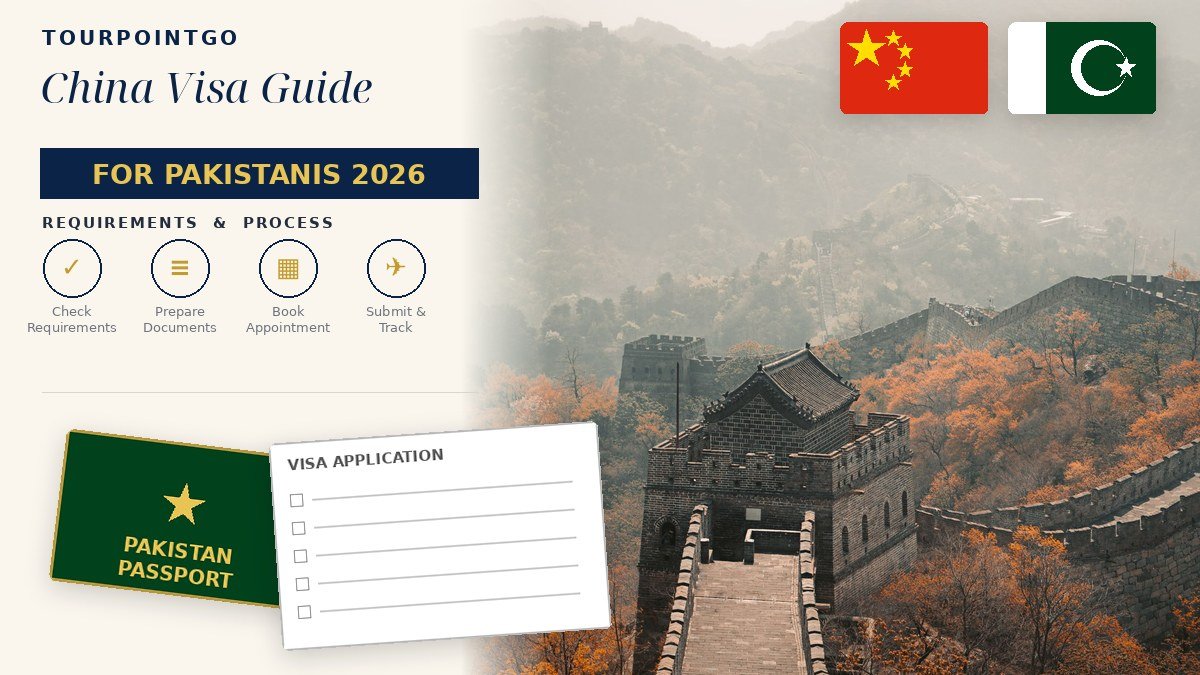
China rewards the traveller who plans properly: the Great Wall winding over the mountains north of Beijing, the Forbidden City in the heart of the capital, the Terracotta Army outside Xi’an, the karst hills of Guilin, and the neon skylines of Shanghai and Shenzhen. For a Pakistani traveller, the visa side of that trip works differently from almost every other guide on this website, and that difference is the whole point of this article. China does not handle Pakistani tourist applications the way it handles tourist applications from most other countries. If you apply on the assumption that an individual tourist visa is a routine online form, you will waste time, and you may pay an agent for a route the visa centre will not accept. Read the group rule first, and everything else in this guide will make sense.
The short version is this. Pakistani ordinary passport holders need a visa for China. There is no visa-free entry for a Pakistani ordinary passport, and there is no visa on arrival for tourism. The Chinese Embassy in Pakistan publishes a visa instruction table for applicants in Pakistan, and in that table the tourist category is listed as Group L: tourists visiting China in a group of at least five people, supported by an Invitation Letter for Tourist Group issued by the duly authorized tourism office in China. Applications are submitted through Gerry’s Chinese Visa Application Service Center in Islamabad, Karachi or Lahore, according to where you permanently reside. The visa fee itself is free for Pakistani ordinary passport holders under the reciprocal fee exemption, but Gerry’s charges its own service fee, which you must confirm with the centre before paying. The Embassy generally needs four working days to process an application after receiving the passport, and it does not offer an urgent or extra urgent service.
Key Facts at a Glance
| Item | Detail |
|---|---|
| Visa needed for Pakistani ordinary passport holders | Yes, arranged before travel |
| Visa-free entry for Pakistani ordinary passports | No |
| Visa on arrival for tourism | No |
| Tourist visa category in Pakistan | Group L, for a tourist group of at least 5 people |
| Group invitation | Invitation Letter for Tourist Group, issued by the duly authorized tourism office in China at the request of the local travel agency in China |
| Where to apply | Gerry’s Chinese Visa Application Service Center, Islamabad, Karachi or Lahore, by consular district |
| Online form | China Online Visa Application System at bio.visaforchina.cn, with all documents uploaded online |
| Chinese visa fee for Pakistani ordinary passports | Exempt, PKR 0, under the reciprocal fee arrangement |
| Gerry’s service fee (reported centre table, confirm before paying) | Islamabad and Karachi regular service PKR 13,200; faster service PKR 19,800; Lahore regular service PKR 13,300 |
| Processing time | Generally 4 working days after the Embassy receives the passport; no urgent service |
| Passport validity | More than 6 months, with at least one blank visa page |
| Police character certificate | Required for applicants aged 10 and above, covering the period since birth until now; apostilled by the Ministry of Foreign Affairs of Pakistan if it has no verifiable QR code |
| Information checked | 31 October 2026 |
Do Pakistanis Need a Visa for China?
Yes. Start with the plain answer, because a persistent piece of misinformation is circulating on this exact point. Several secondary visa guides currently claim that Pakistan was added to China’s visa-free policy from 10 November, for stays of up to 30 days. That claim mangles a real announcement. In November 2025, China’s Ministry of Foreign Affairs extended its unilateral visa-free policy to 31 December 2026 and added Sweden with effect from 10 November 2025. The list covered 45 countries across Europe, Asia-Pacific, the Gulf and South America. Pakistan was not on it. A further updated list published in February 2026 covers 50 countries, and Pakistan is not on that list either. The United Kingdom and Canada were added to China’s visa-free scheme during 2026, but that change applies to British and Canadian passports, not to Pakistani passports. A Pakistani ordinary passport holder who boards a flight to China expecting visa-free entry will be refused boarding, or refused entry on arrival.
There is one narrow transit exception, and it is not a visit route. A passenger transiting through a Chinese airport onward to a third country within 24 hours may qualify for the direct transit exemption at that port, subject to the port’s conditions. Pakistan is not among the nationalities eligible for the longer 240-hour visa-free transit scheme at Beijing. Do not plan a sightseeing stopover on a transit exemption. If you intend to leave the airport and see China, you need a visa in advance.
The Group L Rule: The Fact That Decides Your Trip
This is the section to read twice. The Chinese Embassy in Pakistan’s published instruction for visa applications lists every visa type with the documents each type requires. For tourism, it lists one category only: Group L, issued to tourists visiting China in a group of at least five people. The supporting document is an Invitation Letter for Tourist Group, issued by the duly authorized tourism office in China, usually the local Culture and Tourism Bureau, at the request of the local travel agency in China. In practice, that means a Pakistani tourist application is normally built around an organized group tour: a travel agency in Pakistan works with an authorized travel agency in China, the Chinese agency obtains the group invitation, and the group members apply together through Gerry’s.
That rule explains a great deal of the confusion online. Guides written for other nationalities describe an individual L visa supported by hotel bookings and flight reservations, because that is how the L visa works for most nationalities. The general definition of the L visa is the same: it is issued to those who intend to go to China as a tourist. But the Pakistan-specific instruction table does not list an individual L category. Some recent secondary guides describe individual tourist applications being submitted through the online system in Pakistan, and the online system does accept an application form from an individual. The honest position, and the one this guide takes, is that the Embassy’s published Pakistan instruction is the governing document: it lists Group L only. Before you book non-refundable flights or hotels, or pay any agent, confirm with Gerry’s on the helpline 051-8439385 whether your particular case will be accepted as an individual tourist application or whether you must join a group of at least five. Do not pay an agent who promises you an individual tourist visa without that confirmation, and be very cautious of any agent selling an invitation letter on its own: the Embassy lists forged or incorrect invitation documents and unverifiable inviting organizations among its common reasons for refusal.
If you cannot form a group of five, you still have legitimate options, and they are worth considering before you abandon the trip. Joining an existing organized group tour run by a reputable Pakistani travel agency is the most straightforward route, and it is how many first-time Pakistani visitors to China travel. Alternatively, if your real purpose is business, apply for the M visa with the proper business invitation documents. If you have close family in China, the family visit categories below may fit you better than a tourist application. What you should not do is dress up a tourist trip as a business or family visit. The Embassy lists a mismatch between the stated purpose and the visa type applied for as a common refusal reason, and a refusal on dishonesty grounds will harm future applications.

What the Group L Visa Allows
A Group L visa is a tourist visa, and it carries tourist conditions. It permits sightseeing and tourism within the itinerary covered by the group invitation. It does not permit employment, and it does not permit study. The Embassy decides the validity period, the duration of stay and the number of entries case by case, based on the applicant’s personal situation, so this guide does not promise a fixed stay. Secondary guides commonly describe a tourist stay of up to 30 days, with the visa to be used within three months of issue, and that is a reasonable planning assumption, but your own visa sticker governs. Read the validity window, the permitted stay and the number of entries on the visa itself as soon as you collect your passport, and plan your return flight inside those limits. Travelling outside the group itinerary, overstaying, or working on a tourist visa can lead to fines, detention and future refusals, and the group invitation that supported your visa is part of the record of your trip.
Families should note one practical point. The group of at least five does not have to be one family, and it does not have to be five adults travelling for the same personal reason beyond the shared tour. A family of three can join a larger organized group to reach the minimum. Each member of the group still applies individually with their own passport, form, CNIC copy and police character certificate, and each member’s application is decided on its own merits. One member’s weak documents do not automatically sink the group, but a returned application is treated as a new application when resubmitted, and its processing time is recalculated from the date the new application is forwarded to the Embassy.
Fees: The Visa Is Free, the Service Is Not
China’s visa fee for Pakistani citizens is one of the best pieces of news in this guide, and it is confirmed in the Embassy’s own fee page. Holders of diplomatic and official passports from every country except the United States, as well as ordinary passports from Pakistan, are exempt from paying all types of visa fees. For a Pakistani ordinary passport, the Chinese visa fee is zero. That exemption comes from the reciprocal arrangement between China and Pakistan, and the Consulate General in Lahore states it in the same terms: there are no consular fees for visas charged from Pakistani citizens.
The fee you will actually pay is Gerry’s service fee, and it is a different thing. Gerry’s is a service provider, not the Embassy, and the Embassy states plainly that the service fee is not associated with the Embassy and that applicants should contact Gerry’s directly for the fee structure. The centre’s fee table as reproduced in current secondary sources is as follows, and you should treat it as reported and confirm it before paying, because the Embassy does not publish it and centre fees change.
| Centre and service | Reported service fee (PKR) | Reported processing |
|---|---|---|
| Islamabad and Karachi, regular service | 13,200 | 4 working days |
| Islamabad and Karachi, faster service | 19,800 | 3 working days |
| Lahore, regular service | 13,300 | 6 working days |
Payment at the centre is reported as cash. Service fees are charged by the centre and are not refunded if the visa is refused, because the refusal decision is the Embassy’s, not the centre’s. That is another reason to confirm your category and documents with Gerry’s before you submit: the money you risk on a wrong-category application is the service fee, even though the visa fee itself is free. If an agent quotes you a “China visa fee” of tens of thousands of rupees for a Pakistani passport, ask for a written breakdown. The visa fee portion should be zero, and anything above the centre’s service fee is the agent’s own charge.
For comparison, the same Embassy fee page shows what other nationalities pay, which underlines how unusual the Pakistani exemption is. A third-country passport holder pays PKR 7,200 for a single-entry visa, PKR 10,800 for a double-entry visa, PKR 14,400 for a six-month multiple-entry visa and PKR 21,600 for a one-year or longer multiple-entry visa. United States passport holders pay PKR 39,400, and Canadian passport holders pay PKR 15,200. Those figures are not your cost, but they explain why agents sometimes quote a “standard” China visa fee that does not apply to you.
Documents Required
The Embassy divides the required documents into common documents, which apply to almost every visa type, and characterized documents, which are specific to the visa type. For a Group L tourist application from Pakistan, prepare both sets, and prepare them exactly as described, because the online system returns cases with visible deficiencies before they ever reach a consular officer.
Common documents for every applicant
- Original passport, valid for more than six months, with at least one blank visa page, plus a photocopy of the passport personal information page.
- Copy of the front and back of your Pakistan National ID Card (CNIC). This is a Pakistan-specific common document, and it is required for Pakistani citizens.
- A valid police character or clearance certificate, for applicants aged 10 and above, covering the period since birth until now. Applicants under 10 are not required to submit one. If the certificate does not contain a verifiable QR code, it must be apostilled by the Ministry of Foreign Affairs of Pakistan. Start this document early: obtaining the certificate from your local police, and then the apostille if needed, is often the slowest part of the whole application, and it is the document first-time applicants most often get wrong.
- A completed online visa application form, filled in truthfully, completely and accurately, with a standard coloured digital ID photograph, recently taken, 2-inch size, against a white background, uploaded with the form.
- If you were previously a Chinese national and are applying for a Chinese visa for the first time after naturalization in another country, the original Chinese passport and a copy of its personal information page.
- If your name has changed and differs from the name in your new passport, an official certificate of the name change, apostilled by the Ministry of Foreign Affairs of Pakistan.
- Third-country nationals applying in Pakistan must also provide evidence of legal stay or residence in Pakistan, such as a visa or Pakistan Origin Card.
Group L characterized document
- The Invitation Letter for Tourist Group, issued by the duly authorized tourism office in China, usually the local Culture and Tourism Bureau, at the request of the local travel agency in China. Check that the letter names the group, the itinerary and the inviting agency correctly, because an invitation letter that lacks arrival and departure times, or that carries a signature or seal that does not comply with Chinese requirements, is a listed refusal reason.
Supporting evidence worth preparing
The Embassy’s general L guidance for other nationalities also describes itinerary documents, namely a round-trip air ticket booking record and proof of hotel reservation, or an invitation letter from a relevant entity or individual in China. For a group application, the group invitation and the tour itinerary normally cover this purpose, but carry your flight bookings and hotel confirmations with you, and keep them consistent with the group itinerary. Inconsistency between the stated itinerary and the documents is exactly the kind of discrepancy that gets an application returned. For business applicants, the Embassy separately specifies a six-month personal bank statement with a closing balance sufficient to cover the stay, at no less than USD 100 per day, where the specified invitation documents are unavailable. That figure is a business visa circumstance, not a published tourist threshold, and this guide does not present it as a tourist requirement. If Gerry’s asks you for financial evidence for your tourist application, provide what they ask for and keep it genuine: the Embassy lists insufficient financial resources as a refusal reason.

How to Apply, Step by Step
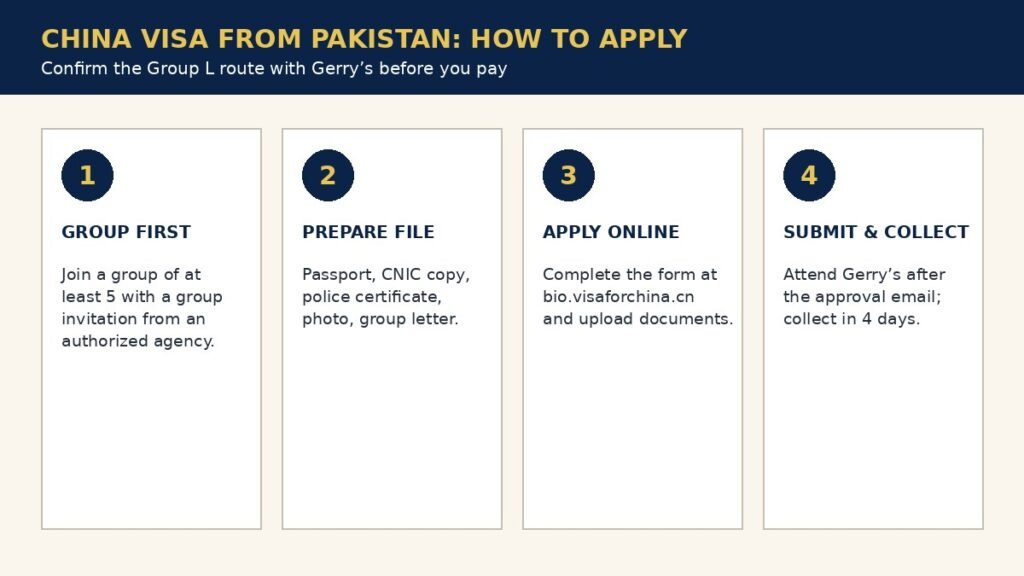
Step 1: Settle your group and itinerary first
Before you touch the online form, settle the question the whole application turns on: are you travelling as part of a group of at least five, and which authorized Chinese travel agency is issuing the group invitation? If you are joining an organized tour, your Pakistani travel agency should confirm the Chinese agency, the group invitation and the itinerary in writing. If you are forming your own group of family and friends, the agency arranging the tour must still obtain the group invitation from the authorized tourism office in China. Do not book non-refundable flights until the group invitation is in hand.
Step 2: Complete the online form and upload everything
Visit the China Online Visa Application System at bio.visaforchina.cn. Read the online instructions carefully and complete the form item by item, exactly as your passport personal information page shows it. Names, dates of birth, nationality and passport numbers must match the passport, or the application will be returned. Upload a standard coloured digital ID photograph, recently taken, 2-inch size, against a white background, and upload all the application documents. Gerry’s and the Embassy review the documents online and return cases with visible deficiencies, so a careful upload saves you a wasted trip to the centre. Fill in the inviting organization correctly: for visa types with an inviting organization, the form asks for the organization’s name exactly as it appears on its legal business licence in China, not the name of an individual contact. If any item does not apply to you, give the reason the online system asks for rather than leaving it blank.
Step 3: Wait for the Online Visa Approved email
Do not go to the centre before you receive the “Online Visa Approved” email. The online approval is the signal that your documents have passed the initial review and that the centre is ready to receive your passport and originals. If your case is returned online, supplement the documents and make the adjustments advised, and remember that a resubmission is treated as a new application for processing-time purposes.
Step 4: Submit your passport and originals at Gerry’s
Take your passport, the Visa Application Certificate and all original documents to the Gerry’s centre for your consular district. Fingerprints are collected under the Embassy’s fingerprint rules, described below, so the applicant should attend as instructed by the centre. Pay the centre’s service fee and keep the pick-up form, which states your collection time. The centre forwards your passport to the Embassy; the centre itself does not decide the application, and its staff cannot promise approval.
Step 5: Wait four working days, then collect and check
The Embassy generally needs four working days to process the application after receiving the passport, and it does not provide a fast service. Processing may take longer if documents must be supplemented or an interview is required. Collect your passport at Gerry’s at the pick-up time on your form. For special cases the pick-up time is uncertain, and Gerry’s will notify you by telephone, so do not miss the call. At the counter, check the visa information immediately: your name, passport number, visa type, validity window, permitted stay and number of entries. Raise any error with the staff at once, before you leave the centre.
Where to Submit: Consular Districts
China divides Pakistan into consular districts, and you must apply through the centre for the district where you permanently reside. Submitting in the wrong district is a wasted journey.
| Your permanent residence | Responsible mission | Gerry’s centre to attend |
|---|---|---|
| Islamabad, Rawalpindi, Khyber Pakhtunkhwa, Gilgit-Baltistan | Embassy of China in Islamabad | Islamabad: Gerry’s Building, Park Road, adjacent to Punjab Cash and Carry, Islamabad |
| Sindh, Balochistan | Consulate General of China in Karachi | Karachi centre (confirm the current address with Gerry’s on 051-8439385 before travelling) |
| Punjab, except Rawalpindi | Consulate General of China in Lahore, handled on Lahore’s behalf by the Embassy in Islamabad | Lahore: 20, Ex American Centre Building, Queen’s Road, opposite Ganga Ram Hospital, Lahore 54000 |
Gerry’s centres are open from 9:00 to 15:00, Monday to Friday, excluding holidays. The central helpline is 051-8439385, and the online system is at bio.visaforchina.cn. Centre addresses and hours change, so confirm the Karachi centre address and the current opening hours on the helpline before you travel, especially if you are coming from another city.
Fingerprints: What to Expect
Under the Embassy’s instruction, fingerprints have been collected from all applicants, including Pakistani citizens, since 15 June 2018, under Chinese law. The exemptions listed by the Embassy are: applicants under 14 or over 70 years old; holders of diplomatic passports or applicants meeting the requirements for Chinese diplomatic, service or official or courtesy visas; applicants who have had their fingerprints collected with the same passport at the same location within the past five years, counting from 22 October 2018; and applicants whose ten fingers are all mutilated or whose fingerprints cannot be collected. Some 2026 guides report a temporary exemption from fingerprint collection for short-term visas of 180 days or less until 31 December 2026. That report conflicts with the Embassy instruction’s general collection rule, and this guide does not treat either version as settled. Plan to attend in person and to give fingerprints, and confirm the position for your appointment with Gerry’s when you book. If you have given fingerprints with the same passport at the same centre within the past five years, mention it and carry the previous visa record.
Common Reasons for Refusal
The Embassy publishes its common refusal reasons, and they are worth reading as a checklist before you submit, because every one of them is avoidable.
- Dishonest behaviour, including fabricating the purpose of the visit or submitting fake or modified documents.
- Wrong or insufficient information, including an incorrectly filled form, an inviting organization’s name that is wrong, a contact number that cannot be reached, an invitation letter without arrival and departure times, or a seal that does not comply with Chinese law or is found to be forged.
- A mismatch between the stated purpose of the visit and the visa type applied for.
- Insufficient financial resources to cover the stay in China.
- Other circumstances in which the Embassy considers the applicant unsuitable for a visa.
Two further points from the Embassy’s guidance matter. Consular officers may require additional supporting documents and may interview an applicant, and failure to cooperate directly affects the outcome. And under China’s Exit and Entry Administration Law, visa authorities are not obligated to give reasons for a refusal. That makes a first, careful application far cheaper than a refusal followed by a reapplication: a returned or refused application costs you the centre’s service fee again, and it costs you the processing time a second time.
Other Visa Types You May Need Instead
Tourism is not the only reason Pakistanis travel to China, and applying for the wrong category is itself a refusal reason, so match the category to your real purpose.
- Business (M visa): For commercial and trade activities. The key documents are an invitation from a Chinese trade partner, with the strongest forms being an Invitation Letter (TE) or a Verification Letter of Invitation, or, where those are unavailable, an ordinary invitation letter from a real inviting organization in China plus a six-month personal bank statement covering at least USD 100 per day. Canton Fair and China International Import Expo invitation letters are separate recognized circumstances.
- Family visit (Q2 visa): For family members of Chinese citizens or foreigners eligible for Chinese permanent residence, for a short visit of 180 days or less. You need an invitation letter from the inviter, a copy of the inviter’s Chinese national ID card or permanent resident documents, and the original and photocopy of the family relationship certificate, apostilled by the Ministry of Foreign Affairs of Pakistan if issued by a Pakistani government office, plus round-trip itinerary or ticket booking information.
- Visiting relatives in China for work or study (S2 visa): For family members visiting foreigners who reside in China for work or study, for 180 days or less, and also for medical treatment or accompanying a patient. The documents mirror the Q2 pattern: invitation letter, inviter’s passport and residence permit or valid visa, relationship certificate, and round-trip itinerary.
- Longer family and study routes (Q1, S1, X1, X2, Z visas): For stays over 180 days, study and work, the document sets are longer and are set out in the same Embassy instruction. If your trip is really a study or work trip, do not use a tourist application as a shortcut; the category mismatch will be caught, and the consequences last longer than the trip.
For readers planning a wider Asia trip, our companion guides cover the region’s other major destinations. For a second stop in East Asia, see our Japan visit visa from Pakistan guide and our South Korea visit visa from Pakistan guide. For Southeast Asia on the same journey, see our Malaysia visit visa from Pakistan guide, our Thailand visit visa from Pakistan guide and our Singapore visit visa from Pakistan guide.
Practical Tips for a Smooth Application
Apply early. The Embassy itself advises applicants to reserve enough time for communication with the inviting organization, document preparation, submission, flight booking and hotel reservation, and it warns that the applicant bears all losses from changing or cancelling flights and hotels because of a visa refusal or delay. A sensible timetable is to start the police character certificate at least a month before you intend to submit, and to submit the online application at least three weeks before travel, so that a returned case still leaves room for a resubmission inside the four-working-day processing window.
Keep every document consistent. The name on the form, the passport, the CNIC copy, the group invitation and the flight booking must all agree. If a name differs between documents because of a name change, carry the apostilled name-change certificate the Embassy requires.
Do not buy a fake invitation. The Embassy checks seals against Chinese legal requirements, and a forged seal is a refusal reason that also raises a dishonesty flag. A legitimate group invitation comes from the authorized tourism office in China through a real travel agency, and it costs you nothing separate from the tour itself. Any seller offering a standalone invitation letter for cash, without a tour, should be treated as a risk, not a shortcut.
Travel with copies. Carry a photocopy of your passport information page, your visa page, your group invitation and your pick-up form separately from your passport while you are in China, and keep the originals in your hotel safe when you are out sightseeing. If your passport is lost, the copy and the group tour operator’s contact will make the embassy and police process far faster.
Check the visa on collection, and check the entry stamp on arrival. Chinese border officers stamp the entry date, and your permitted stay runs from the visa’s terms, not from a guess. If anything on the visa looks wrong, raise it at the Gerry’s counter before you leave, and if anything at the border looks wrong, raise it politely with the officer before you walk away from the desk.
Frequently Asked Questions
Do Pakistani citizens need a visa for China?
Yes. Pakistani ordinary passport holders need a visa before travelling to China. Pakistan is not on China’s unilateral visa-free list, and there is no visa on arrival for tourism.
Is China visa-free for Pakistanis from November 2026?
No. The November 2025 visa-free extension, effective 10 November 2025 and running to 31 December 2026, covered 45 countries and did not include Pakistan. A further list published in February 2026 covers 50 countries, again without Pakistan. Do not travel on the basis of social media posts claiming otherwise.
What is a Group L visa?
Group L is the tourist visa category listed in the Chinese Embassy in Pakistan’s instruction for applicants in Pakistan. It is issued to tourists visiting China in a group of at least five people, supported by an Invitation Letter for Tourist Group issued by the duly authorized tourism office in China.
Can a Pakistani apply for an individual tourist visa to China?
The Embassy’s published Pakistan instruction lists only Group L for tourism. Some secondary guides describe individual applications through the online system, but that is not settled by the Embassy’s published table. Confirm with Gerry’s on 051-8439385 before booking non-refundable travel or paying an agent who promises an individual tourist visa.
How much does a China visa cost for a Pakistani?
The Chinese visa fee itself is exempt for Pakistani ordinary passports, so it is PKR 0. You pay Gerry’s service fee instead. The reported centre table is PKR 13,200 for regular service in Islamabad and Karachi, PKR 19,800 for faster service there, and PKR 13,300 for regular service in Lahore. Confirm the current fee with Gerry’s before paying, because the Embassy directs applicants to the centre for the fee structure.
How long does a China visa take from Pakistan?
The Embassy generally needs four working days after receiving the passport, and it does not offer an urgent or extra urgent service. Allow extra time for the police character certificate, the online review, and any resubmission if your case is returned.
Where do I submit my China visa application in Pakistan?
Through Gerry’s Chinese Visa Application Service Center, in the centre for your consular district: Islamabad for Islamabad, Rawalpindi, Khyber Pakhtunkhwa and Gilgit-Baltistan; Karachi for Sindh and Balochistan; Lahore for Punjab except Rawalpindi. The online form is completed first at bio.visaforchina.cn, and you attend the centre after receiving the Online Visa Approved email.
Do I need a police character certificate for a China visa?
Yes, if you are aged 10 or above. The Embassy requires a valid police character or clearance certificate covering the period since birth until now. If it has no verifiable QR code, it must be apostilled by the Ministry of Foreign Affairs of Pakistan. Applicants under 10 are exempt.
Do I need to give fingerprints?
Under the Embassy’s instruction, fingerprints have been collected from applicants including Pakistani citizens since June 2018, with exemptions for children under 14, adults over 70, diplomatic passport holders, applicants fingerprinted with the same passport at the same location within the past five years, and applicants whose fingerprints cannot be collected. Some 2026 guides report a temporary short-stay exemption until 31 December 2026; confirm the position with Gerry’s for your appointment.
Can I work or study on a Group L tourist visa?
No. Group L is a tourist visa. Employment and study require the proper work or study visa categories, and working on a tourist visa can lead to fines and future refusals.
What happens if my application is refused?
The centre’s service fee is not refunded, because the decision is the Embassy’s. A returned application treated as a new application has its processing time recalculated. Visa authorities are not obligated to give refusal reasons, so submit a careful, consistent and genuine application the first time.
Official Sources
- Embassy of China in Pakistan, Instruction for Chinese Visa Application
- Embassy of China in Pakistan, Visa Processing Time and Fee (28 April 2025)
- Consulate General of China in Karachi, Visa Processing Time and Fee (11 June 2025)
- Consulate General of China in Lahore, Notice on Chinese Visa Accepted by the Gerry’s Visa Center in Lahore
- China Online Visa Application System
- China Ministry of Foreign Affairs visa-free policy extension (November 2025, 45 countries to 31 December 2026, Pakistan not included), as reported by RNZ and Bloom Pakistan from the Foreign Ministry briefing.
Disclaimer
TourPointGo is an independent visa-information website. It is not a government authority, embassy, consulate, visa centre, travel agency or immigration law firm, and it has no role in visa decisions. Visa rules, centre fees and procedures change, and the Chinese Embassy in Pakistan and Gerry’s Chinese Visa Application Service Center are the final authorities for your case. Confirm your visa category, the current service fee and the centre address with Gerry’s on 051-8439385 before you pay or travel. Information in this guide was checked on 31 October 2026. A visa does not guarantee entry; the final entry decision rests with Chinese border officers on arrival.