Oman is the Gulf at a gentler pace: whitewashed Muscat beneath rugged mountains, the Mutrah Corniche at sunset, the frankincense scent of Mutrah Souq, the vast white marble of the Sultan Qaboos Grand Mosque, and, further afield, the dunes of Wahiba Sands and the green Khareef season of Salalah. It is also a short flight from Karachi, Lahore or Islamabad, which makes it a natural next trip for readers who have already visited the UAE, Saudi Arabia, Qatar or Bahrain. The visa side of the trip needs more care than the flight booking, because Oman runs several different visitor routes and the right one depends on your nationality, your residence and your purpose of travel. This guide explains each route, what it costs, what to prepare, and the one check you must make before you pay anyone anything.
The short version is this. Pakistani ordinary passport holders need a visa for Oman. There is no visa-free entry and no general visa on arrival for ordinary Pakistani passports. Oman’s Ministry of Foreign Affairs states that visitors from more than 100 countries are exempt from entry visas for stays of up to 14 days, and that nationals of the Gulf Cooperation Council states (Bahrain, Kuwait, Qatar, Saudi Arabia and the United Arab Emirates) do not require visas at all. Pakistan is in neither group, so a Pakistani traveller must hold an approved visa before travelling. For tourists, the Ministry points to the Tourist Visit Visa (Unsponsored) as the usually appropriate category, and it states that the process of obtaining a visa for visitors to Oman is managed by the Royal Oman Police (ROP), with applications made through the ROP eVisa website. That portal is therefore your first stop, not a travel agent’s payment page.
One honesty note runs through this guide, and it matters. On 30 October 2026 the ROP eVisa portal itself was checked and found to be displaying a maintenance notice, so the portal’s live visa-type and fee screens could not be opened on the day of writing. The fee figures below are the ROP fee table as consistently reported across independent guides that reproduce it: OMR 5 for a 10-day tourist visa, OMR 20 for a 30-day tourist visa and OMR 50 for a one-year multiple-entry tourist visa. Those figures agree with each other across sources, but they are reported figures, not figures read off the live portal on 30 October 2026. Before you pay, open the portal at evisa.rop.gov.om, select Pakistan as your nationality, and confirm the visa types and fees it offers for your own case. If the portal offers a different type or fee, the portal governs. The same check settles the question that secondary sources answer differently for Pakistan, namely whether the unsponsored tourist eVisa is offered directly to applicants in Pakistan or whether your case is routed through a sponsor or the embassy. Do not pay a third-party site that promises a visa category the portal does not offer you.

Key Facts at a Glance
| Item | Detail |
|---|---|
| Visa needed for Pakistani ordinary passport holders | Yes, arranged before travel |
| Visa-free entry | No; only Gulf Cooperation Council nationals are exempt, and a separate 14-day exemption covers more than 100 other countries, not Pakistan |
| Visa on arrival for Pakistanis | No general visa on arrival for ordinary Pakistani passports; arrange the visa in advance |
| Main route for tourists | Tourist Visit Visa (Unsponsored) through the Royal Oman Police eVisa portal, subject to the portal check described above |
| Reported official fees (ROP fee table as reported across guides; confirm on the portal before paying) | 10-day tourist visa OMR 5; 30-day tourist visa OMR 20; one-year multiple-entry tourist visa OMR 50 |
| Passport validity | At least 6 months from your date of entry |
| Processing time (as reported) | Commonly 1 to 5 working days for an online tourist visa; apply at least 2 weeks before travel |
| Work on a visit visa | Not permitted |
| Official sources | Oman Ministry of Foreign Affairs entry visas page; Royal Oman Police eVisa portal |
| Information checked | 30 October 2026, including the portal maintenance notice on that date |
Do Pakistanis Need a Visa for Oman?
Yes. Start from the official framework, because it rules out the two shortcuts first. Oman’s Ministry of Foreign Affairs explains that visitors from more than 100 countries and regions are exempt from entry visas for stays of up to 14 days, and it lists the Gulf Cooperation Council countries separately as states whose citizens do not require visas to enter Oman. A Pakistani ordinary passport is neither a GCC passport nor a passport of one of the exempt countries, so neither exemption applies. There is also no general visa-on-arrival arrangement for ordinary Pakistani passports of the kind some social media posts suggest. Arriving in Muscat without an approved visa risks refusal of boarding by your airline in Pakistan, or refusal of entry on arrival.
That leaves the advance routes, and the tourist route is the one most readers of this guide will use. The Ministry states that for those coming to Oman as tourists, the Tourist Visit Visa (Unsponsored) will usually be appropriate, and that citizens of other nationalities can establish their visa options on the portal. In practice, the portal, not a blog or an agent, decides the category for your nationality and residence. If the unsponsored tourist visa is offered to you, that is your route. If it is not, the sponsored and embassy routes described below are the fallback, and they must also be arranged before travel.
A separate point for readers who already hold another visa: holding a valid visa or residence permit for the United States, the United Kingdom, Canada, a Schengen country, Australia or Japan is sometimes described as opening an Omani eVisa or a short visa-free stay for some nationalities, but it does not by itself create a visa-free right for a Pakistani passport. Mention it accurately, and let the portal determine what, if anything, it changes for your case. Do not travel on the assumption that a US, UK or Schengen visa alone admits you to Oman.
Oman Visit Visa Types and Fees
Oman’s tourist visas come in three lengths, and choosing the right one saves real money. A single short break needs only the cheapest type, while a traveller who returns frequently is usually better served by the one-year multiple-entry visa than by buying a new single-entry visa for every trip.
| Visa type | Stay allowed | Reported fee (OMR) |
|---|---|---|
| Tourist visit visa, single entry | Up to 10 days | 5 |
| Tourist visit visa, single entry | Up to 30 days | 20 |
| Tourist visit visa, multiple entry, one year validity | Up to 30 days per visit | 50 |
The 10-day visa is not extendable in the reports, while the 30-day single-entry visa is described as extendable once for a further 30 days, subject to approval before expiry. The one-year visa allows repeated visits during its validity, with each visit limited to 30 days; it does not mean a one-year stay.
Omani rials are a strong currency, so convert before you judge the price. At the approximate rate of OMR 1 to USD 2.60, OMR 5 is roughly USD 13, OMR 20 is roughly USD 52 and OMR 50 is roughly USD 130. The bank or card rate on the day decides the exact rupee figure, and this guide does not state a fixed rupee total. Fees are paid online in Omani rials on the portal at the time of application, and government fees are generally not refunded if the visa is refused. If a website quotes far above these figures before any service charge, it is adding a markup; ask for a written breakdown. Apply directly on the official portal wherever your case allows, and treat similarly named sites as private agents, not as the Royal Oman Police.
Validity is a second point that causes confusion. Guides report that the 10-day visa is valid for entry for one month from issue, and that the 30-day visa is valid for entry for six months from issue. Those windows are entry windows, not the length of stay. Your approval states its exact dates. Enter inside the validity window, stay inside the permitted stay, and keep a printed copy of the approval with your passport.
The GCC Resident Route: If You Already Live in the Gulf
A large share of Pakistani readers of this guide do not live in Pakistan at all. They live in Saudi Arabia, the United Arab Emirates, Qatar, Kuwait or Oman itself, and that residence changes the route. If you already live in the Gulf, read this section before you apply as an ordinary tourist from Pakistan.
Under the GCC resident route, a Pakistani national holding a valid residence permit from another Gulf state may qualify for an unsponsored GCC resident tourist eVisa through the ROP portal, provided the occupation shown on the residence permit is on Oman’s approved-professions list, generally professional and managerial roles. Guides describe the GCC resident stay as up to 28 days, with an extension of a further week in some reports, and the route is presented as faster than a sponsored application for those who qualify. If your profession is outside the approved list, or your permit is close to expiry, do not assume the GCC route is automatic; the fallback is a sponsored tourist visa or the standard route as shown by the portal.
If you are a Pakistani resident of the Gulf, carry the residence permit itself, not just a photograph of it, and check its expiry date and profession against the portal’s GCC resident conditions before you travel.
For a Doha stop on the same trip, see our Qatar visit visa from Pakistan guide, for the sponsor-based system across the water, see our UAE visit visa from Pakistan guide, and for the online platform of the island neighbour, see our Bahrain visit visa from Pakistan guide.
Sponsored, Family, Business and Transit Routes
Not every visit to Oman is a tourist trip, and the sponsored routes cover the rest. A family visit visa is sponsored by an Omani citizen or resident relative; the host acts as sponsor and submits supporting documents through the eVisa system, and the exact validity is set case by case under the sponsorship terms. A business visit, often described as an express visa, is sponsored by an Omani company for meetings, conferences and short business activities, usually valid for around 21 days in reports, and generally not extendable. A short transit visa, commonly described as valid for up to 72 hours, covers a layover only.
The practical difference between the sponsored and unsponsored routes is who starts the application. For an unsponsored tourist visa, you apply yourself. For a sponsored visa, your sponsor in Oman begins the process and you supply your passport, photograph and supporting documents. Never pay a stranger offering to act as sponsor for a fee without verifying them through the embassy or a licensed agency, and never let a sponsor hold your original passport for longer than is genuinely required. If no sponsor route fits and the portal does not offer you an unsponsored visa, the remaining channel is the Embassy of Oman in Islamabad.
Documents Required
Prepare your file before you start the application, because a missing document is the most common cause of delay. Every item should match your passport exactly.

- Passport valid for at least 6 months from your date of entry, with blank pages for entry stamps, plus a clear scan of the bio-data page.
- Recent passport-style photograph, in colour, on a plain background, taken within the last 6 months.
- Confirmed return or onward ticket.
- Accommodation proof: a hotel booking for the full stay, or, for a family visit, your host’s details and invitation or sponsorship documents.
- Proof of sufficient funds for the trip, such as a recent bank statement, where the portal or sponsor asks for it.
- A working email address, because the approved eVisa is sent to the email registered on the portal, and a debit or credit card for the online fee.
- For applicants applying from outside Pakistan, or under the GCC resident route, a valid residence permit for the country you are applying from.
Names, dates of birth and passport numbers must match across every document. A single letter’s difference can cause refusal at check-in, and correcting a name on an approved eVisa usually means a new application. Each child needs their own application and fee, and a child travelling with one parent or alone may be asked for additional consent documents; check the portal’s requirements for minors.
How to Apply: Step by Step
The online route, where the portal offers it for your case, follows the same pattern as other Gulf eVisa systems. Work through the steps in order, and stop at the first step that does not match your case rather than forcing the form to fit.
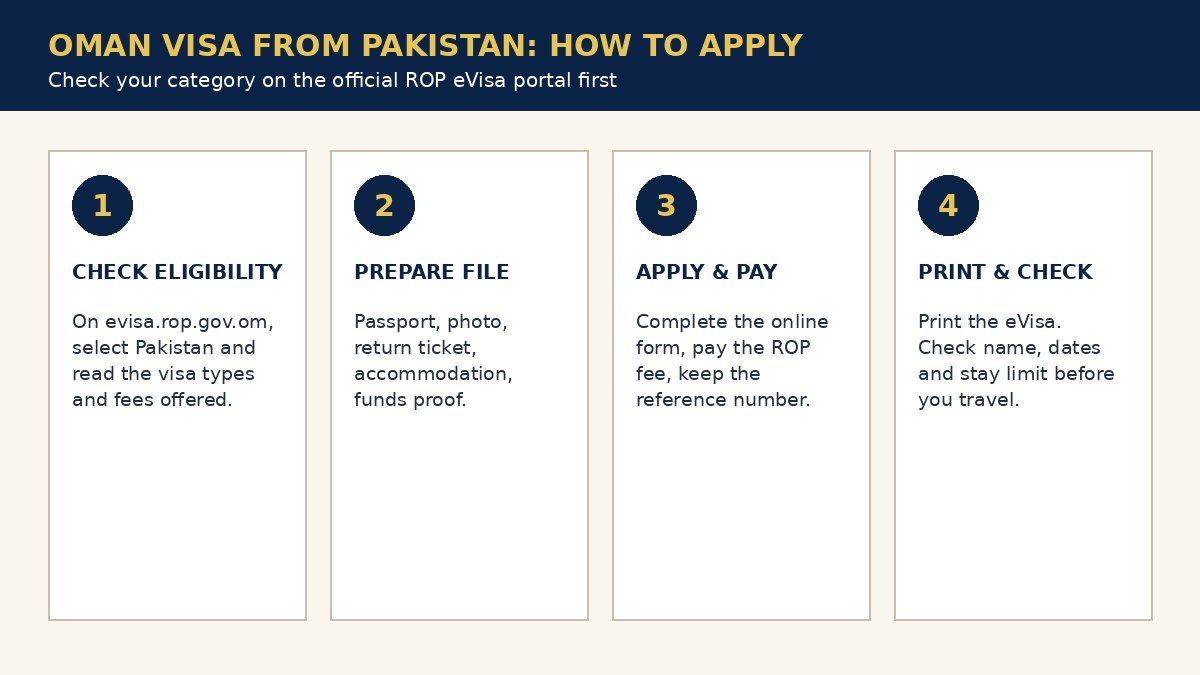
- Confirm your category. Open the ROP eVisa portal at evisa.rop.gov.om and enter your nationality and residence; read the types offered, and choose the 10-day, 30-day or one-year tourist visa that matches your trip. If the portal is under maintenance, as it was on 30 October 2026, wait and recheck before paying anyone.
- Create your account and complete the form. Register with an email address you check regularly, then enter your personal details, passport information and travel plans exactly as they appear in your passport.
- Upload your documents. Submit a clear scan of your passport bio-data page, your photograph, and any accommodation, ticket or funds documents the form asks for.
- Pay the fee online. Pay the exact fee the portal shows for your chosen type, in Omani rials, by debit or credit card. Keep your payment receipt and application reference number.
- Wait for the decision. Guides report 1 to 5 working days for an online tourist visa, with some reports saying 1 to 3 working days or up to 48 working hours. Apply at least 2 weeks before travel.
- Check, print and carry. When the approval arrives by email, check your name, passport number, visa type, validity window and permitted stay. Print the eVisa and carry it with the passport you applied with, plus your return ticket and accommodation proof.
If your case is sponsored, the order changes at step 1: your sponsor in Oman submits the application through the eVisa system and you supply the documents. If neither the portal nor a sponsor route fits your case, contact the Embassy of Oman in Islamabad before booking a non-refundable flight.
Processing Time, Extensions and Overstaying
Processing time is the part of the plan most travellers underestimate. The online tourist visa is commonly reported to take 1 to 5 working days, so the safest planning assumption is the long end of that range. Apply at least 2 weeks before travel, and do not book a non-refundable flight until the approval is in your inbox. A weekend or public holiday in Oman, or an incomplete file or photograph, can add days.
If you need more time in Oman, apply for an extension before your visa expires, not after. The Royal Oman Police provides a visit-visa extension service; guides summarising the official service describe a fee of OMR 20 for a visit-visa extension, with the permitted extra stay depending on the visa type: a sponsored tourist visa valid for 30 days is described as extendable for a similar period, while other categories are decided case by case. The 10-day visa is described as not extendable. Extensions are not automatic.
Overstaying is expensive and it follows you. Guides report an overstay fine of OMR 10 per day, payable before departure, and repeated overstays can affect future applications. Set a reminder two days before your permitted stay ends, and apply for an extension or leave before that date. If you have already overstayed, use the official exit-penalty process and contact the Royal Oman Police for case-specific guidance. The eVisa call centre numbers published by the Ministry of Foreign Affairs are 80080011 toll-free inside Oman, and +968 22848200 from outside Oman.
What a Visit Visa Does Not Allow, and Common Mistakes
A visit visa is a permission to visit, not a permission to live or work in Oman. Paid work, even short-term or informal work, is not permitted, and working can lead to deportation and a ban. Study, long-term residence and employment each need their own category and sponsor; a visit visa cannot be converted into a residence visa from inside Oman. Do not follow advice to enter on a visit visa and sort out a work permit later.
The common mistakes are avoidable, and most of them happen before the application is even submitted: applying on a third-party site that charges several times the government fee; assuming visa on arrival, which is the most serious mistake and can end the trip at the departure airport; a wrong passport number or a name that does not match the passport; a hotel booked for fewer nights than the stay requested; and a passport with less than 6 months’ validity. Check each one before you pay, and check the approval on the day it arrives.
Oman rewards the traveller who gets the paperwork right: a calm capital, a coastline that runs from fishing harbours to empty beaches, mountain wadis, desert nights, and a souq culture traded with South Asia for centuries. Get the category right, confirm the fee on the portal before you pay, and travel inside the stay allowed.
Frequently Asked Questions
Do Pakistani citizens need a visa for Oman?
Yes. Ordinary Pakistani passport holders need an approved visa before travelling. Pakistan is not covered by the GCC exemption or by the 14-day exemption for more than 100 other countries, and there is no general visa on arrival.
Can Pakistanis apply for an Oman eVisa online?
Oman’s visa process is managed by the Royal Oman Police through its eVisa portal at evisa.rop.gov.om. The Ministry directs travellers there to establish the options for their nationality. Select Pakistan, read the types offered, and confirm them before paying. On 30 October 2026 the portal was under maintenance.
How much does an Oman tourist visa cost for Pakistanis?
The ROP fee table as consistently reported across guides is OMR 5 for a 10-day tourist visa, OMR 20 for a 30-day tourist visa and OMR 50 for a one-year multiple-entry tourist visa, roughly USD 13, USD 52 and USD 130 respectively. Confirm the exact fee on the portal before paying.
How long does an Oman eVisa take?
Guides report 1 to 5 working days for an online tourist visa. Apply at least 2 weeks before travel so a delay does not become a missed trip.
How long can I stay in Oman on a tourist visa?
Up to 10 days on the 10-day visa, up to 30 days on the 30-day visa, and up to 30 days per visit on the one-year multiple-entry visa. The validity window for entry and the permitted stay are different dates, and both are printed on your approval.
Can I extend my Oman tourist visa?
The 30-day visa is described as extendable once for a further 30 days, subject to approval before expiry. The ROP visit-visa extension service is described with a fee of OMR 20. The 10-day visa is described as not extendable. Apply before expiry.
What happens if I overstay in Oman?
Guides report a fine of OMR 10 per day, payable before departure, and repeated overstays can affect future applications. Apply for an extension or leave before your permitted stay ends.
Can I work in Oman on a visit visa?
No. Paid work is not permitted on a tourist or visit visa. Employment needs its own sponsored work visa before you start work.
What if I already live in a Gulf country?
Pakistani residents of a Gulf state may qualify for an unsponsored GCC resident tourist eVisa through the ROP portal, provided the occupation on their residence permit is on the approved-professions list. Check the portal’s conditions, and carry the residence permit itself.
Do I need a sponsor to visit Oman?
Not necessarily. The Tourist Visit Visa (Unsponsored) is designed for tourists who apply themselves, where the portal offers it. Family and business visits are sponsored routes. If neither route fits your case, contact the Embassy of Oman in Islamabad before travel.
Sources and Disclaimer
Official sources checked on 30 October 2026: Oman Ministry of Foreign Affairs, Entry visas page, which states the 14-day exemption for more than 100 countries, the Gulf Cooperation Council exemption, that the Royal Oman Police manages the process, and that tourists usually use the Tourist Visit Visa (Unsponsored); and the Royal Oman Police eVisa portal, which on 30 October 2026 displayed a maintenance notice and could not be used to verify visa types, fees or processing times on that date.
The fee, processing-time, extension and overstay figures in this guide are the ROP fee table and service terms as consistently reported across independent guides, and they must be confirmed on the portal before payment. Fees and categories can change without notice.
TourPointGo is an independent visa-information website, not a government authority, embassy, travel agency or immigration adviser. This guide explains the published rules as checked on 30 October 2026. It is not legal advice and does not guarantee approval. Always confirm your category, fee and documents on the official portal or with the Embassy of Oman before travel, and never travel on an unverified promise from a third-party website.