Introduction
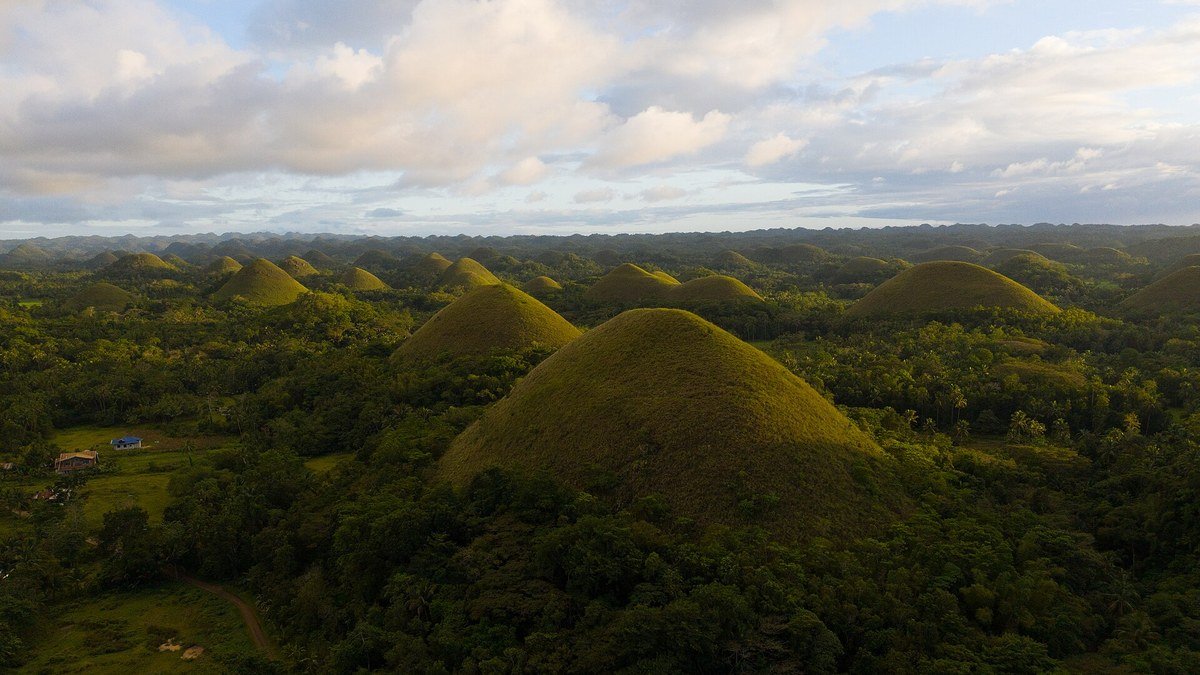
The Philippines is an easy country to dream about and a careful country to plan for. Palawan’s lagoons, the Chocolate Hills of Bohol, the rice terraces of Banaue and the beaches of Boracay sit within one archipelago of more than 7,000 islands, and the distances between them reward a traveller who books flights and hotels in a sensible order. For a Pakistani passport holder, the planning starts earlier than the packing, because a visa must be obtained before travel, in person, from the Philippine Embassy in Islamabad or from a Philippine honorary consulate in Lahore or Karachi.
This guide follows the route as the Embassy in Islamabad itself publishes it. The visa most tourists need is the 9(a) Temporary Visitor’s Visa, issued for pleasure, which covers sightseeing, leisure, recreation and visiting family and friends. It is a sticker visa placed in the passport. It is not a visa on arrival, and it is not an online-only process from Pakistan. The application is prepared through the online visa application system, printed, and then submitted by personal appearance with original documents.
Two points in this guide deserve attention before anything else. First, the Embassy states that the maximum period of stay it grants to temporary visitor’s visa applicants is 30 days, with any longer stay handled by extension through the Bureau of Immigration inside the Philippines. Plan the trip around 30 days unless an extension is genuinely part of the plan. Second, the Embassy’s published visa page does not carry a fee schedule in the text available at the time of writing, and Pakistan-focused guides disagree on the single-entry fee. This guide therefore gives the reported fee range, labels it clearly as reported, and tells readers to confirm the exact amount with the Embassy before paying.
Key facts at a glance
| Item | Detail for Pakistani applicants |
|---|---|
| Visa needed | Yes, before travel. No visa on arrival for Pakistani ordinary passport holders. |
| Visa type | 9(a) Temporary Visitor’s Visa, for pleasure (tourism and leisure). |
| Where to apply | Philippine Embassy, Islamabad, by personal appearance. Honorary Consulates General in Lahore and Karachi also accept applications. |
| Application system | Online Visa Application System at visa.gov.ph, then print and submit in person. |
| Maximum stay granted by the Embassy | 30 days. Longer stays require an extension from the Bureau of Immigration. |
| Regular processing, Islamabad | 9 working days. |
| Expedite processing, Islamabad | 7 working days. |
| Regular processing, Lahore and Karachi | 11 working days. |
| Expedite processing, Lahore and Karachi | 9 working days. |
| Apply at least | 15 working days before the intended departure date. |
| Passport validity | At least 6 months beyond the contemplated period of stay. |
| Fee | Reported, not published on the Embassy visa page: single entry around PKR 12,000 to PKR 15,000, 6-month multiple entry PKR 24,000, 1-year multiple entry PKR 36,000. Confirm before paying. |
| Before departure | Complete the eTravel registration within 72 hours before arrival. |
Do Pakistanis need a visa for the Philippines?
Yes. Pakistani citizens holding ordinary passports need a visa before travelling to the Philippines for tourism. Pakistan does not appear on the Embassy in Islamabad’s published list of nationalities that may enter without a visa for a stay of up to 30 days, and no visa-on-arrival route exists for Pakistani tourists.
One exception is sometimes confused with a general exemption, and it is worth separating clearly. Former Filipinos and their immediate family members may use the Balikbayan visa-free privilege and stay for up to one year without a visa. That privilege belongs to former Filipinos and their families. It does not give a Pakistani tourist without that connection a visa-free entry, and it should not be relied on by ordinary holidaymakers.
A visa also does not guarantee entry. The Embassy’s own guidance is plain that submission of an application and receipt of documents is not a guarantee that a visa will be issued, and admission at the Philippine port of entry remains subject to immigration control by the Bureau of Immigration. Travellers should therefore keep their return or onward ticket ready to present to the immigration officer on arrival, as the Embassy instructs.
Which visa: the 9(a) Temporary Visitor’s Visa
Philippine visas are organised by category, and the tourist route is the 9(a) visa. The Embassy in Islamabad describes the 9(a) visa as covering temporary visitors, and for tourists the relevant purpose is pleasure: sightseeing, amusement, sports and recreation, health reasons, or visiting family and friends.
The same 9(a) category also covers business visitors, medical treatment, training, conferences, meetings, workshops and seminars, but those purposes carry their own additional documents, such as an invitation letter from the organiser or a letter of endorsement from an employer. This guide focuses on the pleasure route. Travellers whose real purpose is paid work, long-term study or settlement need a different visa category altogether, and applying as a tourist for a work purpose is a fast route to a refusal.
Within the 9(a) visa, there are single-entry and multiple-entry options. The Embassy in Islamabad issues single-entry visas and multiple-entry visas valid for 6 months or one year, but multiple-entry visas for 6 months and one year are subject to approval by the Department of Foreign Affairs in Manila. That approval step is a practical reason to apply early if multiple entry is genuinely needed, rather than assuming a multiple-entry visa will be ready on the same timetable as a single-entry one.
What the visa allows, and what it does not allow
A 9(a) visa for pleasure allows a short tourist stay in the Philippines for the purpose stated in the application. It allows sightseeing, leisure travel, recreation and visiting family and friends. It does not allow paid employment in the Philippines, and it is not a route to residence.
The stay is the point most often misunderstood. The Embassy in Islamabad states, in a note on its visa page, that the authorised maximum period of stay granted by the Embassy to all temporary visitor’s visa applicants is 30 days, and that an applicant who will stay beyond 30 days must file an application for extension of stay at the Bureau of Immigration in Manila or at the immigration office nearest to the place where the applicant is temporarily residing.
Readers may see a figure of 59 days in other Philippine embassy guidance. That figure appears in guidance from other Philippine posts, which describe 59 days as the maximum period of stay given at the port of entry by the Bureau of Immigration, and as the maximum per stay for visas they issue. It is not the figure the Islamabad embassy gives for the stay it grants. The safe reading for an applicant in Pakistan is therefore this: plan on the Embassy’s 30-day grant, and treat any longer stay as something to arrange by extension through the Bureau of Immigration after arrival, not as something the Islamabad visa automatically provides.
Validity and stay are different things, and confusing them causes missed flights. Validity is the window in which the visa may be used to enter. Stay is how long the holder may remain after entry. A single-entry visa valid for 3 months does not mean a 3-month stay. The stay is the period stamped or granted on entry, within the Embassy’s 30-day rule.
Fees: what is confirmed and what is reported
This section separates confirmed facts from reported figures, because the fee position for Pakistan is unusually messy and readers lose money when guides blur the two.
What the Embassy in Islamabad publishes: its visa page gives processing times, submission windows and requirements in detail, but the fee schedule does not appear in the published visa page text checked for this guide. The Embassy also publishes one specific fee on the same page: where an affidavit of support and consent for a minor is notarised by a consular officer, the notary fee is USD 25, or PKR 7,500.
What Pakistan-focused guides report for the main visa fees: a single-entry visa valid for 3 months is reported at PKR 12,000 by some guides and PKR 15,000 by others, a 6-month multiple-entry visa at PKR 24,000, a 1-year multiple-entry visa at PKR 36,000, and expedite processing at an additional PKR 4,000. Those figures are consistent across several guides for the multiple-entry options and the expedite addition, but they conflict on the single-entry fee, which is exactly why this guide presents them as reported rather than official.
| Visa option | Reported fee | Status |
|---|---|---|
| Single entry, valid 3 months | PKR 12,000 to PKR 15,000 | Reported; guides conflict, confirm with the Embassy |
| Multiple entry, valid 6 months | PKR 24,000 | Reported; subject to Department of Foreign Affairs approval in Manila |
| Multiple entry, valid 1 year | PKR 36,000 | Reported; subject to Department of Foreign Affairs approval in Manila |
| Expedite processing | Additional PKR 4,000 reported | Reported; confirm with the Embassy |
| Notary fee for a minor’s affidavit, if notarised by a consular officer | USD 25 / PKR 7,500 | Published on the Embassy visa page |
Practical advice follows from that table. Confirm the exact fee with the Embassy, or with the Lahore or Karachi consulate where the application will be lodged, before paying. Keep the official receipt issued on submission of complete requirements, because the release date is based on that receipt. Do not pay an agent a large service charge on the promise that the fee includes guaranteed approval, because no payment to any intermediary changes the Embassy’s decision, and the Embassy states plainly that submission is not a guarantee of issuance.
Documents required

The Embassy in Islamabad requires original supporting documents, not photocopies alone, and incomplete applications are returned. The basic requirements for a 9(a) tourist visa are listed below, followed by the additional documents that depend on the applicant’s situation. Every document that is not in English should be accompanied by an English translation, and the application form itself must be typewritten or printed in block capitals in black or dark blue ink, with no blank left unfilled.
Basic requirements
- Two copies of the accomplished online application, completed through visa.gov.ph, generated from the system and printed by the applicant. Incompletely filled forms are returned.
- Passport valid for at least 6 months beyond the contemplated period of stay in the Philippines.
- Personal appearance by the applicant. Applications by mail are not accepted.
- One copy of itinerary flight details, expressly not a ticket, valid for travel to the Philippines and for the subsequent return to the country of origin or onward to the next destination, including a valid visa for that destination if one is required. The return or onward ticket itself must be presented to the Philippine immigration officer on entry.
- Original bank statement, attested by the Ministry of Foreign Affairs of Pakistan.
- Two photocopies of the relevant pages (information pages) of the passport.
- Two passport-size photographs of the applicant, taken within the last 3 months, pasted in the designated box on the application form. A scanned photograph is not acceptable.
- Original police character certificate or clearance, issued by the authorities at the applicant’s place of residence or business, issued not more than 6 months before the visa application, and attested by the Ministry of Foreign Affairs.
- One copy of hotel booking.
- Any other supporting documents the consular officer may require after evaluating the application.
Additional documents by situation
For pleasure, where the traveller is visiting family or friends or staying with a host rather than only in hotels, the Embassy asks for an original letter of invitation from the inviting party in the Philippines, notarised and authenticated by the Department of Foreign Affairs of the Philippines, indicating the complete address and telephone number, together with the passport copy of the inviter or an ID bearing the inviter’s picture and signature, attesting to guarantee all financial expenses of the visitor and compliance with Philippine laws while in the Philippines.
For proof of living accommodation, a hotel reservation, email confirmation or certificate issued by the chosen hotel in the Philippines should be provided as applicable.
For employed applicants, a certificate of employment issued by the employer, giving the workplace name and address, nature of employment and financial remuneration, plus an original bank statement or report of bank balances attested by the Ministry of Foreign Affairs.
For self-employed applicants, a certificate of business registration issued by the Pakistan government authorities, plus an original bank statement or report of bank balances attested by the Ministry of Foreign Affairs.
For retired or unemployed applicants, a letter stating that fact, plus an original bank statement or report of bank balances attested by the Ministry of Foreign Affairs.
For a spouse of a Philippine citizen, the Filipino spouse’s name should be indicated in the application form, with a passport copy or ID with the spouse’s signature, a copy of the Report of Marriage issued by the Philippine Embassy or the Philippine National Statistics Office, and a letter of invitation from the spouse as sponsor.
For students, a certificate of enrolment issued by the school authorities and a letter of guarantee from a spouse, parents or other guarantor, with the guarantor’s valid ID and an original bank statement or report of bank balances attested by the Ministry of Foreign Affairs.
The two attestation requirements catch more applicants than any other item. The bank statement and the police character certificate must both be attested by the Ministry of Foreign Affairs of Pakistan. An unattested statement or an old police certificate is the kind of defect that delays an application past a flight date, so both should be arranged before the submission appointment is booked.
How to apply, step by step
Step 1: Check the route and the timing
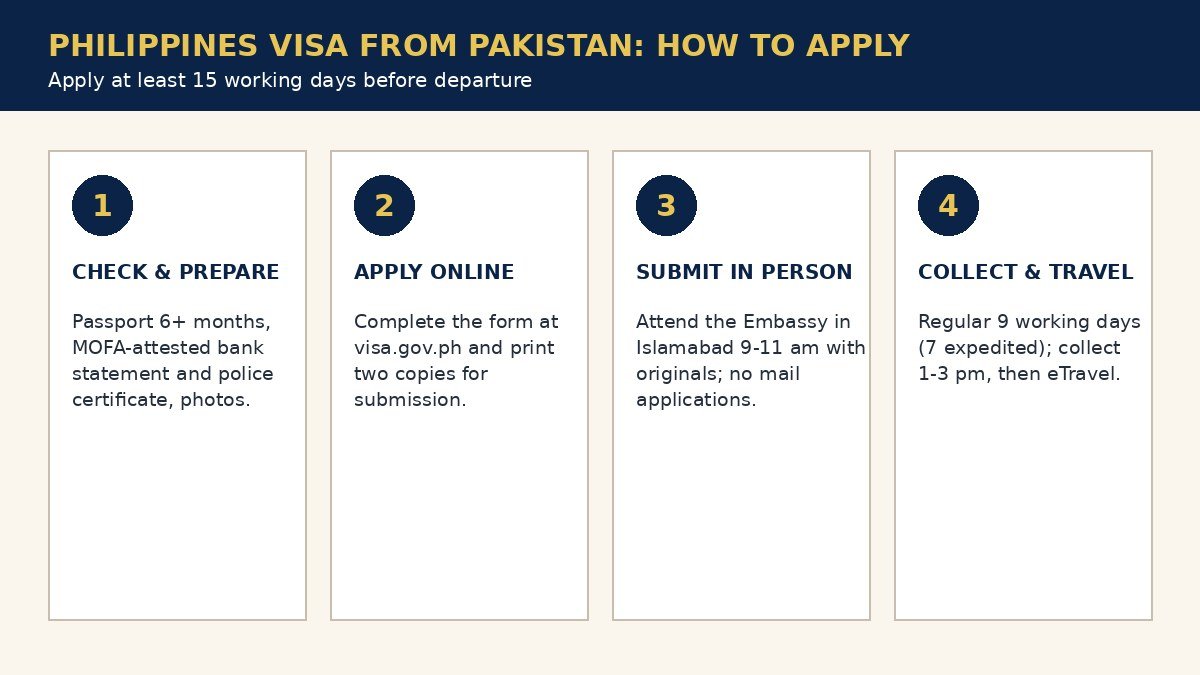
Confirm that the 9(a) pleasure visa fits the trip, that the passport has at least 6 months of validity beyond the contemplated stay, and that the trip can wait for the processing time. The Embassy requires applications to be submitted at least 15 working days before the intended date of departure, so the calendar should be counted backwards from the flight, not forwards from the day the documents feel ready.
Step 2: Complete the online application
Complete the application through the Online Visa Application System at visa.gov.ph. The system generates the form, which the applicant prints. Two copies are required for the Islamabad submission. Fill every entry, write clearly in block capitals if completing by hand, and use black or dark blue ink. A form with blank spaces or unclear entries will be returned.
Step 3: Attest the bank statement and police certificate
Obtain the original bank statement and the original police character certificate, and have both attested by the Ministry of Foreign Affairs. The police certificate must have been issued not more than 6 months before the application. Keep the originals safe, because the Embassy requires original supporting documents.
Step 4: Prepare the travel and stay evidence
Prepare one copy of the itinerary flight details, not a purchased ticket, and one copy of the hotel booking. The Embassy’s distinction between itinerary details and a ticket is deliberate and useful: it lets applicants show a genuine travel plan without paying for a non-refundable ticket before the visa is decided. Where a host in the Philippines is inviting the traveller, arrange the original notarised and authenticated invitation letter early, because authentication by the Department of Foreign Affairs in Manila takes time on the host’s side as well.
Step 5: Submit in person
Submit the complete file by personal appearance at the Embassy in Islamabad, or at the honorary consulate in Lahore or Karachi if that is where the application is being lodged. Visa processing submissions are received from 9:00 am to 11:00 am, and releases are from 1:00 pm to 3:00 pm. Applications by mail are not accepted, and personal appearance is required for all applicants. An official receipt is issued on submission of complete requirements, and the release date is based on that receipt.
Step 6: Wait, then collect and check
Wait for the processing period for the chosen route, then collect the passport in the release window and check the visa immediately: name spelling, passport number, validity dates, number of entries and the stay granted. Any error should be raised with the consular section at once, before travel, because an error discovered at the airport is far harder to fix.
Step 7: Complete eTravel before departure
Complete the eTravel registration within 72 hours before arrival in the Philippines, through etravel.gov.ph or the eGovPH app. The eTravel system replaces the paper arrival card and is required for all travellers, including visa holders. It is a registration, not a visa, and it does not replace the 9(a) visa itself.
Where to submit in Pakistan
The Philippine Embassy in Islamabad is the main submission point. Its address is Plot Nos. 3, 4 and 5, Khayaban-e-Suhrwardy, Diplomatic Enclave, Sector G-5, Islamabad, Pakistan. Consular hours for passport processing are Monday to Friday, 9:00 am to 3:00 pm, with officer hours for other services from 9:00 am to 11:00 am, and visa submission from 9:00 am to 11:00 am with releases from 1:00 pm to 3:00 pm. The Embassy’s consular email for inquiries is islamabad.pe@dfa.gov.ph, and its consular mobile number is +92-333-1509891.
Applications may also be lodged with the Philippine Honorary Consulates General in Lahore and Karachi, where processing takes longer: 11 working days for regular processing and 9 working days for expedite processing, against 9 and 7 working days in Islamabad. Applicants outside Islamabad should therefore add those extra days to their planning, and still meet the Embassy’s rule of submitting at least 15 working days before departure.
Processing times
| Submission point | Regular processing | Expedite processing |
|---|---|---|
| Embassy, Islamabad | 9 working days | 7 working days |
| Honorary Consulate General, Lahore | 11 working days | 9 working days |
| Honorary Consulate General, Karachi | 11 working days | 9 working days |
These are the Embassy’s published processing times, and they run from submission of complete requirements, as shown by the official receipt. They do not include the time needed to obtain Ministry of Foreign Affairs attestation, to secure a host’s authenticated invitation letter, or to obtain Department of Foreign Affairs approval in Manila for a 6-month or 1-year multiple-entry visa. A multiple-entry application should therefore be lodged earlier than a single-entry one. The Embassy also warns that the consular officer may require additional documents, refuse an application, or deny issuance in accordance with Philippine law, so the processing time is a guide for complete and straightforward cases, not a promise for every file.
The eVisa question: what applies from Pakistan
The Philippines operates an electronic visa system, eVisaPH, at selected foreign service posts, and it expanded visibly during 2026, including a rollout at the Philippine Consulate General in Dubai in October 2026 for eligible nationals of visa-required countries, including Pakistanis resident in the UAE. That expansion is real, but it does not automatically change the route for an applicant living in Pakistan.
The Embassy in Islamabad’s published visa process remains a personal-appearance sticker visa: the application is completed through visa.gov.ph, printed, and submitted in person, and the Embassy states that applications by mail are not accepted and personal appearance is required for all applicants. Pakistan-focused guidance current in 2026 likewise describes the route from Pakistan as a physical submission at the Embassy in Islamabad or a consulate in Karachi or Lahore, not an eVisa.
The careful position for a reader in Pakistan is therefore to apply through the Islamabad route described in this guide, and to check the post list on evisa.gov.ph before assuming that an eVisa is available from Islamabad. An eVisa issued for another post’s jurisdiction, or obtained through an unofficial website, is not a substitute for the visa the Islamabad embassy issues, and unofficial visa websites that charge a fee for a so-called online Philippines visa should be treated with suspicion. The official eVisa portal is evisa.gov.ph, the official online application system for the Islamabad route is visa.gov.ph, and the official eTravel portal is etravel.gov.ph. Any other site asking for payment should be checked against those three addresses before any money is sent.
Travelling with children
Children under 18 who travel alone, unaccompanied by parents, or accompanied by someone other than a parent, or who are not coming to join a parent in the Philippines, must meet additional requirements. Two copies of the duly accomplished visa application form are required, which a parent may complete on the minor’s behalf. The minor’s original passport must be submitted, valid for at least 6 months beyond the intended stay, with two photocopies of the relevant passport page for both the child and the accompanying guardian, and two passport-size photographs taken not more than 6 months before the application. A scanned photograph is not acceptable.
The key additional document is an Affidavit of Support and Consent to Travel, executed by either or both parents, indicating the travelling companion and the address in the Philippines, duly notarised by a local notary public, attested by the Ministry of Foreign Affairs and by a consular officer of the Philippine Embassy. That affidavit must be presented to immigration officials at the port of entry in the Philippines. On arrival, the Bureau of Immigration issues a Waiver of Exclusion Ground for the minor. Where the affidavit is notarised by a consular officer, the published notary fee is USD 25, or PKR 7,500. Families travelling with children should start this paperwork first, because it involves three separate steps: notarisation, Ministry attestation and consular attestation.
Common mistakes that delay or damage an application
The first mistake is buying a non-refundable ticket before the visa is decided. The Embassy asks for itinerary flight details, not a ticket, at the application stage, and the ticket itself is presented to the immigration officer on entry. Booking a refundable or holdable itinerary until the visa is issued protects the traveller’s money.
The second mistake is submitting an unattested bank statement or an out-of-date police certificate. Both documents need Ministry of Foreign Affairs attestation, and the police certificate must be less than 6 months old at application. Attestation queues are part of the timeline, not an afterthought.
The third mistake is a scanned or old photograph. The Embassy requires two passport-size photographs taken within the last 3 months, pasted in the designated box on the form, and states that a scanned photograph is not acceptable. A fresh set of photographs is cheap insurance.
The fourth mistake is leaving the application too late. The Embassy requires submission at least 15 working days before departure, and regular processing in Islamabad is 9 working days, longer in Lahore and Karachi. A file submitted inside that window, or a multiple-entry file waiting on Manila approval, can easily miss a flight.
The fifth mistake is treating the visa as permission to work, or treating the 30-day grant as a 3-month stay. Neither is true. Work needs a different visa, and a longer stay needs a Bureau of Immigration extension applied for before the authorised stay expires. Overstaying creates immigration problems that follow a traveller far beyond one holiday.
Refusals: what to know
A visa officer may refuse an application or deny issuance where the requirements are not met, the purpose is not credible, the finances do not support the trip, the ties to Pakistan are weak, or the documents do not agree with each other. Submission of a complete file and payment of a fee do not guarantee issuance, and the Embassy states this explicitly.
If an application is refused, the useful response is to find out, as far as the Embassy will explain, which part of the file failed, and to fix that part before reapplying rather than resubmitting the same file with a new cover letter. A refusal followed quickly by an identical application rarely changes the outcome. Stronger evidence of return, clearer finances, a coherent itinerary and consistent dates across every document are the changes that matter. Applicants should also keep every receipt and every document copy, because a second application is judged against the first file as well as on its own merits.
Practical tips for the trip itself
Plan the islands in one direction rather than zigzagging between them, because domestic flights and ferry times shape a Philippines itinerary more than hotel prices do. Travellers comparing Southeast Asian routes may also find the guides to the Thailand visit visa, the Malaysia visit visa and the Singapore visit visa useful, since those destinations follow different rules for Pakistani passport holders, and the Indonesia visit visa and Vietnam visit visa guides cover two more nearby options. Keep the return or onward ticket, hotel confirmations and the eTravel registration accessible on arrival, since immigration officers may ask for them. Carry the same documents that supported the visa application, in case questions arise at the port of entry. If the stay will exceed 30 days, visit the Bureau of Immigration before the authorised stay expires and apply for an extension there, rather than hoping an overstay will go unnoticed. Finally, keep copies of the passport data page and the visa separate from the originals, and store the Embassy’s contact details with the travel documents.
Frequently asked questions
Do Pakistani citizens need a visa for the Philippines?
Yes. Pakistani ordinary passport holders need a 9(a) Temporary Visitor’s Visa before travel. There is no visa on arrival for Pakistani tourists, and Pakistan is not on the Embassy’s visa-free list. The Balikbayan privilege for former Filipinos and their immediate families is a separate rule and does not apply to ordinary tourists.
Can I apply for a Philippines eVisa from Pakistan?
Not on the route the Embassy in Islamabad publishes. From Pakistan, the application is completed through visa.gov.ph, printed, and submitted by personal appearance for a sticker visa. The Philippines eVisa system operates at selected posts, and it rolled out in Dubai in October 2026, but applicants in Pakistan should follow the Islamabad route and check the post list on evisa.gov.ph before assuming an eVisa is available from Islamabad.
How much is the Philippines visit visa fee from Pakistan?
The Embassy’s published visa page does not carry the main fee schedule in the text checked for this guide, and guides conflict on the single-entry fee. Reported figures are PKR 12,000 to PKR 15,000 for a 3-month single-entry visa, PKR 24,000 for a 6-month multiple-entry visa, PKR 36,000 for a 1-year multiple-entry visa, and an additional PKR 4,000 reported for expedite processing. Confirm the exact amount with the Embassy or consulate before paying.
How long does processing take?
In Islamabad, regular processing is 9 working days and expedite processing is 7 working days. In Lahore and Karachi, regular processing is 11 working days and expedite processing is 9 working days. Applications must be submitted at least 15 working days before departure, and multiple-entry visas need Department of Foreign Affairs approval in Manila, so apply earlier for those.
How long can I stay in the Philippines on a tourist visa?
The Embassy in Islamabad grants a maximum stay of 30 days to temporary visitor’s visa applicants. A longer stay requires an extension of stay filed with the Bureau of Immigration in Manila or at the immigration office nearest to where the traveller is temporarily residing. Do not treat a 3-month visa validity as a 3-month stay.
Must I appear in person?
Yes. The Embassy in Islamabad requires personal appearance for all applicants, and applications by mail are not accepted. Visa submissions are received from 9:00 am to 11:00 am, and releases are from 1:00 pm to 3:00 pm.
Do my bank statement and police certificate need attestation?
Yes. The original bank statement and the original police character certificate must both be attested by the Ministry of Foreign Affairs of Pakistan. The police certificate must have been issued not more than 6 months before the application.
Can I extend my stay inside the Philippines?
Yes, by applying to the Bureau of Immigration before the authorised stay expires. The Embassy’s guidance directs applicants staying beyond 30 days to file for an extension with the Bureau of Immigration in Manila or the nearest immigration office. Apply before expiry, not after.
Can I work in the Philippines on a tourist visa?
No. The 9(a) visa for pleasure covers tourism, leisure and visiting family and friends. Paid work requires a different visa category, and working on a tourist visa risks refusal of future applications and immigration action.
What if my visa application is refused?
A refusal is not cured by immediately resubmitting the same file. Identify the weak part of the application, whether purpose, finances, ties to Pakistan or inconsistent documents, strengthen that part with genuine evidence, and reapply with a coherent file. Keep all receipts and document copies from the first application.
Official sources
- Embassy of the Republic of the Philippines in Islamabad, Visa: https://www.isdpe.com.pk/visa.htm
- Philippine eVisa portal, eVisaPH: https://evisa.gov.ph/
- Online Visa Application System: https://www.visa.gov.ph/
- Philippines eTravel System: https://etravel.gov.ph/
- Philippine Embassy in Oslo, Temporary Visitor’s Visa (9a), for the 59-day port-of-entry maximum and the single and multiple-entry validity pattern used by Philippine posts: https://oslope.dfa.gov.ph/temporary-visitors-visa/
- Bureau of Immigration, Philippines, for extensions of stay: https://immigration.gov.ph/
Disclaimer
TourPointGo is an independent visa-information website. It is not the Philippine Embassy, the Department of Foreign Affairs of the Philippines, or the Bureau of Immigration, and it cannot guarantee any visa outcome. Visa rules, fees and processing times change, and the Embassy in Islamabad is the final authority for applications lodged in Pakistan. Confirm the fee, the current requirements and the submission arrangements with the Embassy before paying or travelling. Information in this guide was checked on 1 November 2026.




1 thought on “Philippines Visit Visa From Pakistan 2026: 9(a) Tourist Visa, Fees and How to Apply”