Georgia is one of the most rewarding short trips a Pakistani traveller can plan: a walkable old town in Tbilisi, the Caucasus mountains a few hours north, Black Sea beaches to the west and a wine region to the east, all in a country smaller than many single provinces. The visa side of that trip, however, is where most Pakistani travellers go wrong, because Georgia has three different doors and which one is open to you depends entirely on documents you already hold.
The short version is this. A Pakistani ordinary passport on its own does not give you visa-free entry to Georgia, and there is no visa-on-arrival route for Pakistani passport holders to rely on. What many Pakistanis do have is a second document that changes everything: a valid Schengen visa, a visa from an OECD country, a Schengen or OECD residence permit, or a qualifying Gulf residence document. Depending on which document you hold, you may be able to apply for a Georgia e-Visa online, or you may be able to enter without a Georgian visa at all for up to 90 days. If you hold none of those documents, you need a consular visa through Georgia’s application system, not an online shortcut.
One honesty note runs through this guide. Georgia’s e-Visa Portal is a JavaScript-driven application system, and its eligibility answers are shown after you select your nationality and documents inside the application flow, not on a single public list page that can be quoted here. Where this guide reports what the portal is said to show for Pakistani applicants, it says so plainly, and it tells you to confirm your own case on the portal before you pay anything. That matters, because several agency websites describe the Georgia rules as if every Pakistani applicant were in the same position, and they are not.
Key Facts at a Glance
| Item | Detail |
|---|---|
| Visa-free on a Pakistani ordinary passport alone | No |
| Visa on arrival for Pakistanis | Not a route to rely on; arrange permission before travel |
| Official e-Visa portal | https://www.evisa.gov.ge/ |
| e-Visa route for Pakistanis (as reported) | Available with a valid supporting document: a Schengen visa, an OECD-country visa, or a Schengen/OECD residence permit |
| Visa-free substitute route | Up to 90 days in any 180-day period for holders of valid visas or residence permits of listed countries (see below); special condition for Pakistani nationals using a Gulf document |
| e-Visa fee (as reported) | USD 20 plus a 2% service fee (USD 20.40), plus a separate USD 15 identity-verification charge; the portal shows the actual fee at payment |
| e-Visa decision time | Not less than 5 working days (a minimum, not a guaranteed maximum); plan 2 to 3 weeks ahead |
| e-Visa validity and stay (as commonly reported) | 120 days validity with up to 30 days stay, multiple entry; your issued visa states the exact dates |
| Mandatory tourist insurance (from 1 January 2026) | Valid health and accident policy, in Georgian or English, covering the full stay, minimum 30,000 GEL |
| Portal contact (from the portal home page) | Tel (995 32) 2945050; contact@evisa.gov.ge; 0118 Georgia, Tbilisi, Sh. Chitadze str. 4 |
| Information checked | October 2026 |
Do Pakistanis Need a Visa for Georgia?
Yes, unless you qualify under the substitute-visa rule described below. A Pakistani ordinary passport holder needs permission before travelling to Georgia for tourism or a short visit. Georgia’s visa-free list covers about 90 countries, including EU states, the United Kingdom, the United States, Canada, Australia, Japan, South Korea, Turkey and the Gulf states, but Pakistan is not on that list for ordinary passports. Do not confuse the two Georgias either: this guide is about the country in the Caucasus, not the US state of Georgia, and a US visa does not by itself make you visa-free for the country, although, as you will see below, a valid US visa can count as a supporting document.
The second shortcut to rule out is visa on arrival. Georgia does not offer a visa-on-arrival counter that a Pakistani tourist can plan around. If you fly to Tbilisi without either an issued e-Visa, a consular visa, or a qualifying document for visa-free entry, you risk being refused boarding by your airline or refused entry on arrival. Sort out which of the three routes below applies to you before you book anything non-refundable.
The Three Routes at a Glance
| Route | Who it fits | What you get | Where it starts |
|---|---|---|---|
| 1. e-Visa with a supporting document | Pakistani applicants who hold a valid Schengen visa, an OECD-country visa, or a Schengen/OECD residence permit | An electronic visa issued before travel, printed and carried with your passport | The official e-Visa Portal at evisa.gov.ge |
| 2. Visa-free entry on a qualifying document | Holders of a valid visa or residence permit of the EU/EFTA states, GCC states, the United States, the United Kingdom, Canada, Australia, New Zealand, Japan, South Korea or Israel | Entry without a Georgian visa for up to 90 days in any 180-day period, subject to the Pakistan-specific Gulf condition below | No application; the document is checked at the border |
| 3. Consular visa | Applicants who hold none of the documents above, or who need a category the portal does not serve | A visa issued through Georgia’s consular system | Georgia’s E-Application System, which directs you to the consular office that handles your case |
Start with Route 1 if you hold a supporting document, check Route 2 if you hold a qualifying visa or permit and would rather travel without applying, and use Route 3 if neither applies. The rest of this guide works through each route in turn.
Route 1: The Georgia e-Visa With a Supporting Document
Georgia’s e-Visa Portal is the official online route for short-stay visits. It issues a short-term ordinary visa, category C1 for tourism and similar short purposes, without a visit to an embassy. You complete the form online, pay by card, and receive the visa by email to print and carry.
For Pakistani applicants, the key reported rule is the supporting document. Independent e-Visa guides that reproduce the portal’s nationality groups place Pakistan, together with Bangladesh, Sri Lanka, Afghanistan, Iraq, Nigeria, Cameroon and several others, in the group of e-Visa countries whose applicants must also hold a valid supporting document: a Schengen visa, a valid visa from an OECD member country, or a valid residence permit of a Schengen or OECD country. The portal’s own frequently asked questions, as reproduced in official summaries, anticipate exactly this situation: an applicant who does not hold a supporting document is told to continue registration leaving the supporting-document fields unfilled, which is a strong hint that the portal does not hard-block the form, but it is not a promise that an application without a supporting document will succeed. The safe reading is the one the guides converge on: for a Pakistani applicant, the supporting document is part of the case, and you should not pay the fee until the portal has shown you, for your nationality and your document, that you can proceed.
That supporting document must be valid. A used single-entry Schengen visa that has already expired, or a residence permit that ends before your trip, is not the document the rule describes. If your supporting document is a Gulf residence permit, read Route 2 carefully as well, because the visa-free route treats Gulf documents differently from the e-Visa route, and you may not need an e-Visa at all.
Documents for the e-Visa Application
Prepare these before you start the form, because the portal asks for uploads and the decision clock does not wait for a missing scan:
- A valid Pakistani passport, with at least 3 months of validity beyond the end of your planned stay and at least 2 free (blank) pages. Every detail on the form must match the passport exactly.
- A recent biometric-style photograph: taken within the last 6 months, facing the camera directly, with your head taking up roughly 50 to 70 percent of the frame from chin to crown, on a plain light background, with no other person in the frame. Do not upload a scan of a passport photograph.
- A copy of your valid supporting document: the Schengen visa, OECD-country visa, or Schengen/OECD residence permit described above.
- Proof of accommodation for your stay: a hotel booking confirmation or an invitation letter from a host in Georgia.
- A return or onward flight ticket, if you are travelling by air. If you are travelling by another means, the portal asks for the equivalent travel evidence.
- Travel and health insurance covering your stay. Since 1 January 2026 this is also a legal entry requirement in its own right, with a minimum cover of 30,000 GEL, so it is not optional paperwork. See the Insurance section below.
- Proof of financial means: a bank statement or card evidence showing funds that cover the trip. For business visitors, proof of the purpose of travel may be asked for instead of, or in addition to, financial evidence.
- Any purpose-of-travel document the portal asks for in your case, such as an invitation or business letter.

Two warnings follow from that list. First, the information on the e-Visa must match your passport and your supporting document exactly, because the portal warns that incorrect information invalidates the e-Visa and can lead to refusal of entry. Check names, passport number, dates and document numbers character by character before you pay. Second, keep every uploaded document with you for the border as well: the portal’s own guidance lists the travel document, proof of purpose, accommodation, insurance and financial evidence as documents to present at the Georgian border, not just at application.
e-Visa Fees
The fee most often reported for the Georgia e-Visa is USD 20 plus a 2% service fee, which comes to USD 20.40, paid by card on the portal. Separately, the portal’s identity-verification step, known as DuVerify, is reported to cost a further USD 15 per applicant. That puts the commonly reported total at USD 35.40. Treat both figures as reported, not as an official fee schedule quoted in this guide: the portal shows the fee it will actually charge at the payment step, and that is the figure to budget from. Visa fees are not refunded if an application is refused, so the fee is a further reason to confirm your eligibility and your supporting document before you pay, rather than after.
e-Visa Processing Time and Validity
The portal’s stated position, reproduced in official summaries, is that a decision takes not less than 5 working days. Read that sentence carefully: it is a minimum, not a promise that your visa will arrive on the fifth working day. Public holidays in Georgia are not working days, and an incomplete file or a query about a document will take longer. The practical planning advice in the e-Visa guides is to apply 2 to 3 weeks before travel, and that is the advice this guide repeats. Complete the email, payment and identity-verification steps inside their deadlines: guides report that the DuVerify step should be completed within 24 hours of the main application, and a missed step is a common cause of delay.
On validity and stay, the variant most often reported for e-Visa nationalities in this group is 120 days of validity with up to 30 days of stay, multiple entry, running from the arrival date you select in the application. That means you cannot enter before the valid-from date, and leaving and re-entering does not reset the permitted stay. Your issued e-Visa states the exact validity, stay and entry terms that apply to you, and those printed terms override any summary in this guide. An e-Visa cannot be extended in Georgia, and it can only be applied for from outside Georgia, so if your plans change to a longer stay, you need a different plan, not an extension request at the border.
Route 2: Visa-Free Entry on a Qualifying Visa or Permit
This is the route that surprises most Pakistani readers, and it is also the one most often stated wrongly online. Georgia allows holders of valid visas or residence permits of a listed set of countries to enter without a Georgian visa for up to 90 days in any 180-day period. The listed issuers, as summarised from Georgia’s Ordinance No. 256, are the EU member states, the EFTA states, the GCC states, Australia, Canada, Israel, Japan, New Zealand, South Korea, the United Kingdom and the United States. The visa or permit must be valid when you arrive in Georgia. There is no application, no fee and no embassy appointment for this route: the document is checked at the border, and the final admission decision stays with the Georgian border authorities.
For Pakistani nationals, there is an extra condition on Gulf documents, and it is the single most important sentence in this section. Reporting that cites the Georgian Embassy in the United Arab Emirates states that a Pakistani passport holder entering on a UAE visa or residence permit needs that document to have at least one year of remaining validity on the date of entry, and that where entry is based on a UAE visa, the visa must be multiple-entry. A residence permit with less than one year remaining does not qualify under this exemption, and the embassy’s direction in that situation is to apply for a tourist visa instead. Other summaries phrase the same condition slightly differently, as a document valid for at least one year before arrival, so the exact wording is worth confirming against the Georgian consular service before you travel if your document is anywhere near the boundary. Do not rely on a summary, including this one, for a document with, say, 13 months left that will fall below 12 months by the time you fly: check the rule against your exact travel date.
A related trap is the single-entry visa. If your qualifying visa is a single-entry Schengen visa that you have already used, or a single-entry visa for any listed country, it may not count as a valid visa at the border even though it was once genuine. The document must be valid on arrival, and for the Gulf route the multiple-entry point above applies. When in doubt, Route 1, an actual Georgian e-Visa, is the safer document to travel on, because it is a Georgian decision in your hand rather than a border officer’s reading of a third country’s visa.
Route 3: If Neither Route Applies
If you hold no supporting document and no qualifying visa or permit, do not pay a third-party website that promises a Georgia e-Visa for your passport. Georgia’s system for other categories runs through its E-Application System, which takes an online application and books submission of the signed application and hard-copy documents at the appropriate consular office. Short-term consular visas are decided within 10 calendar days under the official framework, against 5 working days for the e-Visa Portal route and 30 calendar days for long-term visas. Which consular office handles an application made from Pakistan, and what its current submission arrangements are, is something to confirm through the Georgian consular service at geoconsul.gov.ge before you send original documents anywhere. Never post your passport to an address you have not verified through that service, and never hand it to a person who cannot show that they are part of an authorised channel.
Mandatory Tourist Insurance From 1 January 2026
This is a 2026 rule, and it applies to every tourist entering Georgia, whichever route you used. Under Georgia’s Law on Tourism, from 1 January 2026 all tourists entering Georgia must hold a valid health and accident insurance policy. The policy must be presentable in physical or electronic form, in Georgian or English, and it must cover the full period of your stay, including both your arrival and departure dates. The minimum coverage is 30,000 GEL, and the policy may be issued by a Georgian or a foreign insurance company. The policy must state the contracting parties, the covered territory, the subject matter, the coverage dates, the insured risks, the sum insured, and the premium amount with its place and terms of payment. A policy that covers only part of your stay, or that is written in a language other than Georgian or English, does not meet the rule as stated. Diplomatic and special visa holders, holders of diplomatic, official, service and special passports, accredited mission staff and their families, persons entering under international treaties, and international road freight and passenger drivers are exempt. Ordinary tourists are not, so buy the policy before you fly and carry it with your passport, not in checked luggage.
How to Apply: Step by Step
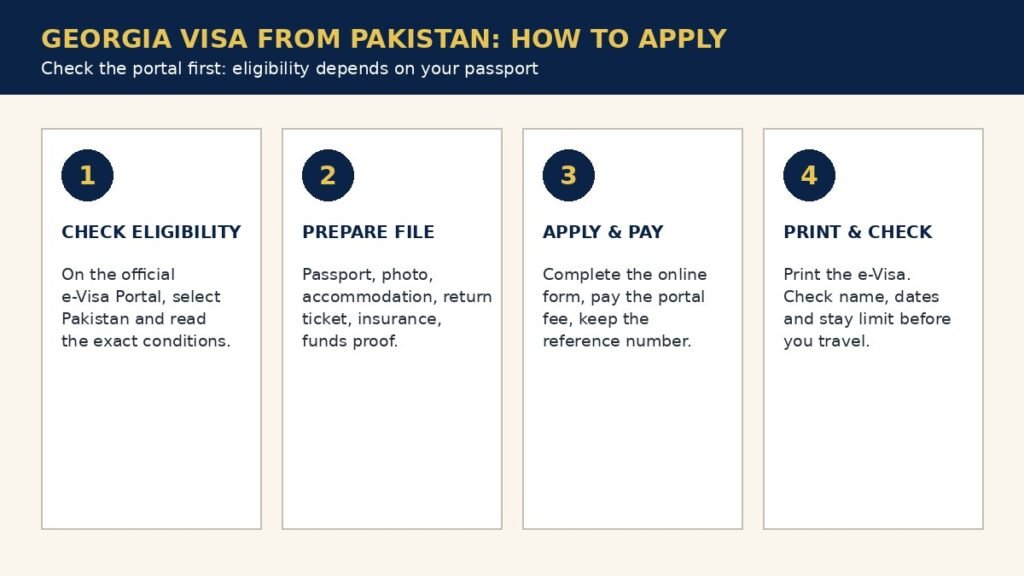
Step 1: Work out your route before you pay anything. Check whether you hold a supporting document for Route 1 or a qualifying visa or permit for Route 2, including the Pakistan-specific Gulf condition. If you hold neither, go to Route 3.
Step 2: Open the official portal, not a lookalike. Use evisa.gov.ge only. Third-party sites with similar names charge their own fees on top of, or instead of, the official fee, and they cannot create eligibility that the portal does not offer. If a site asks you to pay before the portal has confirmed your nationality and documents, stop.
Step 3: Select Pakistan and read what the portal shows for you. Confirm the validity, stay, document list and fee the portal shows for your case. If the portal does not offer your nationality, or does not accept your supporting document, do not pay a third-party alternative: use Route 3.
Step 4: Prepare the file. Gather the passport, photograph, supporting document, accommodation proof, return ticket, insurance and financial evidence from the Documents section, and check that every name, number and date matches across all of them.
Step 5: Complete the form, pay, and finish the verification step. Fill in the form exactly as your passport shows it, pay the fee the portal shows, and complete the identity-verification step inside its deadline. Note the reference or tracking number and keep the payment receipt.
Step 6: Wait, and do not buy non-refundable travel yet. A decision takes not less than 5 working days, and 2 to 3 weeks of planning room is the sensible allowance. If the portal asks for an extra document, provide it quickly and exactly as requested, rather than submitting a second application.
Step 7: Print and check the e-Visa. Print the e-Visa and check it line by line: your name and passport number against your passport, the validity dates, the permitted stay and the number of entries. If anything is wrong, raise it through the portal’s contact channels before you travel, because errors are far harder to fix at an airport.
After Approval: Before You Fly and At the Border
An e-Visa, and visa-free entry, are both permission to present yourself at the border, not a guarantee of entry. Border officers can ask for the same file you used to apply: your passport, the printed e-Visa where one was issued, your supporting or qualifying document, hotel bookings, a return or onward ticket, proof of funds, and your mandatory insurance policy. Keep these together in hand luggage, in paper or on a phone, and make sure the names, dates and passport number match across all of them.
If your plans change after the visa is issued, check whether the issued visa still covers your new plans, especially if the new arrival date falls outside the validity period shown on the visa, or before the valid-from date you selected in the application. Overstaying a permitted stay, even by a day, creates a record that will be visible on your next application, so plan your departure inside the stay the visa actually grants.
Common Mistakes to Avoid
- Paying a third-party site before checking the portal. If a website offers a Georgia e-Visa without asking about your supporting document, it is not following the portal’s process for Pakistani applicants.
- Assuming a Gulf residence permit alone is enough. For Pakistani nationals, the visa-free Gulf route carries the one-year remaining-validity condition, and a multiple-entry condition for UAE visa-based entry. A permit with less than a year left does not qualify.
- Travelling on an expired or already-used supporting document. The supporting or qualifying document must be valid on arrival.
- Travelling without the 2026 insurance. Since 1 January 2026, a compliant policy with at least 30,000 GEL of cover, in Georgian or English, for the full stay, is an entry requirement, not a recommendation.
- Booking non-refundable travel before the decision. A decision takes not less than 5 working days, and queries take longer. Keep bookings changeable until the visa is in hand.
- Submitting a second application while the first is pending. A duplicate file creates confusion, not speed. Answer a query on the first application instead.
- Assuming the e-Visa guarantees entry. Border officers still check the file at arrival, and incorrect information on the e-Visa can invalidate it.
- Planning a two-country trip on one entry without checking re-entry. If your itinerary leaves Georgia and comes back, for example a side trip combined with our guide to Azerbaijan, check that your visa’s entries and stay cover the second entry. The Azerbaijan guide itself warns that a single-entry e-Visa does not cover a return after a side trip to Georgia.
Why Visit Georgia

Georgia rewards a Pakistani traveller who likes variety in a small area. Tbilisi, the capital, packs a walkable old town, sulphur baths, a fortress above the river and a modern bridge into a single day. The Caucasus mountains rise a few hours north, the Black Sea coast sits to the west, and the Kakheti wine region lies to the east. Food is a large part of the trip: khachapuri, khinkali and Georgian wine are everyday items, not special-occasion finds, and prices for meals and local transport are generally lower than in Western Europe, which is part of why the country has become popular with travellers from Pakistan and the Gulf.
Tbilisi first. The Old Town sits on the banks of the Mtkvari (Kura) river, with narrow streets, carved wooden balconies and the Narikala Fortress above it. The sulphur baths of Abanotubani, the Bridge of Peace, and the Holy Trinity Cathedral (Sameba) on its hill are the sights most first-time visitors tick off, and they are close enough to cover on foot with a cable car ride up to the fortress.
Kazbegi second. The drive north on the Georgian Military Highway, past the Ananuri fortress and the Jvari Pass, ends at Stepantsminda, below Mount Kazbek. The Gergeti Trinity Church, a 14th-century church at about 2,170 metres, is Georgia’s most photographed sight, and the walk or four-wheel-drive ride up to it is the centrepiece of the trip. Weather in the mountains changes fast, so a Kazbegi day needs a flexible plan rather than a fixed timetable.
Beyond those two, a longer trip can add Svaneti, with its medieval defensive towers and the village of Ushguli; Batumi on the Black Sea, with its boulevard and botanical garden; and Kakheti, where wine has been made in clay qvevri for thousands of years. A single week covers Tbilisi plus one of Kazbegi or Kakheti comfortably; two weeks allow all three without rushing.
Travellers who already hold a Schengen visa may also find our Schengen guide useful background on the document that most often serves as a supporting document, and those combining Georgia with a neighbouring trip can read our Turkey guide for the land-border neighbour to the south-west.
Frequently Asked Questions
Do Pakistanis need a visa for Georgia?
Yes, unless you qualify for visa-free entry on a qualifying visa or residence permit under Route 2. A Pakistani ordinary passport alone does not give visa-free entry, and there is no visa-on-arrival route to rely on.
Can Pakistanis apply for a Georgia e-Visa?
As reported by the e-Visa guides that reproduce the portal’s nationality groups, yes, with a valid supporting document: a Schengen visa, a valid visa from an OECD country, or a valid residence permit of a Schengen or OECD country. Confirm your own case on the official portal at evisa.gov.ge before you pay, because the portal shows the conditions for your nationality and documents inside the application flow.
What is a supporting document for the Georgia e-Visa?
A valid Schengen visa, a valid visa from any OECD member country, or a valid residence permit of a Schengen or OECD country. It must be valid, and a copy of it is uploaded with the application. The portal’s guidance anticipates applicants without one by telling them to leave the supporting-document fields unfilled, but that is not a promise of approval without one.
How much does a Georgia e-Visa cost for Pakistanis?
The commonly reported total is USD 20 plus a 2% service fee (USD 20.40) plus a separate USD 15 identity-verification charge, making USD 35.40 in total. The portal shows the actual fee at payment, and that figure is the one to budget from. Fees are not refunded on refusal.
How long does a Georgia e-Visa take?
A decision takes not less than 5 working days, which is a minimum rather than a guaranteed maximum. Apply 2 to 3 weeks before travel, complete the verification step inside its deadline, and keep travel bookings changeable until the visa is issued.
How long can I stay in Georgia on an e-Visa?
The variant most often reported for this group is 120 days of validity with up to 30 days of stay, multiple entry. Your issued e-Visa states the exact dates and terms that apply to you, and those printed terms override any summary. An e-Visa cannot be extended in Georgia.
Can I enter Georgia visa-free with a UAE residence permit?
Possibly, under Route 2, but with a Pakistan-specific condition: reporting that cites the Georgian Embassy in the UAE states that the document must have at least one year of remaining validity on the date of entry, and that a UAE visa used for this route must be multiple-entry. A document with less than a year remaining does not qualify, and the embassy’s direction in that case is to apply for a tourist visa. Confirm the condition against the consular service before you travel if your document is near the boundary.
Do I need travel insurance for Georgia in 2026?
Yes. From 1 January 2026, under Georgia’s Law on Tourism, every tourist entering Georgia must hold a valid health and accident insurance policy, in Georgian or English, covering the full stay, with a minimum cover of 30,000 GEL. Carry it with your passport.
What happens if my Georgia e-Visa application is refused?
Under the official framework, a refusal can be appealed within 10 business days of receiving the reply, with the appeal and documents submitted in the Georgian language. In practice, most travellers first check the reason, correct the problem, and apply again with a stronger file. Do not travel on a refused application, and do not pay an agent who promises to reverse a refusal for an extra fee.
Can I work or study in Georgia on a visit visa?
No. A short-stay visit visa covers tourism, family visits, short business meetings and similar short purposes. It does not cover work, long-term study or residence. If your real purpose is work or study, you need the correct category before you travel.
Official Sources
- Georgia e-Visa Portal, official home page and application system (eligibility shown by nationality inside the application flow; portal contact Tel (995 32) 2945050, contact@evisa.gov.ge): https://www.evisa.gov.ge/
- Georgian MFA consular platform, mandatory insurance for tourists (Law of Georgia “On Tourism”, from 1 January 2026; minimum 30,000 GEL; Georgian or English; full stay): https://www.geoconsul.gov.ge/en/news/69
- Embassy of Georgia to Norway, mandatory insurance notice (same MFA text): https://norway.mfa.gov.ge/en/news/749970-information-regarding-mandatory-insurance-for-tourists-entering-georgia
- Reported e-Visa nationality groups, supporting-document rule, fee and validity (used only where labelled as reported, never as official): Wego Georgia e-Visa guide, https://blog.wego.com/georgia-e-visa/; Flado Georgia e-Visa guide, https://flado.id/visageo/; Wego cheapest countries from Pakistan 2026, https://blog.wego.com/cheapest-countries-to-visit-from-pakistan/
- Reported Pakistan-specific Gulf condition (used only where labelled as reported): Saifco visa-free countries for Pakistani expats in the UAE, citing the Georgian Embassy in the UAE, https://www.mysaifco.com/visa-free-countries-for-pakistani-expats-living-in-dubai-uae/
Disclaimer
TourPointGo is an independent visa-information website, not a government authority, embassy, travel agency or immigration law firm. Visa rules can change without notice. Always confirm the current requirements, fee and submission route on the official Georgia e-Visa Portal and through the Georgian consular service before you travel, and never rely on an agent’s claim or a third-party visa website’s promise over an official source. This guide was checked against official and convergent sources in October 2026, and where a figure could not be verified from an official source, that gap is stated in the guide rather than filled in with a guess.




1 thought on “Georgia Visit Visa From Pakistan 2026: e-Visa Rules, Visa-Free Exceptions and How to Apply”