Vietnam has become one of the most rewarding trips a Pakistani traveller can plan: a single journey can take in the limestone islands of Ha Long Bay, the lantern-lit streets of Hoi An, the food streets of Hanoi and the energy of Ho Chi Minh City, all at prices that compare well with other popular Asian destinations. The visa side of that trip is simpler than many people expect. Since August 2023, citizens of all countries and territories, including Pakistan, have been able to apply for a Vietnam e-visa entirely online, with no embassy visit and no agent needed.
This guide covers the official route for 2026: who can apply, what the e-visa costs, how long it takes, which documents you need, and the entry points where it is accepted. Every fee, time limit and rule below comes from an official Vietnamese source checked in October 2026, and where an official source could not be confirmed, that is stated plainly rather than filled in with a guess.
Key Facts at a Glance
| Item | Detail |
|---|---|
| Route for Pakistanis in 2026 | Vietnam e-visa, applied for online before travel |
| Official portal | evisa.gov.vn (Vietnam Immigration Department) |
| Eligibility | Citizens of all countries and territories, including Pakistan, since 15 August 2023 |
| Maximum stay | Up to 90 days |
| Entry types | Single entry or multiple entry |
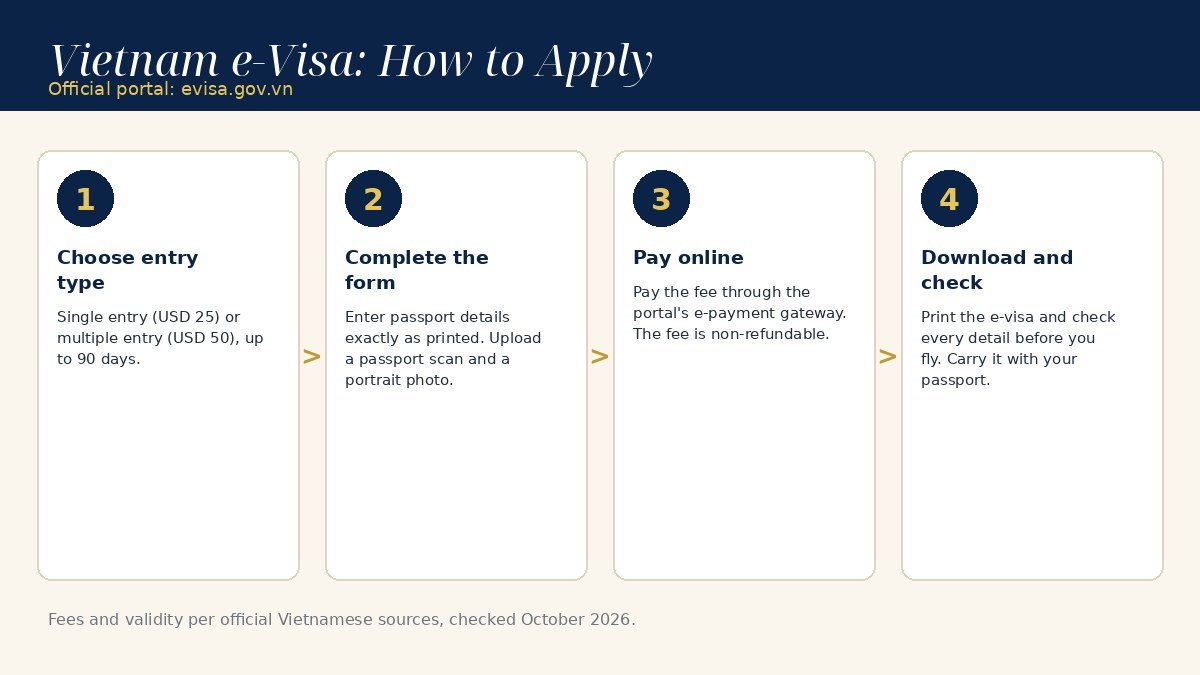
| Official fee | USD 25 single entry; USD 50 multiple entry |
| Fee refund | No refund if the application is refused |
| Official processing time | Within 3 working days of a complete application and fee |
| Entry points | 83 designated checkpoints (17 airports, 27 land borders, 39 seaports) |
| Passport advice | Keep at least 6 months of validity as a prudent standard (see Documents) |
| Work on a tourist e-visa | Not the purpose of a visit visa; work needs a separate permit and visa |
| Information checked | October 2026 |
Do Pakistanis Need a Visa for Vietnam?
Yes. Pakistan is not on any of Vietnam’s visa-exemption lists, so a Pakistani passport holder needs a visa before travelling. The good news is that the visa itself is now an online process. Under Government Resolution No. 127/NQ-CP, issued on 14 August 2023 and effective from 15 August 2023, Vietnam’s electronic visa applies to citizens of all countries and territories. That general rule is what covers Pakistani applicants: no official source lists Pakistan separately, and no official source adds any Pakistan-specific extra document, fee or longer processing time.
There is one important condition on where you apply from. The Immigration Department’s portal states that the e-visa is for foreigners outside Vietnam. You must therefore complete the application and receive the approval before you travel, not after you arrive.
What Is the Vietnam e-Visa?
The e-visa is a digital entry permit issued by the Vietnam Immigration Department, under the Ministry of Public Security. You apply on the official portal, pay online, and print the result yourself. As the Immigration Department itself puts it, the whole process from application to approval and printing is conducted electronically, without going through a visa office abroad, an international border gate, or any intermediary.
The e-visa is valid for a maximum of 90 days, with single or multiple entry. That is a real change from the old system, under which the e-visa allowed a maximum of 30 days with single entry only. The 90-day figure is the maximum: the validity dates printed on your approved e-visa are the ones that count, so read them before you book anything non-refundable.
Choosing between single and multiple entry is a practical decision, not a trick question. If your trip stays inside Vietnam from arrival to departure, single entry is enough and costs less. If you plan to leave Vietnam during the trip and come back, for example a side trip to Cambodia or Thailand in the middle of a longer holiday, you need multiple entry. A single-entry e-visa cannot be reused once you have left Vietnam. Readers planning a multi-country Southeast Asia itinerary may also want to read our guides to Thailand, Malaysia and Singapore, which cover the neighbouring legs of such a trip.
Who Can Apply
The e-visa is open to Pakistani ordinary passport holders travelling for tourism or a short visit, applying from Pakistan or from any other country where they are outside Vietnam. Each traveller needs their own e-visa, including children.
A small group of people cannot use the standard e-visa route. Under the law, foreigners falling into the cases in Clauses 1, 2, 3 and 4 of Article 8 of the Law on Entry and Exit, such as official guest delegations and diplomatic or consular personnel, must apply through the inviting or guaranteeing agency to the Ministry of Foreign Affairs instead. Ordinary tourists and family visitors are not in that group.
Entry is also subject to the general entry conditions in Vietnamese law. You must hold a passport and a visa, and you must not fall into a case of suspension from entry under Article 21 of the same law. An approved e-visa does not by itself guarantee entry: the immigration officer at the checkpoint still checks that the entry conditions are met.
Documents Required
The official process asks for surprisingly little, and it is worth being precise about what is officially required and what is only common advice.
Officially, the law requires an applicant to declare the information in the e-visa application, upload a photo and a passport record on the e-visa information site, and submit the fee after receiving an electronic profile code. The Immigration Department’s portal adds the condition of holding a valid passport. In practice, prepare these items before you start:
- A valid Pakistani passport. The law text ties an explicit 6-month validity rule to visa-exempt entry rather than to e-visa holders, so this guide does not present 6 months as a quoted e-visa rule. Even so, 6 months of remaining validity is the prudent standard used across international travel, and airlines and border officers apply it widely. Do not travel with a passport close to expiry.
- A recent portrait photograph, uploaded digitally. The portal shows its own size and format instructions on the form itself, so follow exactly what the form asks for rather than trusting a figure from a blog.
- A clear scan of your passport data page, with all details legible. Again, follow the upload instructions shown on the portal.
- The details of your trip as the form asks for them: your intended entry checkpoint, your intended entry and exit dates, and your address in Vietnam. Choose your entry checkpoint from the official designated list (see below), because the e-visa is only valid at those checkpoints.
- A valid international debit or credit card for the fee payment through the portal’s own e-payment gateway.
Note what is not on that list. No official source checked for this guide requires a hotel booking, a return ticket, a bank statement or an invitation letter as a condition of a standard e-visa application. Third-party guides often list such items, but they are not official document requirements. That does not mean you should travel without a plan: airlines and immigration officers can still ask about your stay, and a sensible traveller carries a hotel booking and a return or onward ticket in any case. The distinction matters because you should not pay an agent who claims an official rule requires those documents.
Visa Fees
| Item | Official figure | Source |
|---|---|---|
| Single-entry e-visa (up to 90 days) | USD 25 | Vietnam Ministry of Justice fee schedule |
| Multiple-entry e-visa (up to 90 days) | USD 50 | Vietnam Ministry of Justice fee schedule |
| Refund if refused | None: the fee is not refunded | Vietnam Immigration Department portal |
| Stamping fee on arrival for e-visa holders | None: the e-visa is the complete permit | Immigration Department (fully online process) |
The USD 25 and USD 50 figures are the government fees. They are paid online during the application, in US dollars, through the portal’s e-payment gateway. Your bank or card issuer sets the rupee amount on the day of payment, so this guide does not state a fixed rupee total.
Two warnings follow from the fee rules. First, the fee is not refunded if the application is refused, so check every detail before you pay. Second, any website charging more than USD 25 or USD 50 for the e-visa itself is adding its own service charge. The Immigration Department’s public line is that the process needs no intermediaries. If you use an agent, you are paying for help with the form, not for a government fee, and you should know which part of the bill is which.
Processing Time
Vietnamese law sets a clear deadline: immigration authorities must consider, process and respond to an e-visa application within 3 working days from the date on which all information and fees have been received. The Immigration Department has confirmed the same 3-working-day figure publicly.
Treat that as a deadline, not a promise of instant approval. Working days exclude weekends and Vietnamese public holidays, and an incomplete application or an unclear upload can slow things down. Many third-party guides quote 3 to 5 working days as a practical allowance, but that wider figure is not the official rule. The safe approach is to apply at least two weeks before travel, and never to buy non-refundable flights or hotels until the e-visa is approved and printed.
How to Apply: Step by Step
Step 1: Go to the official portal only. Use evisa.gov.vn, the Vietnam Immigration Department’s portal. Vietnam’s government has warned publicly about lookalike visa websites, and every other domain is a private business. Check the domain letter by letter before you enter passport details or pay.
Step 2: Start the application and choose your entry type. Select single entry or multiple entry, and enter your details exactly as they appear in your passport. A single spelling difference between your application and your passport can cause refusal or trouble at the border.
Step 3: Upload your photo and passport record. Follow the size and format instructions shown on the form. Make sure the passport scan is clear and complete.
Step 4: Receive your electronic profile code and pay the fee. After you submit the application, the system gives you an electronic profile code. Pay the fee through the portal’s e-payment gateway. Remember that the fee is not refunded if the application is refused.
Step 5: Wait for the decision, then print the e-visa. Immigration must respond within 3 working days of receiving your complete application and fee. Once approved, use your electronic profile code to check and print the result from the portal. Print a copy and keep a digital copy on your phone, and carry the printout with your passport.
Where You Can Enter With an e-Visa
This is the section where many guides are out of date, so read it carefully. An e-visa is not valid at every border point in Vietnam. The law requires e-visa holders to enter through international border checkpoints decided by the Government, and the current list is much longer than the one most older guides print.
Under Government Resolution No. 389/NQ-CP, dated 2 December 2025, the list was expanded by 41 border gates, bringing the total to 83 designated checkpoints: 17 airports, 27 land borders and 39 seaports. The airports most relevant to Pakistani travellers are Noi Bai (Hanoi), Tan Son Nhat (Ho Chi Minh City), Da Nang, Cam Ranh (Nha Trang), Cat Bi (Hai Phong), Can Tho, Phu Quoc, Phu Bai (Hue), Van Don, Tho Xuan, Dong Hoi, Phu Cat, Lien Khuong and the newer additions of Vinh and Chu Lai.
One trap to avoid: the Immigration Department’s own ports PDF linked from its portal still lists only 33 ports, and it is outdated against the December 2025 resolution. Do not plan your entry from that old PDF. Check the current designated list on the official portal before you choose your entry checkpoint, and make sure the checkpoint you pick matches the one on your application.
The Visa-on-Arrival Question
You will see many agency websites offering a Vietnam visa on arrival for Pakistanis: a pre-arranged approval letter plus a stamping fee paid in cash at the airport. Treat that route with caution. No official Immigration Department or Foreign Ministry page found for this guide confirms a visa-on-arrival approval-letter route, its airports or its stamping fee for Pakistani nationals, and the figures quoted by third-party sites conflict with each other.
The Immigration Department’s own public position points the other way: the e-visa process is fully online and needs no intermediaries. For a Pakistani traveller in 2026, the e-visa is the official, verifiable route, and it is also the cheaper and simpler one. If an agency insists you need visa on arrival, ask them to show you the official rule they are relying on, and check with the Embassy of Vietnam in Islamabad before you pay anything.
The Embassy Route in Islamabad
The e-visa makes an embassy visit unnecessary for most tourists, but the embassy is still the right contact if your case does not fit the e-visa route, for example a long stay, a work purpose or a diplomatic category. The Embassy of Vietnam in Pakistan lists its address as House No. 1, Street No. 38, Sector F-8/1, Islamabad, telephone (0092-51) 2655785 / 2655787, and email vnemb.pakistan@mofa.gov.vn. Note that some third-party sites still show an older E-7 address and a Yahoo email address; the F-8/1 address and the mofa.gov.vn email above are the ones on the embassy’s official homepage. The embassy’s site does not publish an English-language tourist visa procedure, fee or processing time, so contact the embassy directly for any non-e-visa case rather than trusting a third-party figure.
After Approval: Before You Fly
Check the printed e-visa line by line: your name and passport number against your passport, the entry type (single or multiple), the validity dates, and the entry checkpoint. If anything is wrong, contact the Immigration Department or the embassy before you travel, because errors are far harder to fix at the airport.
On arrival, present your passport and your printed e-visa at a designated checkpoint, and meet the general entry conditions. Keep the e-visa with you for the whole trip: hotels and domestic checks in Vietnam can ask to see it, and you will need it again if you leave and re-enter on a multiple-entry visa.
Extending Your Stay
There is no simple in-country extension of an e-visa. The Immigration Department’s portal states that e-visa holders in Vietnam may be considered for a new visa if they are invited or guaranteed by an authority, organisation or individual in Vietnam, under the Law on Entry and Exit. In practice, that means a person already in Vietnam who wants to stay longer must have a sponsor start a new visa procedure with the immigration management agency, which then has 5 working days to consider a complete dossier.
Do not plan to overstay and sort it out later. Overstay fines are not officially quantified in any source found for this guide, so no figure is quoted here, but an overstay can also affect future visa applications. If your plans change, the clean options are to leave before the e-visa expires and apply for a new e-visa from outside Vietnam, or to arrange a sponsored new visa in good time before expiry.
Common Mistakes to Avoid
- Using a lookalike website. Only evisa.gov.vn is the official portal. Copycat sites charge extra and sometimes collect passport details for their own purposes.
- Choosing the wrong entry type. A single-entry e-visa ends when you leave Vietnam. If your itinerary leaves and re-enters, pay for multiple entry from the start.
- Picking a checkpoint that is not designated. The e-visa is only valid at the 83 designated checkpoints. Entering anywhere else is not an option on this visa.
- Details that do not match your passport. Names, dates and passport numbers must match exactly, or the e-visa may be refused or rejected at the border.
- Applying from inside Vietnam. The e-visa is for foreigners outside Vietnam. Apply before you travel.
- Paying before checking. The fee is non-refundable. Review the whole application, including the entry checkpoint and dates, before payment.
- Trusting an agent’s extra requirements. No official source requires a bank statement, hotel booking or invitation letter for a standard e-visa. Pay for an agent’s help only if you understand what you are paying for.
Why Visit Vietnam
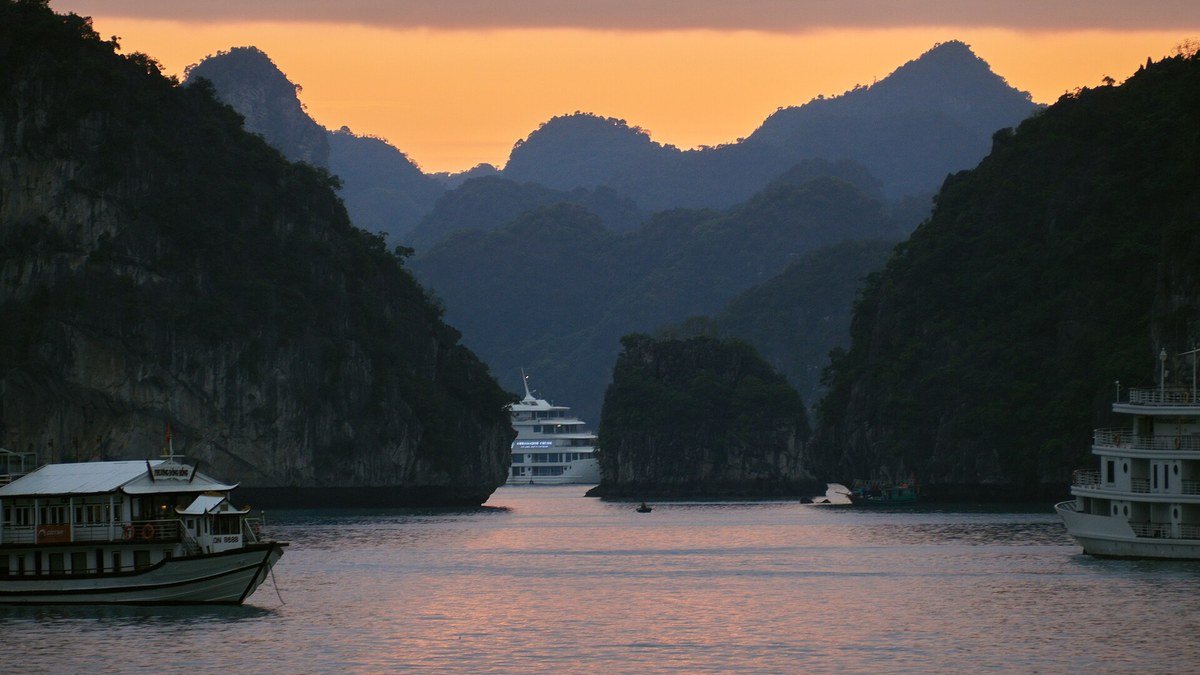
Ha Long Bay, in the north, is Vietnam’s most famous sight for good reason: more than a thousand limestone islands rising from calm, green water, best seen from an overnight cruise. Hanoi, the capital, pairs old streets and street food with lakes and temples, while Hoi An’s lantern-lit old town and the beaches around Da Nang suit a slower middle leg of a trip. In the south, Ho Chi Minh City offers markets, museums and a very different urban energy, and the Mekong Delta is an easy side trip. A 90-day e-visa gives you room to see all of it without rushing, and the multiple-entry option makes it easy to combine Vietnam with neighbouring Thailand or Indonesia in one longer journey.
Frequently Asked Questions
Can a Pakistani passport holder apply for a Vietnam e-visa?
Yes. Since 15 August 2023, Vietnam’s e-visa has been open to citizens of all countries and territories, which includes Pakistan. There is no official Pakistan-specific extra document, fee or longer processing rule.
How much does a Vietnam e-visa cost for Pakistanis?
USD 25 for a single-entry e-visa and USD 50 for a multiple-entry e-visa, both for stays of up to 90 days. The fee is paid online in US dollars and is not refunded if the application is refused.
How long does a Vietnam e-visa take?
Vietnamese law requires immigration authorities to respond within 3 working days of receiving a complete application and fee. Apply at least two weeks before travel to allow for weekends, public holidays and any queries.
How long can I stay in Vietnam on an e-visa?
Up to 90 days, single or multiple entry, as shown on your approved e-visa. The dates printed on the approval are the ones that count.
Do I need to visit the Vietnam embassy in Pakistan?
No, not for a standard tourist e-visa. The whole process is online, and the printed e-visa is your permit. The embassy in Islamabad is the contact for cases that do not fit the e-visa route.
Can I enter Vietnam at any airport with an e-visa?
No. The e-visa is valid only at the 83 Government-designated checkpoints, including 17 airports such as Noi Bai (Hanoi), Tan Son Nhat (Ho Chi Minh City) and Da Nang. Check the current list on the official portal before you apply.
Is visa on arrival available for Pakistanis?
No official Immigration Department or Foreign Ministry page confirms a visa-on-arrival approval-letter route for Pakistani nationals, and third-party figures for it conflict. The official route is the e-visa, applied for online before travel.
Can I extend my Vietnam e-visa while I am in Vietnam?
There is no simple extension. A person in Vietnam can only seek a new visa through an inviting or guaranteeing sponsor under the Law on Entry and Exit. Otherwise, leave before expiry and apply for a new e-visa from outside Vietnam.
What happens if my e-visa application is refused?
The fee is not refunded. Check the refusal reason, correct the problem, and apply again. Do not travel on a refused application, and do not pay an agent who promises to reverse a refusal for an extra fee.
Do I need a bank statement or hotel booking for the e-visa?
No official source requires them for a standard e-visa application. Carry a hotel booking and a return or onward ticket anyway, because airlines and immigration officers can ask about your stay.
Official Sources
- Vietnam Immigration Department, National Portal on Immigration (e-visa information): https://evisa.xuatnhapcanh.gov.vn/
- Official Vietnam e-visa portal: https://evisa.gov.vn/
- Embassy of Vietnam in Warsaw, Resolution No. 127/NQ-CP on electronic visas: https://vnembassy-warsaw.mofa.gov.vn/en-us/News/EmbassyNews/Pages/Resolution-No-127NQCP-on-the-application-of-electronic-visas.aspx
- Ministry of Justice, Vietnam, fee schedule (single-entry USD 25, multiple-entry USD 50): https://moj.gov.vn/vbpq/en/lists/vn%20bn%20php%20lut/view_detail.aspx?itemid=10532
- Government News, expansion of e-visa ports to 83 (Resolution No. 389/NQ-CP, 2 December 2025): https://en.baochinhphu.vn/viet-nam-expands-list-of-ports-for-e-visa-111251203153134777.htm
- Embassy of Vietnam in Pakistan: https://vnembassy-islamabad.mofa.gov.vn/
- Law No. 51/2019/QH14, Article 16a (3-working-day processing rule): https://comingo.gov.vn/data/data/comingo/files/van-ban/Law%2051_2019_doc.pdf
Disclaimer
TourPointGo is an independent visa-information website, not a government authority, embassy, travel agency or immigration law firm. Visa rules can change without notice. Always confirm the current requirements on the official e-visa portal and with the Embassy of Vietnam in Pakistan before you travel, and never rely on an agent’s claim over an official source. This guide was checked against official Vietnamese sources in October 2026.






1 thought on “Vietnam Visit Visa From Pakistan 2026: e-Visa Fees, Requirements and How to Apply”