Kenya does not issue a traditional visa to Pakistani visitors any more, and that surprises many first-time travellers. Since January 2024, Kenya has used an Electronic Travel Authorisation, known as the eTA, instead of its previous general visa system. For a Pakistani passport holder, this is actually good news: there is no embassy visit, no paper form and no visa sticker. The whole application is completed online, the standard fee is USD 30, and most applications are processed within three working days.
This guide explains who needs the eTA, what it costs, which documents to prepare, and how to apply step by step through Kenya’s official portal. All fees, processing times and rules below were checked against the official Kenya eTA portal, etakenya.go.ke, on 3 November 2026. Where a detail is not stated on the official portal, this guide says so rather than filling the gap with a guess.
Key facts at a glance

| Question | Answer for Pakistani passport holders |
|---|---|
| Do Pakistanis need an eTA? | Yes. Pakistan is not on any of Kenya’s eTA exemption lists, so an ordinary Pakistani passport holder needs an approved eTA before travelling |
| What is it? | A pre-travel electronic authorisation, not a visa sticker and not a guarantee of entry |
| Standard fee | USD 30 |
| Transit eTA fee | USD 20 |
| Processing time | Generally three working days (72 hours); it can take longer in some cases |
| Urgent option | Expedited processing, an additional USD 100, processed immediately according to the portal |
| Where to apply | Only at etakenya.go.ke or through the official Kenya Travel Authorisation mobile app |
| Travel-use validity | Valid for travel within 90 days from the date of issue |
| Permitted stay | Decided by the immigration officer at the point of entry; it is not fixed by the eTA itself |
| Entries (standard eTA) | Single entry: it allows entry into Kenya once |
| Children | Every traveller, including infants and children, needs their own eTA |
Do Pakistanis need an eTA for Kenya?
Yes. Kenya’s official “How to Apply” page lists the people who are exempt from the eTA under the Kenya Citizenship and Immigration (Amendment) Rules, 2025. The exempt groups are citizens of the East African Partner States (Burundi, Democratic Republic of Congo, Rwanda, South Sudan, Tanzania and Uganda, for stays up to 180 days), nationals of a published list of countries exempt for up to 90 days, nationals of another published list of African countries exempt for up to 60 days, and certain special categories such as airside transit passengers who do not leave the airport and holders of specified laissez-passers on official business.
Pakistan appears on none of those lists. A Pakistani ordinary passport holder therefore needs an approved eTA before the journey begins, even for a short holiday, a family visit or a business trip. The portal states this plainly: all visitors, including infants and children, who intend to travel to Kenya must have an approved eTA before the start of their journey. Airlines check it too, so do not plan to sort it out at the airport in Nairobi. There is no visa on arrival to fall back on.
One common misunderstanding is worth clearing up at the start. An approved eTA gives you permission to travel to Kenya. It is not the final authority to enter the country. The portal repeats this in its general information: admissibility is determined at the point of entry, and the immigration officer there decides both whether you are admitted and how long you may stay. Treat the eTA as the first gate, not the only one.
What the Kenya eTA is, and what it is not
The eTA is a semi-automated system run by Kenya’s Directorate of Immigration Services, under the Ministry of Interior and National Administration. When you apply, you submit biographic information and answers to eligibility questions. The system checks your eligibility to travel, and if approved, you receive an electronic authorisation by email.
It is not a visa in the old sense. Nothing is pasted into your passport. Your approval arrives as a PDF document attached to an email, and you either print it or save it to your mobile device or to the official Kenya Travel Authorisation app. You show it at departure and at arrival.
It is also not a promise of a particular length of stay. This is the single most misunderstood point in Kenya travel writing, so it deserves emphasis. The eTA is valid for travel within 90 days from the date of issue. That 90-day period is the window in which you must travel, not a guaranteed 90-day stay. Once you arrive, the immigration officer issues a visitor’s pass and decides your permitted stay. Do not book a 90-day trip on the assumption that the eTA alone entitles you to 90 days in Kenya.
Fees: what you actually pay
The official eligibility page lists the eTA types and their fees as follows. The standard eTA is the one almost every Pakistani tourist, family visitor or business visitor needs.
| eTA type | Fee | What it covers |
|---|---|---|
| Standard eTA | USD 30 | Entry into Kenya once |
| Transit eTA | USD 20 | For travellers on a transit flight through Kenya |
| One-Year Multi-Entry eTA | USD 300 | Multiple entries over a period of one year |
| Five-Year Multi-Entry eTA | USD 185 | For American nationals visiting multiple times over five years |
| East African Tourist eTA | Coming soon | Listed on the portal as coming soon; it is not currently available to apply for |
Two warnings follow from that table. First, the five-year multi-entry option is described on the portal as being for American nationals, so a Pakistani traveller should not plan around it. Second, the East African Tourist eTA, which would cover Kenya, Uganda and Rwanda, is marked “coming soon” on the portal. It should not be presented as a live alternative. If you plan to visit Uganda or Rwanda as well as Kenya, check each country’s own entry rules separately rather than assuming one authorisation covers all three.
On top of the base fee, the portal offers an expedited option at an additional USD 100, which it describes as processed immediately. The standard fee is described as “starting at USD 30” in the portal’s frequently asked questions, so check the final total shown at checkout before you pay, in case payment charges are added. Fees are paid online by card during the application. Never pay through a third-party site that adds its own service charge on top of the government fee; the official portal and the official app are the only channels named by the Government of Kenya.
Documents to prepare before you start
The portal’s required documents list is short, which is part of the eTA’s appeal. Before starting your application, make sure you have the following:

- A valid passport with at least six months of validity and at least one blank page.
- A selfie or passport-type photo.
- Contact details, meaning an email address and a phone number.
- Your travel itinerary, showing arrival and departure details.
- An accommodation booking confirmation.
- A payment method, such as a credit or debit card.
Depending on the purpose of your trip, the portal asks for additional documents. Business travellers need an invitation letter from the company in Kenya and a copy of that company’s registration. Family visitors need an invitation letter from their host, plus the host’s ID, passport, alien card or entry permit. Medical travellers need a referral letter from a hospital, conference travellers need an invitation or participation letter, and employment travellers need a contract document. Vaccination or test result certificates are also listed among the additional documents that may be requested, depending on your circumstances.
A practical point on the photo: this is the document that causes the most avoidable delays in online applications generally, so take a clear, recent, passport-style photograph against a plain background, with your face fully visible and no sunglasses or head covering that obscures your face (unless worn for religious reasons and still showing your face clearly). A blurry selfie taken in poor light is the easiest way to slow down an otherwise simple application.
You do not need to show a fixed bank balance figure, because the portal does not publish one for the standard eTA. That does not mean funds are irrelevant at the border: an immigration officer can still ask how your trip is funded, so carry the same sensible evidence you would for any international trip, such as your return ticket, your accommodation booking and access to funds for your stay. Present these as supporting evidence, not as a published requirement, because that is what they are.
How to apply, step by step
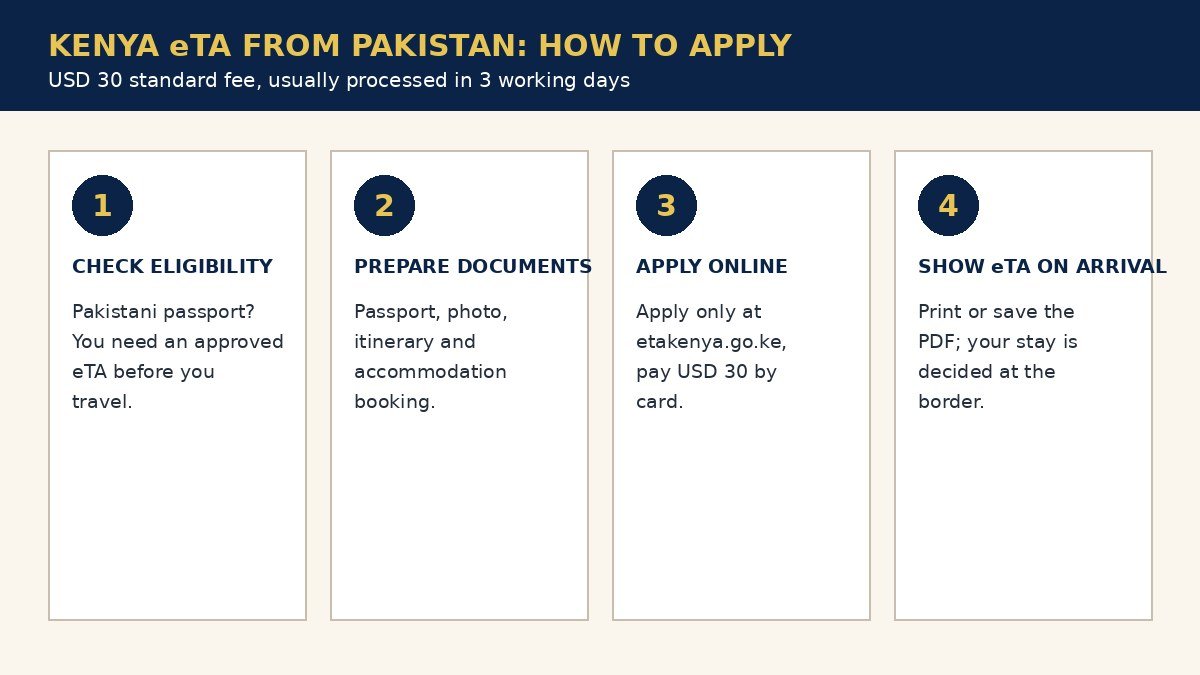
Apply only at etakenya.go.ke or through the official Kenya Travel Authorisation mobile application. Every other website that looks similar is not the government portal, however convincing its design. The portal’s own frequently asked questions state that applications must be completed only through the official website or the official app, and must be done for each individual traveller.
Step 1: Open the official portal and choose how to apply
Go to etakenya.go.ke and click “Apply Now”. You can apply as an individual or as a group. A group application still creates an eTA for each passenger; there is no family eTA that covers several people on one document. You can also apply on behalf of another traveller, provided you enter that traveller’s information correctly and indicate that you are applying on their behalf when you finish the application. This is useful for parents applying for children, since every child, including an infant, needs their own eTA.
Step 2: Enter your details exactly as they appear in your passport
Enter your biographic details, passport details, contact details and travel itinerary exactly as shown in your passport and bookings. Small mismatches between an application and a passport are a classic cause of problems at check-in, so check spelling, passport number and dates of travel twice before moving on. Choose the correct eTA type: standard for an ordinary visit, transit if you are transiting through Kenya and need to enter the country during transit.
Step 3: Upload your photo and any purpose-specific documents
Upload your selfie or passport-type photo, and add any additional documents for your purpose of travel, such as a business invitation letter or a host invitation letter for a family visit. If the form asks for your accommodation booking confirmation, upload the booking you actually intend to use. A booking made only to satisfy the form, and then cancelled, helps no one if an officer asks about your stay on arrival.
Step 4: Pay and submit
Pay the fee by card and submit the application. You will receive an email confirming receipt of your application, and a further email confirming receipt of payment where applicable. Keep the reference number sent to your email: you need it to check the status of your application at any time through the “Check Status” button on the portal homepage.
Step 5: Wait for the decision, then travel only after approval
Applications are generally processed within three business days, or 72 hours, but the portal warns that they may take longer depending on verification. Its general information recommends submitting at least two weeks before travel to allow adequate time for processing. That recommendation is worth following even though three days is the usual time: a verification delay a few days before a flight is far more stressful than the same delay a fortnight out.
When a decision is made, you receive an email confirming approval or refusal. If approved, the email carries your eTA as a PDF. Print it, or download it to your mobile device or save it in the official app, and show it at all departure and arrival points. The portal is explicit: you are only allowed to travel after your application has been approved. If your application is refused, you cannot travel to Kenya for the moment on that application, and you should contact the portal’s support team for further details rather than boarding anyway and hoping the problem resolves at the airport.
When to apply
The timing question has two parts, and keeping them separate avoids the most common planning error.
First, apply early. The portal recommends at least two weeks before travel, even though standard processing is usually three working days. Apply as soon as your passport, itinerary and accommodation are settled, and do not leave it to the week of departure unless you are prepared to pay the additional USD 100 for expedited processing.
Second, do not apply too early either. Because the eTA is valid for travel within 90 days from the date of issue, an eTA issued too far ahead of your trip can expire before you travel. In practice, this means the sensible window is to apply a few weeks before departure: early enough to absorb a verification delay, but not so early that the 90-day travel window closes before your flight. If your plans change and your eTA expires unused, you will need a new one.
Transit through Kenya
Transit is the one area where some travellers genuinely do not need an eTA, and it is narrowly defined. Passengers who arrive and leave by the same aircraft, or who transfer to another aircraft without leaving the precincts of the airport, are exempt. The same applies to passengers arriving and leaving by the same ship without leaving the ship, and to airline and ship crew travelling on the manifest.
If your transit requires you to leave the airport, for example to stay overnight in Nairobi or to catch a flight the next day from a different terminal arrangement that takes you through immigration, you are no longer in that exempt airside category. The portal lists a Transit eTA at USD 20 for travellers on a transit flight through Kenya. When in doubt, apply for the transit eTA rather than assuming you are exempt: the cost of the eTA is small compared with the cost of a missed connection.
Extending your stay in Kenya
Your permitted stay is decided on arrival, and it can be extended. Guidance from Kenya’s embassies explains that a visitor who wishes to stay beyond the period given on entry should apply for an extension at the nearest Immigration Office, and that a visitor’s pass can be extended by up to 90 days in the first instance and by a further period of up to 90 days, up to a maximum of 180 days in total. Do not overstay and then explain it afterwards. Apply for the extension before your current permission expires, and keep proof of your application.
Overstaying is a poor bargain in any country, and Kenya is no exception. An overstay can affect future eTA applications and future travel far beyond one trip, so treat the date on your visitor’s pass, not the 90-day eTA travel window, as the date that governs your stay.
What the eTA allows, and what it does not allow
The standard eTA covers the ordinary purposes of a visit: tourism, visiting family and friends, and business visits such as meetings and conferences, with the purpose-specific documents described above. It does not authorise you to take up employment in Kenya. The employment category on the portal is a separate purpose with its own contract requirement, and working on a visitor authorisation is not a shortcut to it.
It also does not cover study, long-term residence or any activity that needs a Kenyan permit or pass. If your real purpose is to study, work or live in Kenya, the eTA is the wrong route, and you should look at the relevant permit category instead of stretching a visitor authorisation to fit. The eTA gets you to the border for a visit; what you do after arrival must match the purpose you declared.
Common mistakes that delay or damage an application
- Applying through a lookalike website. Only etakenya.go.ke and the official Kenya Travel Authorisation app are the government channels. Copycat sites charge extra and can mishandle your personal data.
- Treating the eTA as a visa on arrival. There is no arrival fallback for Pakistani passport holders. Without an approved eTA, you should not board.
- Confusing the 90-day travel window with a 90-day stay. The eTA must be used for travel within 90 days of issue; your stay is decided at the border.
- Applying for one person and assuming it covers the family. Every traveller, including infants, needs their own eTA.
- Entering passport details with a typo. The name, number and expiry date must match the passport exactly.
- Applying too late, or far too early. Aim for a few weeks before departure, and follow the portal’s recommendation of at least two weeks.
- Assuming the East African Tourist eTA is available. The portal marks it as coming soon. Plan multi-country trips on each country’s own rules until it launches.
- Assuming the five-year multi-entry eTA applies to everyone. The portal describes it as for American nationals. Pakistani travellers should use the standard eTA, or the one-year multi-entry option if their travel pattern genuinely needs it.
Refusals and entry problems
A refusal of an eTA means you cannot travel to Kenya on that application. The portal’s advice in that situation is to contact its support team for further details. You can reach the eTA support lines published on the portal’s contact page, on +254 717 436 070, or on +254 202 222 022 and +254 110 922 064. Do not attempt to travel on a refused application, and do not submit a string of duplicate applications without understanding why the first one was refused: repeated identical applications do not improve your chances and can complicate your record.
Even with an approved eTA, entry is decided at the border. Carry the same documents you used for the application, in printed or easily accessible form: your passport, your printed or saved eTA, your return or onward ticket, your accommodation booking, and any invitation letter for a business or family visit. If an officer asks about your plans, a clear, consistent answer backed by those documents is worth more than any argument about the approval email.
Practical tips for the trip itself
Kenya rewards the traveller who plans the visit around the eTA rather than around the flight deal. Book refundable or flexible accommodation until your eTA is approved, keep your approval PDF in two places (printed and on your phone), and save the portal’s status-check reference number where you can find it at the airport.
For the safari itself, the Maasai Mara National Reserve is Kenya’s most famous wildlife destination, and Amboseli National Park, with its elephant herds on the plains below Mount Kilimanjaro across the border in Tanzania, is the country’s classic postcard view. Both are reached from Nairobi, and both are best enjoyed through a reputable local operator with proper park arrangements, rather than improvised on arrival. Park fees, internal flights and lodge bookings are separate from the eTA and are not covered by the USD 30 fee, so budget for them separately.
Finally, keep a note of the distinction this whole guide turns on. The eTA is cheap, quick and online, but it is a permission to travel, not a right of entry and not a fixed stay. Respect that distinction, apply a few weeks ahead, and the authorisation itself should be the simplest part of the trip.
Frequently asked questions
Do Pakistani citizens need an eTA for Kenya?
Yes. Pakistan is not on any of Kenya’s exemption lists under the 2025 immigration rules, so an ordinary Pakistani passport holder needs an approved eTA before travelling. Every traveller, including infants and children, needs their own eTA.
How much does the Kenya eTA cost for Pakistanis?
The standard eTA costs USD 30. A transit eTA costs USD 20. Expedited processing costs an additional USD 100. Check the final total at checkout before paying, in case payment charges are added.
How long does the Kenya eTA take?
Applications are generally processed within three working days (72 hours), but they can take longer if verification is needed. The portal recommends applying at least two weeks before travel.
How long is the Kenya eTA valid for?
The eTA is valid for travel within 90 days from the date of issue. That is the window in which you must travel. Your permitted stay in Kenya is decided by the immigration officer at the point of entry, and it is not automatically 90 days.
Is the Kenya eTA a visa?
No. It replaced Kenya’s previous general visa system in January 2024. It is an electronic pre-travel authorisation. Nothing is pasted into your passport; your approval arrives by email as a PDF.
Can I get a visa on arrival in Kenya?
No, not as a Pakistani passport holder. There is no general visa on arrival fallback. You must have an approved eTA before your journey begins, and you should not board without it.
Does one eTA cover my whole family?
No. The portal requires an eTA for each individual traveller. You can submit a group application, and you can apply on behalf of another traveller, but each person, including each child, receives their own eTA.
Can I work in Kenya on an eTA?
No. The standard eTA covers visits such as tourism, family visits and business meetings. It does not authorise employment. Employment is a separate purpose with its own contract requirement.
Can I extend my stay in Kenya?
Yes, by applying at the nearest Immigration Office before your current permission expires. Embassy guidance describes extensions of up to 90 days in the first instance and a further 90 days, up to 180 days in total. Do not overstay and explain it afterwards.
What should I do if my eTA is refused?
Do not travel on that application. Contact the portal’s support team for further details, using the support numbers published on the portal’s contact page, and understand the reason before deciding your next step.
Where do I apply for the Kenya eTA?
Only at etakenya.go.ke or through the official Kenya Travel Authorisation mobile app. Any other website offering a Kenya eTA for a higher fee is not the government portal.
Official sources
- Kenya Electronic Travel Authorisation, official government portal: https://etakenya.go.ke/
- Kenya eTA, How to Apply (exemptions under the Kenya Citizenship and Immigration (Amendment) Rules, 2025, required documents, processing time): https://etakenya.go.ke/how-to-apply
- Kenya eTA, General Information (eTA as permission to travel, admissibility at the point of entry, recommendation to apply at least two weeks before travel): https://etakenya.go.ke/general-information
- Kenya eTA, Eligibility and fees (standard USD 30, transit USD 20, one-year multi-entry USD 300, five-year multi-entry for American nationals USD 185, East African Tourist eTA coming soon): https://etakenya.go.ke/eligibility
- Kenya eTA, Frequently Asked Questions (application steps, three business days or 72 hours, expedited processing at an additional USD 100, status checking): https://etakenya.go.ke/faqs
- Kenya eTA, Contact (support telephone numbers): https://etakenya.go.ke/contact-us
- Embassy of Kenya, Washington D.C., Electronic Travel Authorization (eTA replacing the previous evisa.go.ke platform effective 5 January 2024; eTA valid for travel within 90 days from issue; stay determined at the point of entry): https://kenyaembassydc.org/eta/
All official pages above were checked on 3 November 2026. Fees and rules can change, so re-check the portal before you apply and before you travel.
Related TourPointGo guides
- Nepal Visit Visa From Pakistan
- Sri Lanka Visit Visa From Pakistan
- Thailand Visit Visa From Pakistan
- Malaysia Visit Visa From Pakistan
Disclaimer
TourPointGo is an independent visa-information website. It is not a government authority, embassy, travel agency or immigration adviser, and it is not affiliated with the Government of Kenya. This guide summarises official information checked on 3 November 2026, but immigration rules, fees and portal procedures can change without notice. Always confirm the current requirements on the official Kenya eTA portal before applying or travelling, and seek professional advice for complex cases. An approved eTA does not guarantee entry into Kenya.