Thailand is one of the most popular holiday destinations for Pakistani travellers, and it is easy to see why. Bangkok offers temples, markets, shopping malls and street food within a single city. Phuket, Krabi and the Phi Phi Islands offer white sand beaches and clear water. Chiang Mai offers cooler weather, mountain scenery and night markets. Flights from Pakistan are frequent, the food is affordable, and halal food is widely available.
The visa process is also more straightforward than many travellers expect, because Pakistanis now apply for a Thailand visa online through the official e-Visa system. There is no need to queue at the embassy to collect a paper form, and there is no visa sticker placed in your passport for the standard tourist route. This guide explains who needs a visa, which visa to choose, the documents you need, the fees, the processing time, and the separate digital arrival card you must complete before you fly.
Key Facts at a Glance
| Detail | Summary |
|---|---|
| Visa type | Tourist Visa (TR), applied for online as an e-Visa |
| Who needs it | Pakistani passport holders travelling for tourism or a short social visit |
| How to apply | Online through the official e-Visa portal at thaievisa.go.th |
| Visa on arrival | Not available for Pakistani passport holders |
| Visa exemption | Pakistan is not on Thailand’s visa exemption list |
| Single entry fee | Rs 13,000 (cash at the embassy) |
| Multiple entry fee | Rs 65,000 (cash at the embassy) |
| Processing time | About 14 working days after the fee is received and acknowledged |
| When to apply | At least 3 to 4 weeks before travel |
| Stay allowed | Up to 60 days per entry |
| Single entry validity | 3 months from the date of issue |
| Multiple entry validity | 6 months from the date of issue |
| Passport validity | At least 6 months from the date of entry |
| Arrival card | Thailand Digital Arrival Card (TDAC), free, within 72 hours before arrival |
| Checked | 17 October 2026 against official Thai government sources |
Do Pakistanis Need a Visa for Thailand?
Yes. Pakistani passport holders must hold a valid visa before they travel to Thailand. Pakistan does not appear on any of Thailand’s visa exemption lists, and it is not one of the three countries whose nationals can apply for a visa on arrival. The Royal Thai Embassy’s published exemption and visa-on-arrival page lists 60 countries for a 30-day exemption and only Azerbaijan, Belarus and Serbia for visa on arrival, effective 15 September 2026. Pakistan is on neither list.
This matters at the airport. An airline can refuse boarding if you arrive at the airport without an approved visa, because the airline would be responsible for carrying a passenger who is not allowed to enter. Do not book non-refundable flights or hotels until you understand the visa timeline, and never travel hoping to sort out the visa on arrival.
One exception is worth noting for completeness. Holders of Pakistani diplomatic passports are exempt from the visa requirement for stays of up to 30 days under a bilateral arrangement. This guide is written for ordinary Pakistani passport holders, who do need a visa.
What Is the Thailand e-Visa?
The Thailand e-Visa is an electronic visa issued through the official portal at thaievisa.go.th, which is operated under the Thai Ministry of Foreign Affairs. You create an account, complete the application form online, upload scanned documents, pay the visa fee, and receive the approved e-Visa by email. You print the e-Visa and carry it with you when you travel. Your passport is not sent anywhere and no sticker is placed in it for the standard tourist route.
Applicants living in Pakistan file with the Royal Thai Embassy in Islamabad or the Royal Thai Consulate-General in Karachi, depending on where they live. You must be physically in Pakistan while your application is processed, and you will be asked to upload proof of your current location, such as a rental agreement, a utility bill or Pakistani immigration stamps. A Pakistani citizen living in another country must apply through the Thai mission that covers that country, not through Islamabad.
No agent is needed to use the system. The portal is designed for applicants to complete it themselves, and the embassy’s own guidance says the system is fully online. If you do choose to use an agent or a drop-box service, remember that the decision is still made by the embassy, and that nobody can guarantee approval.
Tourist Visa Types: Single Entry or Multiple Entry
The tourist visa (TR) comes in two main versions. Most first-time visitors need only the single entry version.
| Visa type | Validity | Stay per entry | Best for |
|---|---|---|---|
| Tourist Visa, single entry | 3 months from the date of issue | Up to 60 days | One holiday in Thailand |
| Tourist Visa, multiple entry | 6 months from the date of issue | Up to 60 days per entry | Several trips to Thailand within six months |
A multiple entry visa is not simply a longer holiday. It suits people who genuinely plan to enter Thailand more than once within six months, for example for repeated business trips combined with tourism, or for a traveller who plans to visit neighbouring countries and return to Thailand. If you plan a single trip, apply for the single entry visa. Note that the visa validity and the permitted stay are different things. A single entry visa may be valid for three months, but that means you must enter Thailand within those three months. Once you enter, you may stay for up to 60 days, and the exact date is stamped in your passport at the border.
Eligibility and Conditions
To qualify for a tourist visa, you must show that you are a genuine visitor. In practice, that means:
- You hold a Pakistani passport valid for at least six months from your date of entry, with blank pages available.
- Your purpose is tourism, visiting friends or family, or another short social visit. You must not work in Thailand on a tourist visa.
- You can show confirmed travel plans, including return flights and accommodation.
- You can show enough money to support yourself during the trip.
- You intend to leave Thailand before your permitted stay ends.
If you have previously overstayed in Thailand or breached visa conditions, your application will face extra scrutiny. A tourist visa also does not allow you to take a job, run a business or study full time in Thailand. Those activities need a different visa category.
Documents Required
Prepare clear scans of every document before you start the online form. The portal asks you to upload documents in the specified formats, and an incomplete file can delay the decision or lead to a request for more documents.

| Document | Notes |
|---|---|
| Passport bio-data page | Ordinary passport, valid at least 6 months from entry |
| Recent passport-size photograph | White background, taken within the last 6 months |
| Proof of current location | Rental agreement, utility bill or Pakistani immigration stamps showing you are in Pakistan |
| Confirmed return or onward flight booking | Must show you leaving Thailand within your permitted stay |
| Proof of accommodation | Hotel booking or invitation letter from a host in Thailand |
| Financial proof | Recent bank statement showing sufficient funds (see below) |
| Employment or business proof | Employment letter, salary slips, business registration or NTN, as applicable |
| CNIC copy | May be requested to confirm identity and residence |
| Family documents | Marriage or family registration certificate if travelling with family |
Consular officers may request additional documents at any stage, and the embassy may ask for an interview in some cases. Provide exactly what is asked for, and respond promptly. A slow or incomplete response can add weeks to the process.
Financial Proof: How Much Money Do You Need?
Thailand’s official guidance for tourist visa applicants requires proof of financial means of at least THB 20,000 per person, or THB 40,000 per family. This is the figure used by Thai embassies and consulates in their published tourist visa requirements. The e-Visa portal checklist for Islamabad asks for this to be shown through bank statements for the last 3 months or a sponsorship letter.
There is no official figure published in Pakistani rupees, because the requirement is set in baht. In practice, the embassy looks at the overall picture: a regular salary or business income, a stable balance and a pattern of spending that matches the trip you describe. A large lump sum deposited days before the application, with no history behind it, is less convincing than a steady account.
For a multiple entry tourist visa, the embassy’s older tourist visa sheet asks for more: a balance of more than Rs 650,000 held in the account for six months in a row. If you plan to apply for the multiple entry version, prepare for this stricter test.
Make sure the name on the bank statement matches your passport, and that the statement is stamped or certified by your bank if the embassy asks for it. If someone else is funding your trip, such as a parent or spouse, include a sponsorship explanation and that person’s bank statement and proof of relationship.
How to Apply: Step by Step
- Create an account on thaievisa.go.th. Use your own email address, because the visa decision and all updates are sent there. One account can be used for family applications.
- Select the correct mission. Choose the Royal Thai Embassy in Islamabad or the Royal Thai Consulate-General in Karachi, according to where you live in Pakistan.
- Choose the visa category. Select Tourist Visa (TR), then single entry or multiple entry.
- Complete the online form. Enter your personal details, passport information and travel details exactly as they appear in your passport. The application cannot be amended after submission, and errors such as a misspelt name or a wrong passport number can lead to rejection.
- Upload your documents. Upload each document in the format and size the portal asks for. Check that every scan is clear and fully legible.
- Pay the visa fee in cash at the embassy. After submitting online, print the application confirmation and take it with the cash fee to the Royal Thai Embassy visa gate in Islamabad (9:30am to 1pm or 2pm to 3:30pm on working days). Karachi applicants pay at the Consulate-General, which has its own payment options. The fee is non-refundable, even if the visa is refused, so check every detail before you pay.
- Wait for processing. The embassy reviews applications in the order the fee is received. Check your email and the portal regularly for requests for extra documents.
- Download and print your e-Visa. Once approved, the e-Visa is sent by email. Print it and carry the printed copy when you travel. Electronic copies are not accepted at immigration checkpoints.
Fees
The Royal Thai Embassy in Islamabad charges the following fees under its Consular and Visa Services fee sheet, effective 15 July 2024. Fees are paid in cash at the embassy visa gate and are never refunded, even if the application is refused or withdrawn.
| Visa type | Validity | Fee |
|---|---|---|
| Tourist, single entry | 3 months | Rs 13,000 |
| Tourist, multiple entry | 6 months | Rs 65,000 |
| Transit, single entry | Not stated | Rs 11,000 |
| Transit, double entry | Not stated | Rs 22,000 |
| Non-Immigrant, single entry | 3 months | Rs 26,000 |
| Non-Immigrant, multiple entry | 1 year / 3 years | Rs 65,000 / Rs 130,000 |
| Destination Thailand Visa (DTV) | Not stated | Rs 130,000 |
| Diplomatic, official, courtesy | Not stated | Free |
Two warnings are worth repeating. First, pay only the published fee. The embassy has warned that any extra fee demanded by anyone is not part of its schedule, and applicants should report anyone asking for extra money. Second, be careful with third-party charges. Some agents and drop-box services charge several thousand rupees on top of the embassy fee for handling the application. That service charge is separate from the government fee, and you should always ask for the breakdown before you pay. You do not need an agent: the embassy says anyone can apply alone through the e-Visa portal.
Processing Time
The embassy estimates approximately 14 working days, counted from when your fee is received and acknowledged, not from when you submit the online form. Until you pay at the embassy gate, nothing moves. Fourteen working days is close to three calendar weeks, and it can be longer around Pakistani and Thai public holidays, so plan for a full month between applying and flying. A booking confirmation is enough for the application, so you do not need to buy non-refundable tickets before the visa is approved.
If the embassy asks for additional documents, the processing time can extend further from the date the complete set is received. Check your email and your portal account regularly, and respond promptly to any request.
Thailand Digital Arrival Card (TDAC)
The e-Visa is not the last step. Since 1 May 2025, every foreign visitor to Thailand must also complete the Thailand Digital Arrival Card (TDAC) before arrival. The TDAC replaced the paper TM6 arrival card that travellers used to fill in on the plane.
- Where: the only official portal is tdac.immigration.go.th, run by the Thai Immigration Bureau.
- When: within 72 hours before your arrival in Thailand.
- Cost: free. Any website that charges a fee for the TDAC is not the official portal.
- What you need: your passport details, flight number, accommodation address in Thailand, and a working email address.
- What you receive: a confirmation email with a QR code. Keep it on your phone and take a screenshot as a backup.
- Who needs one: every foreign visitor, including children and infants. Each person needs their own TDAC.
The TDAC is not a visa. It is an arrival declaration. You still need your e-Visa, and you still need to meet the entry conditions at the border. Airlines increasingly check the TDAC at check-in, so complete it before you leave for the airport. Malaysia runs a similar system for its visitors: if you are comparing nearby destinations, read our Malaysia visit visa from Pakistan guide, which covers its eVisa and its own digital arrival card.
At the Border: What Immigration May Ask For
When you arrive in Thailand, an immigration officer will check your passport, your printed e-Visa and your TDAC QR code, and will stamp your permitted stay. The officer may also ask for:
- Your return or onward ticket.
- The address of your accommodation.
- Proof of enough money for your stay (THB 20,000 per person or THB 40,000 per family in cash or equivalent).
- Your travel plans.
Answer clearly and honestly. Keep your hotel booking and return ticket easily accessible, not buried in checked luggage. The date stamped in your passport is the date that matters: it is your legal deadline to leave or to extend your stay. Read it before you leave the counter.
Where to Go in Thailand
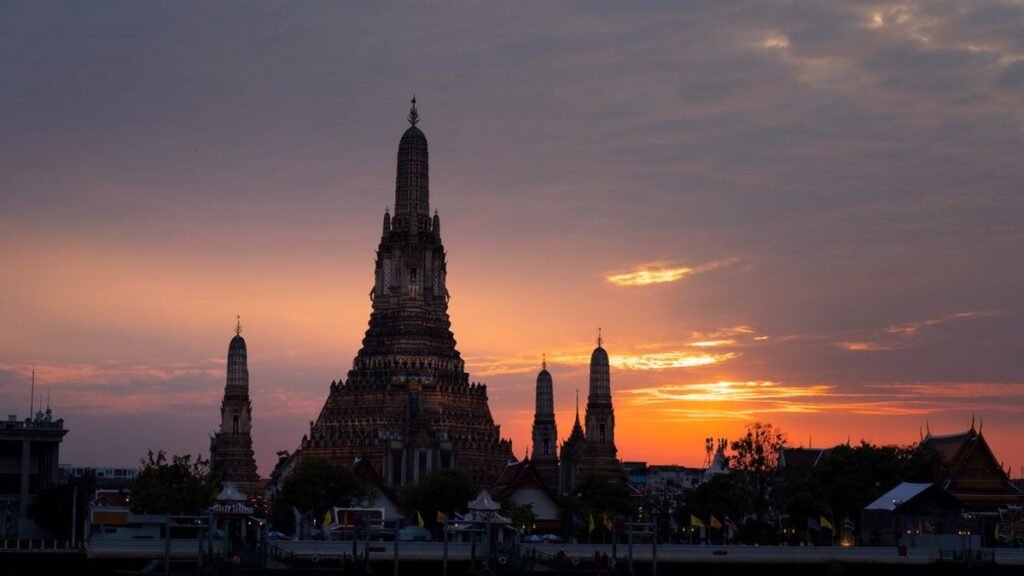
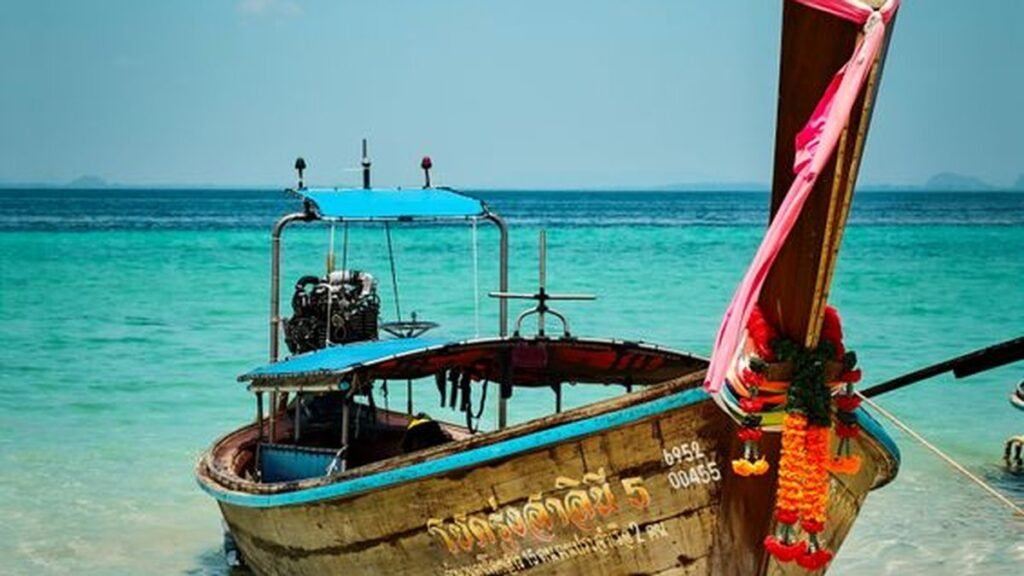
If this is your first trip, a simple route works well. Spend three or four days in Bangkok for the Grand Palace, Wat Arun (the Temple of Dawn), Wat Pho, the Chao Phraya river boats, and the markets and malls. Then fly south to Phuket or Krabi for beaches and island trips, or north to Chiang Mai for temples, mountain scenery and night markets. Domestic flights in Thailand are affordable and frequent, and the islands are reached by ferry or speedboat.
A few practical points help the trip run smoothly. Dress modestly when visiting temples: cover your shoulders and knees, and remove your shoes before entering temple buildings. Carry cash for markets, small restaurants and island trips, because cards are not accepted everywhere. E-cigarettes and vapes are banned in Thailand, including possession, and the penalties are serious, so leave them at home. Finally, keep your passport and e-Visa printout safe, and keep a photo of them on your phone.
For another Southeast Asian option, see our Philippines visit visa from Pakistan guide.
Extending Your Stay in Thailand
If you want to stay longer than your original 60 days, you can usually apply for one extension of up to 30 days at a Thai immigration office before your permitted stay expires. The government fee is THB 1,900, payable in cash. You apply in person, with your passport, a completed TM.7 form, a passport-size photograph, and proof of your accommodation. The extension runs from your original expiry date, so applying early does not cost you days.
You cannot extend after your stay has expired. Once the stamp has expired, you are overstaying, and no extension can fix it. If you think you will need more time, visit the immigration office early in your stay rather than in the last few days.
Overstaying: Fines and Bans
Thailand enforces overstay rules strictly. The fine is THB 500 per day, up to a maximum of THB 20,000, paid when you leave. Longer overstays also bring re-entry bans: overstays of 90 days or more can lead to bans of one to ten years, depending on the length and whether you left voluntarily or were caught. An overstay record also stays on your immigration history and can affect future Thai visa applications. If something goes wrong, such as an illness or a cancelled flight, go to the immigration office before your stay expires and explain the situation. Do not simply wait and hope.
Common Reasons for Refusal
- Incomplete or inconsistent documents. Bank statements that do not match the declared income, or bookings that do not cover the full trip.
- Weak financial proof. A low or unstable balance, or a sudden large deposit with no explanation.
- Unclear purpose of travel. A vague itinerary, or a stated purpose that does not match the documents.
- Errors on the form. A misspelt name, a wrong passport number or a wrong date of birth. These cannot be fixed after submission.
- Poor immigration history. A previous overstay in Thailand or in another country.
- Applying from the wrong country. The embassy only processes applicants who are physically in Pakistan.
If your application is refused, the fee is not refunded. Read the refusal message carefully, fix the specific problem, and submit a fresh, corrected application. Do not submit the same file again and expect a different result.
FAQs
Do Pakistanis get a visa on arrival in Thailand?
No. Pakistan is not on Thailand’s visa-on-arrival list. As of 15 September 2026, only Azerbaijan, Belarus and Serbia qualify for visa on arrival. Pakistani passport holders must obtain a visa before travelling.
Is Thailand visa free for Pakistan?
No. Pakistan is not on Thailand’s visa exemption list. Ordinary Pakistani passport holders must apply for a tourist visa in advance through the e-Visa portal.
How much is the Thailand visa fee from Pakistan?
Rs 13,000 for a single entry tourist visa and Rs 65,000 for a 6-month multiple entry tourist visa, under the embassy’s fee sheet effective 15 July 2024. The fee is paid in cash at the Royal Thai Embassy in Islamabad and is non-refundable.
How long does the Thailand visa take from Pakistan?
About 14 working days after the embassy receives and acknowledges your fee, according to the embassy. Plan for a full month between applying and flying to allow for holidays and any requests for extra documents.
How long can I stay in Thailand on a tourist visa?
Up to 60 days per entry. A single entry visa is valid for 3 months from the date of issue, meaning you must enter Thailand within that window. You can usually extend your stay once by up to 30 days at an immigration office inside Thailand for THB 1,900.
Do I need to print my Thailand e-Visa?
Yes. The approved e-Visa is sent to you by email. Print it and carry the printed copy when you travel. Electronic copies are not accepted at immigration checkpoints.
Do children need a visa and a TDAC?
Yes. Every traveller, including children and infants, needs their own visa (or to be covered by the applicable rules for their passport) and their own TDAC. For minors, the application also requires parental consent documents and copies of the parents’ passports or ID.
Can I work in Thailand on a tourist visa?
No. A tourist visa does not allow any form of work in Thailand. If you breach this condition, your stay permit can be cancelled and you can be barred from entering Thailand in the future. Work requires a non-immigrant visa and a work permit.
Can I convert a tourist visa into another visa inside Thailand?
In some cases, a change of visa status is possible through the Immigration Bureau, for example from a tourist entry to a non-immigrant category, provided enough days remain on your stay. This is a separate application with its own fee and requirements, and approval is discretionary. Do not assume it will be granted.
What should I do if my e-Visa application asks for more documents?
Respond through the e-Visa portal only, and do it promptly. The embassy does not accept documents by email for e-Visa applications. An unanswered request delays the decision, and the processing clock can restart from the date the embassy receives the complete set of documents.
Related Guides
If you are weighing Thailand against other popular destinations from Pakistan, see our Malaysia visit visa from Pakistan guide (also an online eVisa plus a digital arrival card) and our UAE visit visa from Pakistan guide. For a neighbouring Southeast Asia trip, see our Vietnam visit visa from Pakistan guide.
If your Asia trip extends beyond Southeast Asia, see also our Japan visit visa from Pakistan guide.
Sources
- Royal Thai Embassy, Doha: Tourist Visa Exemption and Visa-on-Arrival (lists effective 15 September 2026): doha.thaiembassy.org
- Thailand e-Visa official portal: thaievisa.go.th
- Thailand Digital Arrival Card, Immigration Bureau: tdac.immigration.go.th
- Royal Thai Consulate-General, Los Angeles: Tourist Visa (Tourism and Leisure Activities) (TR stay, validity and financial proof): thaiconsulatela.thaiembassy.org
- Royal Thai Embassy, Islamabad: FAQs on Thailand’s e-Visa (March 2025) and Consular and Visa Services Fees sheet (effective 15 July 2024), as verified and quoted by Pakera on 29 September 2026: pakera.pk/thailand-evisa-pakistan (the embassy’s own website rendered only a generic Ministry of Foreign Affairs splash page when checked on 17 October 2026, so the fee and FAQ figures are quoted from the embassy documents as verified in that secondary report)
- Immigration Bureau of Thailand: immigration.go.th
Disclaimer
This guide is independent editorial content published by TourPointGo for general information. It is not a visa consultancy, travel agency, government authority or immigration law firm, and it does not guarantee that any application will be approved. Visa rules, fees and procedures can change without notice. Always confirm the current requirements on the official e-Visa portal and the Royal Thai Embassy in Islamabad website before you apply.


8 thoughts on “Thailand Visit Visa From Pakistan 2026: Requirements, Fees and How to Apply”