
Key Facts at a Glance
| Detail | Summary |
|---|---|
| Visa type | UK Standard Visitor visa |
| Who needs it | Pakistani passport holders (visa nationals) |
| Maximum stay | 6 months per visit |
| Entries | Multiple entry |
| Standard fee (2026) | £135 for up to 6 months |
| Standard processing time | 3 weeks from your biometrics appointment |
| How to apply | Online at GOV.UK, then biometrics at a VFS Global centre in Pakistan |
If you hold a Pakistani passport and plan to visit the United Kingdom in 2026, whether for a holiday, to see family, or for a short business trip, you will almost certainly need a UK Standard Visitor visa before you travel. Pakistan is on the UK’s list of “visa national” countries, so you cannot travel to the UK without a visa, and the Electronic Travel Authorisation (ETA) scheme does not apply to Pakistani citizens.
This guide covers everything a Pakistani applicant needs to know: who qualifies, what the visa allows, the documents you should prepare, the current fees, how to apply through VFS Global in Pakistan, and how long a decision takes. Every fee, rule and procedure below was checked against official UK government sources on 9 October 2026.
If you are also considering the United States or Canada, you may find our guides to the USA visit visa from Pakistan and the Canada visitor visa from Pakistan useful for comparison. For a long-haul alternative, see our guide to the Australia visit visa from Pakistan.
Do Pakistani Citizens Need a Visa to Visit the UK?
Yes. Pakistani nationals are “visa nationals” under UK immigration law, which means you must obtain a visa before travelling. You cannot get a visa on arrival, and you will not be allowed to board a flight to the UK without one.
The UK’s Electronic Travel Authorisation (ETA) is sometimes confused with a visa. The ETA is only for citizens of countries that do not need a visa for short visits. Because Pakistanis do need a visa, the ETA does not apply to you, and applying for one will not help.
The correct route for tourism, family visits and most short business trips is the Standard Visitor visa.
Eligibility: The Genuine Visitor Requirement
UK Visas and Immigration (UKVI) assesses every application against the “genuine visitor” requirement in Appendix V of the Immigration Rules. In practical terms, you must show that:
- You hold a passport or travel document that is valid for your whole stay.
- You will leave the UK at the end of your visit.
- You can support yourself and any dependants during the trip, or someone else is funding you.
- You can pay for your return or onward journey, or someone else is funding it.
- You will not live in the UK through frequent or successive visits, or make the UK your main home.
Alongside these points, UKVI runs suitability checks covering previous immigration breaches, deception in earlier applications and criminal history. A poor immigration record can lead to refusal even when the basic requirements are met.
The central question a caseworker asks is simple: is this a genuine short visit, after which the applicant will return home? Your documents should answer that question convincingly.
What You Can and Cannot Do on a Standard Visitor Visa
You can:
- Visit for tourism, holidays and sightseeing
- Visit family and friends
- Volunteer for up to 30 days with a registered charity
- Transit through the UK to another country
- Attend meetings, interviews, conferences and negotiations, provided you are not paid by a UK-based organisation
- Carry out permitted paid engagements as an expert, such as giving a lecture or performing
- Study for up to 6 months, including short recreational courses of up to 30 days
- Receive private medical treatment (which you must pay for yourself)
You cannot:
- Do paid or unpaid work for a UK company, or work as self-employed in the UK (except permitted paid engagements)
- Claim public funds or benefits
- Live in the UK through frequent or successive visits
- Marry or give notice of marriage (that requires a Marriage Visitor visa)
There is no official requirement to buy travel insurance, although it is widely recommended as a sensible precaution. No Immigration Health Surcharge is payable on visitor visas, but any medical treatment you receive must be paid for privately.
Documents Required for a UK Visit Visa From Pakistan
Strictly speaking, the only mandatory document is your passport. Everything else is supporting evidence that helps you satisfy the genuine visitor requirement. Submitting the documents below does not guarantee approval, but a thin application with little evidence is far more likely to be refused.
| Document | Why it matters | Notes for Pakistani applicants |
|---|---|---|
| Valid passport | Mandatory; must cover your whole stay | Include copies of previous passports showing travel history |
| Employment letter | Proves stable income and ties to Pakistan | On company letterhead: job title, salary, length of employment |
| Bank statements | Shows funds and where they came from | Statements should clearly show the origin of funds |
| Proof of earnings | Corroborates your income | Salary slips or an employer letter stating start date, salary and role |
| Evidence of ties to Pakistan | Proves you will return | Family details, property documents, business registration, enrolment if studying |
| Travel itinerary | Shows a clear, credible purpose | Flight plans, hotel bookings, day-by-day plans where relevant |
| Invitation letter | Supports family or business visits | From your UK host with proof of your relationship and their UK status, or from a business event organiser |
| Sponsor documents | If someone else funds the trip | What support is provided, evidence the sponsor can afford it, proof of relationship, sponsor’s lawful UK status |
| Translations | Required for non-English documents | Full translation with the translator’s name, signature, date and confirmation of accuracy |

A tuberculosis (TB) certificate is not required for visits of 6 months or less, even though Pakistan is otherwise a TB-testing country.
In Pakistan, applicants commonly also include NADRA CNIC copies, tax returns and property deeds. These are sensible supporting documents, though they are not on the official mandatory list.
Financial Requirements: Is There a Minimum Bank Balance?
There is no official minimum. The Home Office states clearly that there is “no set level of funds required” for a visitor visa. Any website quoting a fixed minimum balance, in pounds or rupees, is inventing a rule that does not exist.
Instead, the caseworker checks whether your income and savings, after your normal home commitments, can reasonably cover the likely cost of your trip. Three things matter most:
- The money is genuinely yours and accessible. Statements must show where funds came from, not just a final balance.
- The amount is proportionate to the trip. A two-week holiday needs credible funding; the figures should make sense next to your declared income.
- The pattern is consistent. Sudden large deposits shortly before applying, with no explanation, are a classic reason for refusal. Caseworkers look for funds that build up naturally from your earnings.
As a matter of practice, keep your bank activity clean and consistent for several months before applying, and be ready to explain any unusual transactions. Never borrow money temporarily to inflate your balance; if UKVI suspects the funds are not genuinely available to you, the application will fail.
UK Visit Visa Fees 2026
The fees below are from the official Home Office fee table published 8 October 2026, with rates effective since 8 April 2026. Fees are paid online by debit or credit card when you submit the application, and they are not refunded if your visa is refused or if UKVI grants a shorter visa than you applied for.
| Visa | Fee |
|---|---|
| Standard Visitor, up to 6 months | £135 |
| Long-term Standard Visitor, 2 years | £506 |
| Long-term Standard Visitor, 5 years | £903 |
| Long-term Standard Visitor, 10 years | £1,128 |
| Visit for private medical treatment, up to 11 months | £234 |
| Visit as an academic, up to 12 months | £234 |
Faster decisions are available at extra cost: priority service (usually a decision within 5 working days) costs £500, and super priority (usually a decision by the end of the next working day) costs £1,000. Availability of these services can vary by location, so check at the time of booking.
Note that some third-party websites still show the old pre-April 2026 fees (£127 for 6 months and similar). Those figures are out of date.
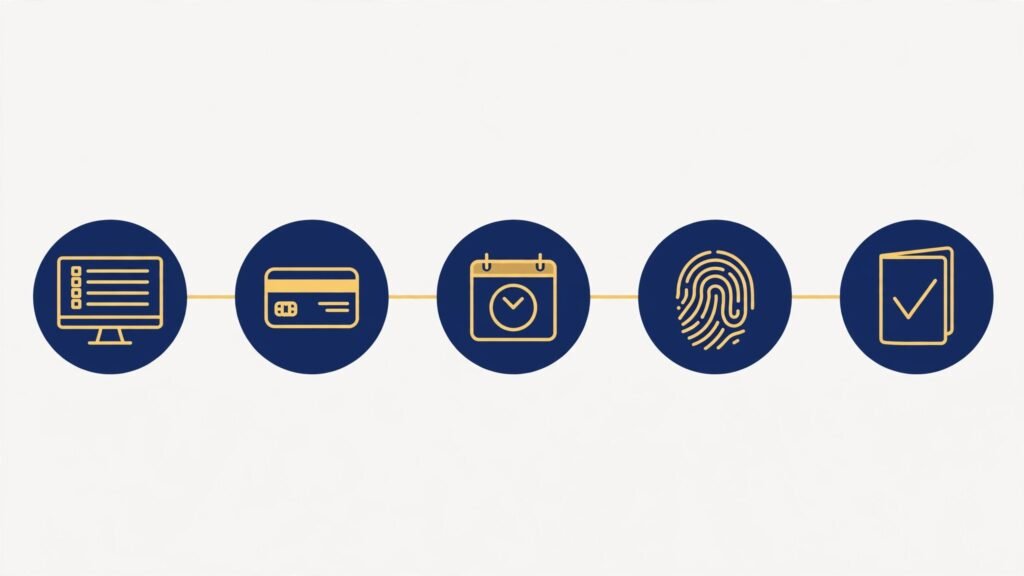
How to Apply for a UK Visit Visa From Pakistan: Step by Step
Step 1: Confirm this is the right visa
Make sure your planned activities are permitted for a Standard Visitor (see the lists above). If you intend to work, study long term or join family permanently, you need a different route.
Step 2: Apply online at GOV.UK
Complete the online application form. You can apply up to 3 months before your planned travel date. The form asks for your travel dates, UK accommodation details, estimated trip cost, home address, annual income, and details of any criminal, civil or immigration offences. You can also provide up to 10 years of travel history and details of your employer, partner, funder or family in the UK.
Step 3: Pay the visa fee
Pay online by debit or credit card. Remember the fee is non-refundable once processing begins.
Step 4: Book your biometrics appointment
After submitting the form, you book an appointment at a VFS Global visa application centre in Pakistan. VFS Global now operates the UK visa centres in Pakistan (the previous operator, TLScontact, no longer handles UK applications there).
Step 5: Attend the appointment
Bring your passport. Your fingerprints and photograph are taken, and you provide your supporting documents. Documents can usually be uploaded yourself in advance or scanned at the centre with assistance. Your passport is normally returned to you on the same day; you submit it again later only if a visa is granted and a vignette needs to be placed in it, following the centre’s instructions.

Step 6: Wait for the decision
The standard processing time is 3 weeks, counted from your biometrics appointment, not from the date you paid the fee. GOV.UK advises you not to book non-refundable travel before you receive a decision.
Step 7: Receive the decision
You are notified by email. If approved, follow the visa centre’s instructions for passport submission and collection.
VFS Global Visa Application Centres in Pakistan
UK visa application centres in Pakistan are located in Islamabad, Lahore, Karachi and Mirpur, operated by VFS Global. Because centre addresses and available services can change, use the official GOV.UK “find a visa application centre” tool to confirm the current address and book your appointment, rather than relying on addresses printed on third-party websites.
VFS Global also offers optional paid services at its centres, such as prime-time appointments, document-upload assistance, courier passport return and premium lounges. These are conveniences, not requirements, and paying for them does not influence the visa decision, which is made by UKVI.
Processing Time: How Long Does It Take?
The official service standard for a Standard Visitor visa applied for outside the UK is 3 weeks from the biometrics appointment. GOV.UK does not publish a separate processing figure specifically for Pakistan; the 3-week standard applies globally to this route.
Decisions can take longer if your application contains inaccuracies, if UKVI needs further evidence (for example about your funds), if documents need verification, or during periods of high demand. If there is a delay, UKVI contacts you within the standard processing time to explain.
Do not travel to the UK, and do not treat the visa as granted, until you have the decision in hand.
Common Reasons UK Visit Visas Are Refused
GOV.UK does not publish an official list of common refusal reasons. The patterns below come from the Immigration Rules and from refusal letters documented by immigration advisers, so treat them as observed patterns rather than an official ranking:
- Weak evidence of intent to return. No stable job, family or property ties shown, so the caseworker is not convinced the visit is genuinely temporary.
- Funds that do not add up. Bank balances inconsistent with declared income, or large unexplained deposits.
- Vague purpose of visit. No clear itinerary, or an invitation that does not explain the trip convincingly.
- Deception or false documents. Any dishonesty, including withholding material facts, leads to refusal and can affect future applications.
- Previous immigration breaches. Overstaying a previous visa or a history of refusals counts against you under the suitability rules.
If you are refused, the fee is not refunded. The refusal letter sets out the detailed reasons, and you may apply again once you can address them with stronger evidence. There is no formal appeal for most visitor refusals.
Visa Validity, Extensions and Switching to Another Visa
Every Standard Visitor visa is multiple entry; there is no separate multiple-entry application. However, each individual visit is limited to a maximum of 6 months, no matter how long the visa itself is valid. Long-term 2, 5 and 10-year visas suit frequent travellers, but they do not allow 6-month-plus stays, and UKVI may cancel a visa if your travel history suggests you are effectively living in the UK through repeated long visits.
Two further points catch applicants out. First, UKVI may grant a shorter visa than you applied and paid for, with no refund of the difference. Second, long-term visas for under-18s are valid only until 6 months after the child’s 18th birthday.
Extensions are narrow. You can only extend a stay that is currently under 6 months, topping it up to a maximum total of 6 months. Stays beyond 6 months are possible only in limited cases: patients receiving private medical treatment, academics, and graduates retaking PLAB or doing a clinical attachment. Extension applications cost £1,172 and must be made in the UK before your current permission expires.
Switching from a visitor visa to a work, study or family visa inside the UK is not permitted. If you attend a job interview as a visitor and receive an offer, you must leave the UK and apply for the work visa from abroad.
Practical Tips for Pakistani Applicants
- Apply early. You can apply up to 3 months before travel; leaving it to the last weeks adds unnecessary risk.
- Keep finances consistent. Use the months before applying to build a clean, explainable bank history rather than moving money around.
- Match the form to the documents. Inconsistencies between what you write and what your documents show invite extra scrutiny.
- Translate properly. Any document not in English needs a certified translation with the translator’s details.
- Keep copies of everything you submit, including the application form.
- Do not book non-refundable flights or hotels before the visa is granted.
Frequently Asked Questions
How much is the UK visit visa fee from Pakistan in 2026?
The standard 6-month Standard Visitor visa costs £135. Long-term options cost £506 (2 years), £903 (5 years) or £1,128 (10 years). Priority processing costs an extra £500 and super priority an extra £1,000, where available.
How long does a UK visit visa take to process in Pakistan?
The official standard is 3 weeks from your biometrics appointment at the VFS Global centre. GOV.UK does not publish a separate Pakistan-only figure.
Is there an interview for the UK visit visa?
Usually not. The VFS Global appointment is for biometrics (fingerprints and photograph) and document submission, not an interview. UKVI may contact you afterwards if it needs clarification or further evidence.
Can I work in the UK on a visitor visa?
No. Paid or unpaid work for a UK company, and self-employment, are prohibited. Limited exceptions exist for permitted business activities and permitted paid engagements by experts.
Do I need travel insurance for a UK visit visa?
It is not an official requirement, but it is strongly recommended. You cannot use public healthcare funds as a visitor, and any private medical treatment must be paid for.
Can I extend my UK visit visa beyond 6 months?
Only in narrow cases, such as continuing private medical treatment or academic work. A standard tourist or family visit cannot be extended beyond 6 months in total.
What happens if my UK visa application is refused?
The fee is not refunded. You will receive a refusal letter explaining the reasons, and you can submit a new application once you are able to address those reasons with better evidence.
Can my family apply together?
Each traveller, including children, needs their own application and fee, though family members can book VFS appointments together and cross-reference each other’s applications.
Official Sources
All rules, fees and procedures in this article were checked against the following official UK government pages on 9 October 2026:
- Visit the UK as a Standard Visitor: overview
- Apply for a Standard Visitor visa
- Extend your stay as a Standard Visitor
- Guide to supporting documents for visiting the UK
- Home Office immigration and nationality fees, 8 October 2026
- Visa processing times: applications outside the UK
- Find a visa application centre
Disclaimer
TourPointGo is an independent information website and is not affiliated with the UK government, UK Visas and Immigration, VFS Global or any embassy. Immigration rules, fees and procedures change over time; always confirm current requirements on the official GOV.UK pages linked above before applying. This article provides general information only and is not legal or immigration advice.









8 thoughts on “UK Visit Visa From Pakistan 2026: Requirements, Fees and How to Apply”